
Frontend Developer in Germany: The Honest Career Guide 2026
17 June 2026
427 views
This guide is up to date as of October 2026

Written by
Marcus Hale,
IT Talent Acquisition Specialist

Reviewed by
Lukas Schneider,
Senior Tech Recruiter, Germany
Frontend developers in Germany earn between €48,000 and €83,000 gross per year - and that range shifts fast depending on your stack, city, and seniority level. React and TypeScript skills are what employers actually search for; if you have them, you're competitive. If you don't, most job postings in Berlin or Munich will filter you out before a human even reads your CV.
This guide covers what you need to know to make a real decision about working in Germany as a frontend developer: exact salary ranges by level, the tech stack German companies require in 2026, which cities have the most opportunities, whether you need to speak German (short answer: not at first), and how to go from application to job offer - including the visa path for non-EU citizens.
The German Frontend Job Market in 2026
Germany's tech sector runs on a few dominant verticals - and each one needs frontend developers badly.
Fintech is concentrated in Berlin and Frankfurt: companies like N26, Trade Republic, and Scalable Capital have built large engineering teams and keep hiring as they expand across Europe. Automotive tech is the Munich story - BMW, Mercedes, Volkswagen, and the supplier ecosystem around them have all moved aggressively into software-defined vehicles and digital products. That means frontend work: dashboards, dealer portals, customer-facing apps. E-commerce and media anchor Hamburg, with Zalando, Otto Group, and a cluster of digital agencies driving consistent demand. And across all three cities, a layer of B2B SaaS startups has grown steadily - HR tech, logistics software, PropTech - all of them needing React developers to build and maintain product interfaces.
What matters for frontend specifically: these aren't companies hiring one or two frontend devs as an afterthought. They run dedicated frontend teams with defined career tracks, code review culture, and component libraries. Job postings ask for React, TypeScript, and testing experience - not just "JavaScript knowledge." The bar is higher than it was three years ago, and the roles are more specialized.
Germany remains one of Europe’s most attractive destinations for frontend developers in 2026, offering a diverse mix of tech ecosystems, strong salaries, and international work environments. The market is shaped by both established corporations and fast-growing startups, creating opportunities across different experience levels. While Berlin continues to dominate in startup culture, other cities like Munich and Hamburg provide stability through enterprise and industrial tech. Demand for modern frontend skills-especially in React, TypeScript, and performance optimization-remains consistently high.
At the same time, companies increasingly value developers who can collaborate across product, design, and backend teams. Understanding the unique character of each German tech hub is key to navigating this market effectively.
| City | Description |
|---|---|
| Berlin | Berlin is Germany’s leading startup hub, with a strong focus on international teams, SaaS products, and innovative technology business models. The local tech ecosystem is dynamic, fast-paced, and especially welcoming to modern frontend technologies. |
| Munich | Munich is known for its large corporations and deep-tech companies, particularly in the automotive, AI, and enterprise software sectors. The work culture is more structured, with a strong emphasis on quality, reliability, and long-term projects. |
| Hamburg | Hamburg has a well-established media and e-commerce industry, supported by numerous digital agencies and platform-based businesses. The job market is stable and places significant value on UX, content-driven experiences, and scalable frontend solutions. |
| Frankfurt | Frankfurt is Germany’s financial center, with growing demand for FinTech and banking solutions. Frontend developers often work on data-intensive applications, secure platforms, and highly regulated digital products. |
| Stuttgart | Stuttgart is heavily influenced by the automotive industry and specializes in embedded systems and industrial software. Frontend opportunities are increasingly emerging in mobility platforms, connected vehicles, and IoT dashboards. |
| Cologne | Cologne is evolving into a creative technology hub with strengths in media, gaming, and digital products. Although its ecosystem is smaller than Berlin’s, it is collaborative, innovative, and steadily expanding. |
The demand for frontend specialists - not just "full-stack devs who can do some React" - has held up well heading into 2026. Companies that over-hired in 2022-2023 have stabilized, and the current hiring is more deliberate: they know what stack they need and they're looking for people who can own frontend work end-to-end.
Frontend Developer Salary in Germany by Level (2026)
Germany’s frontend developer salaries in 2026 reflect both experience level and regional differences, with strong growth driven by demand for modern JavaScript frameworks and scalable web applications. While entry-level roles remain competitive, mid-level and senior developers benefit from significant salary jumps, especially in tech hubs like Berlin and Munich. Companies increasingly offer additional compensation such as bonuses or equity, particularly in startups and product-focused firms.
| Level | Gross Annual (€) | Gross Monthly (€) | Notes |
| Junior (0-2 yrs) | 45,000-60,000 | 3,750-5,000 | Limited bonuses; mostly fixed salary, higher end in Berlin startups. |
| Mid-level (2-5 yrs) | 60,000-80,000 | 5,000-6,700 | Occasional bonuses; strong demand for React and TypeScript skills. |
| Senior (5+ yrs) | 75,000-100,000 | 6,250-8,300 | Bonuses common; some equity in startups and scale-ups. |
| Lead / Staff | 90,000-120,000 | 7,500-10,000 | Leadership roles; bonuses and equity more frequent. |
| Freelance (day rate) | ~500-800/day | ~10,000-16,000* | High variance; depends on specialization and client type. |
| Top-tier / FAANG-like | 110,000-140,000+ | 9,200-11,700+ | Includes bonuses and stock; limited number of roles in Germany. |
*Estimated based on full-time equivalent workload.
Data based on three main sources: QuickSalaries, which provided the level-based salary breakdown for junior, mid-level, and senior frontend developers in Germany; PayScale, which was used as a benchmark for entry-level and early-career compensation; and GermanTechJobs, which provided an additional Germany-wide salary reference for frontend roles.
What you actually take home is significantly less than the gross figure. Germany's income tax combined with social contributions (health insurance, pension, unemployment, care insurance) takes roughly 40-42% for a mid-level earner. A €65,000 gross salary lands at approximately €38,000-€39,000 net per year, or around €3,200/month in hand. Junior earners sit closer to the 35-38% effective rate; seniors push toward 43-45% once income crosses higher tax brackets.
It's not a pleasant number the first time you see it on a payslip. But healthcare is included, and you don't pay separately for it on top.
Munich salaries run 5-10% higher than Berlin at equivalent levels - a senior who earns €75K in Berlin might expect €79K-€82K for the same role in Munich. The catch is that Munich's cost of living, particularly rent, is substantially higher. A one-bedroom apartment in central Munich averages €1,800-€2,200/month; the same in Berlin runs €1,300-€1,700. The net financial advantage of Munich is real but smaller than the gross salary gap suggests.
React Specialist Salary vs. General Frontend
React has become the dominant framework in German job postings, and companies treat it as a distinct specialty rather than a checkbox.
| Profile | Gross Annual (Mid) | Gross Annual (Senior) | Notes |
| General Frontend Developer | €55,000-€65,000 | €68,000-€78,000 | HTML/CSS/JS focus, framework-agnostic |
| React Developer | €60,000-€70,000 | €73,000-€83,000+ | TypeScript expected; Next.js a strong plus |
| React + TypeScript (strict) | €63,000-€72,000 | €76,000-€86,000+ | Top of market; common at fintech and SaaS scale-ups |
The premium for React-specific experience is real - roughly €5,000-€8,000/year at mid level compared to a general frontend profile. Add TypeScript in strict mode and consistent testing experience, and you're consistently at the upper end of the band. React developer salary Germany 2026 searches reflect this: the framework has moved from "preferred" to "required" in the majority of Berlin and Munich postings.
The Tech Stack German Companies Actually Want
React appears in roughly 70-75% of frontend job postings in Germany. That's not a rough estimate - search LinkedIn Jobs or StepStone for "frontend developer Berlin" and count the first page. Vue and Angular fill most of the remaining slots, with Vue stronger in Hamburg's e-commerce and media companies, and Angular holding ground in Munich's enterprise and automotive sector. Everything else - Svelte, Solid, Ember - shows up occasionally, usually at companies with specific technical reasons for the choice.
TypeScript is no longer optional at mid and senior level. Companies that listed it as "a plus" two years ago now put it in the requirements. If your GitHub shows JavaScript-only projects and you're applying for a mid-level role in Berlin, you're already behind most candidates in the pool.
Core Skills (Required for 90%+ of Job Postings)
These are the skills that appear in almost every frontend job description in Germany. Missing one or two won't disqualify you outright, but missing several will.
- React is the foundation. Employers expect you to know hooks thoroughly - not just useState and useEffect, but useReducer, useCallback, useMemo, and when each one actually helps versus adds noise. Context API for lightweight state, Zustand or Redux Toolkit for anything more complex. The debate between Zustand and Redux has largely settled at the company level: startups prefer Zustand for its simplicity, larger teams often stick with Redux Toolkit because the structure scales better across big codebases.
- TypeScript in strict mode is what separates competitive candidates from the rest. Junior roles might accept TypeScript basics. Mid and senior roles expect you to type your API responses, write generic utility types, and not reach for any when something gets complicated. Bring examples of TypeScript you've written for real projects, not just typed JavaScript.
- REST API integration is assumed. GraphQL literacy is increasingly expected - you don't need to have built a schema from scratch, but you should understand queries, mutations, fragments, and how Apollo Client or React Query handles caching. Companies using GraphQL heavily (common in fintech and SaaS) will test this specifically.
- CSS - the specific tooling matters more than raw CSS knowledge. Tailwind CSS has taken over at product startups; CSS Modules remain common at companies with older codebases or strong design systems; styled-components still appears but is losing ground to Tailwind at new projects. Know at least two of these well enough to work productively without looking up every utility.
- Testing is where many candidates have gaps. German companies, especially those with compliance requirements (fintech, healthcare-adjacent), take test coverage seriously. Jest and React Testing Library are the standard combination. Vitest is growing fast as teams move to Vite. You should be able to write unit tests for utility functions, integration tests for components, and understand the difference between testing implementation details versus testing behavior.
- Git workflow beyond basic commits: feature branches, meaningful commit messages, squash vs. merge decisions, rebase for clean history, and PR reviews where you give and receive feedback. Companies hiring mid/senior devs will ask about this directly in interviews.
High-Value Add-ons (What Separates Candidates)
These skills won't get you the job on their own, but they frequently decide between two otherwise equal candidates - and they push you toward the upper end of the salary band.
- Next.js is the most impactful add-on you can have in 2026. App Router knowledge specifically - how server components work, when to use them versus client components, how data fetching has changed from Pages Router. Berlin startups building customer-facing products have largely standardized on Next.js. If you know it well, mention it prominently.
- Storybook shows up in companies with mature design systems. It signals that you understand component documentation, visual regression testing, and the kind of collaboration between design and engineering that scales. Not universally required, but valued at companies with a dedicated design team.
- Accessibility (WCAG 2.1) is taken more seriously in Germany than in many other markets. Public sector digital projects have legal accessibility requirements. Large e-commerce and fintech companies with EU-wide reach follow suit. Knowing how to audit with axe-core, write accessible React components, and handle keyboard navigation correctly is a genuine differentiator - most candidates have never thought about it beyond adding alt text to images.
- Core Web Vitals and performance optimization - LCP, CLS, FID/INP. Knowing how to profile a React app, identify unnecessary re-renders, code-split correctly, and read a Lighthouse report is expected at senior level and impressive at mid. Companies with high-traffic consumer products (Zalando, trade platforms, media sites) weight this heavily.
- CI/CD basics - you don't need to own the pipeline, but you should know how GitHub Actions works, be comfortable reading a failing workflow, and understand what Docker is doing even if you're not writing Dockerfiles. The expectation is that you can work in a modern deployment environment without needing a DevOps engineer to hold your hand.
- Agile/Scrum fluency - daily standups, sprint planning, retrospectives, writing tickets with enough context that someone else could pick them up. This isn't a technical skill, but German companies - especially scale-ups with international teams - run tight Scrum processes and expect you to participate meaningfully, not just show up.
Framework Notes by City
The city you're targeting affects which parts of your stack to emphasize in applications.
- Berlin startups run almost entirely on React and Next.js. Fast iteration, small teams, pragmatic decisions. If you apply to a Berlin startup and your portfolio shows clean React + TypeScript + Next.js projects with tests, you fit the profile. Angular barely appears here.
- Munich (automotive, enterprise, B2B SaaS) is more divided. React dominates at product companies and scale-ups. Angular holds significant ground at enterprise clients, automotive suppliers, and consulting firms building internal tools. The interview process tends to be more structured, and architecture discussions go deeper.
- Hamburg (e-commerce, media) is the strongest market for Vue. Zalando runs React at scale, but many Hamburg-based agencies and mid-size e-commerce companies use Vue. Design collaboration is tighter here - Hamburg has a strong UX culture, and frontend devs are expected to work closely with designers and implement pixel-accurate interfaces.
What's Losing Traction
Worth knowing what not to spend time on:
- Webpack - Vite has replaced it at most new projects. You might encounter Webpack in legacy codebases, but configuring it from scratch is no longer a useful skill to advertise
- Class components - if your React portfolio is full of class-based code, rewrite it. Hooks have been standard since 2019 and class components signal that your experience hasn't kept pace
- AngularJS (v1) - completely different from modern Angular. If you have AngularJS on your CV, clarify the version or remove it; it reads as outdated
- jQuery - appears in legacy projects but listing it as a skill doesn't help your application at any company worth working for.
Junior vs. Mid vs. Senior Frontend Developer in Germany
German employers are more precise about seniority levels than many other markets. A "junior" label isn't just about years of experience - it comes with specific expectations about autonomy, code quality, and how much hand-holding a company is prepared to offer. The same applies upward: mid-level isn't a vague middle ground, and senior doesn't just mean "more experience." Each level has a defined scope of ownership, and interviewers will probe for it directly. Misrepresenting your level in an application doesn't end well - German hiring managers tend to be direct about fit, and a mismatch surfaces quickly in the technical stage. Understanding where you actually sit helps you target the right roles, negotiate from the right baseline, and avoid wasting time in processes you're not ready for.
| Level | Experience | Core Expectations | TypeScript | Interview Format | Salary Range (Gross) |
| Junior | 0-2 years | Solid React fundamentals, Git basics, ability to work independently on defined tickets | Basics required | Take-home task (small React app) + technical call | €48K-€57K |
| Junior+ | 1-3 years | Completes features with some guidance, writes basic tests, participates in code review | Comfortable | Take-home + code walkthrough | €53K-€62K |
| Mid-Level | 2-5 years | Owns features end-to-end, reviews others' code, performance-aware, mentors juniors | Mandatory | Technical task + architecture discussion | €57K-€70K |
| Mid-Senior | 4-6 years | Leads small workstreams, drives technical decisions within a team, deep TS and testing | Strict mode | System design + live coding | €65K-€76K |
| Senior | 5+ years | Owns frontend architecture, defines patterns, cross-functional communication | Expert level | Architecture review + values/culture interview | €70K-€83K+ |
| Staff / Lead | 7+ years | Sets technical direction across teams, involved in hiring, mentors seniors | Expert level | Multiple rounds including leadership discussion | €85K-€100K+ |
| Engineering Manager | Varies | People management, roadmap ownership, less hands-on coding | Not always tested | Leadership + process + team scenario questions | €90K-€110K+ |
The junior market in Germany is genuinely competitive right now - bootcamp graduates and self-taught developers are applying for the same small pool of entry-level roles, and companies are selective. A strong portfolio with two or three clean TypeScript + React projects, live demos, and readable commit history does more work than any certificate. At senior level, the bar shifts from "can you build this" to "can you make decisions that the whole team lives with" - and German companies, particularly in Munich's enterprise sector, will test that directly.
How to Get a Frontend Developer Job in Germany
The process from "I want to work in Germany" to a signed contract typically takes 2-4 months if you're prepared and 6-12 months if you're not. The difference is almost always preparation quality, not luck.
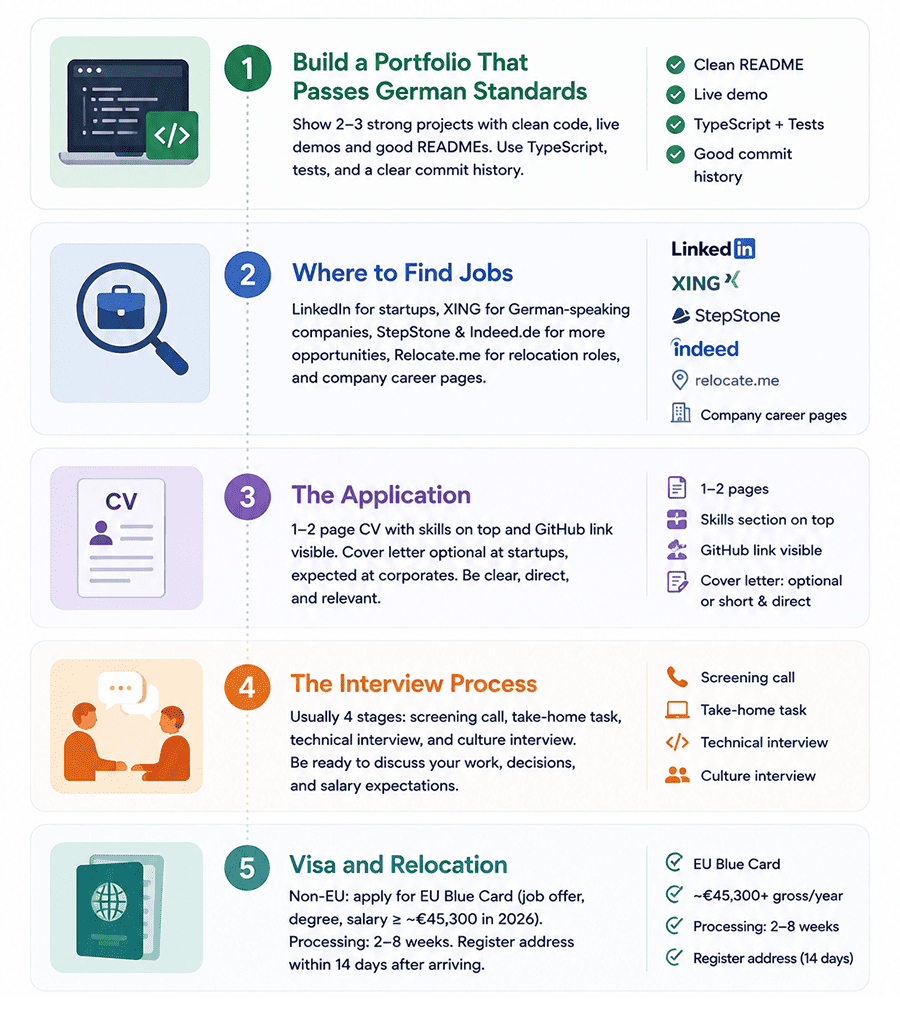
Step 1 - Build a Portfolio That Passes German Standards
German hiring managers look at GitHub before they read your CV. Not to judge your commit frequency, but to see whether you write production-quality code or tutorial-quality code. The difference is visible immediately.
Two or three strong projects beat ten weak ones. Each project needs:
- A clean README explaining what the project does, what stack you used, and why you made key technical decisions
- A live demo deployed on Vercel or Netlify - if the link is dead or throws an error, the project doesn't count
- At least one project in TypeScript with tests written in Jest or React Testing Library
- Commit history that shows iterative development, not one giant initial commit followed by silence
If your strongest project is a to-do app or a weather widget from a tutorial, rebuild something more substantial before applying. A small but complete product - a budget tracker, a job board, a recipe app with authentication - shows more than a copied tutorial ever will. Functional complexity matters more than visual polish, though both help.
Step 2 - Where to Find Jobs
The platforms are not all equal, and knowing which ones to prioritize saves time.
LinkedIn is the primary channel for international companies hiring in Berlin, Munich, and Hamburg. Most postings from scale-ups and tech companies are in English. Set your location to Germany and filter by "Frontend" or "React Developer" - you'll find the highest volume of relevant roles here.
XING is Germany's LinkedIn equivalent and stronger for Mittelstand companies and German-speaking environments. Less relevant if you're targeting English-first startups, but worth a profile if you're open to a broader range of companies.
StepStone and Indeed.de cover a wide range of German employers including corporates, agencies, and mid-size companies. Postings here skew more toward German-language roles, but international companies list here too.
Relocate.me and Berlin Startup Jobs are specifically useful for candidates outside Germany looking to relocate. Many companies listing there are explicitly open to relocation packages and visa sponsorship.
Company career pages directly are underused. If you have a list of 10-15 target companies, check their careers page weekly. Some roles never make it to job boards.
Step 3 - The Application
The CV format in Germany has specific conventions that differ from US or UK norms.
Keep it to 1-2 pages maximum. List your tech stack prominently - in Germany it's standard to have a dedicated skills section near the top with languages, frameworks, and tools listed clearly. A hiring manager scanning 50 CVs should see "React, TypeScript, Next.js, Jest" within five seconds of opening yours.
Photos on CVs are common in Germany, more so than in English-speaking markets, but not required for tech roles at international companies. Skip it if you're uncomfortable; no one at a Berlin startup will notice the absence.
Your GitHub link matters more than a long resume for frontend roles. Put it next to your name and email at the top, not buried in a footer. If your GitHub is sparse, fix that before applying - it's the first thing a technical recruiter or lead will check.
Cover letters: genuinely optional at most startups and product companies; expected at corporates, agencies, and traditional German Mittelstand businesses. When required, keep it to three short paragraphs - why this company, what you bring, what you want. Germans value directness; a cover letter that reads like a marketing pitch for yourself lands badly.
Step 4 - The Interview Process
The typical pipeline at a German tech company runs four stages, though enterprise companies often add rounds.
- Screening call - 20-30 minutes with a recruiter or HR. Covers your background, salary expectations, and availability. Be ready to state your salary range early - German recruiters ask directly and expect a direct answer. Don't deflect with "I'm flexible" - it reads as unprepared.
- Technical task - almost always a take-home assignment at startups and scale-ups: build a small React app within a defined spec, usually with 3-5 days to complete it. Treat it as production code - TypeScript, tests, clean component structure, meaningful README. Live coding sessions are less common but appear at some companies, particularly for senior roles.
- Technical interview - a walkthrough of your task plus deeper questions on architecture, state management, performance, TypeScript patterns, and testing strategy. At senior level this often expands into a system design discussion: how would you structure a large frontend application, handle shared state across features, manage a design system.
- Culture or values interview - common at companies with a strong team culture. Expect questions about how you handle disagreement, how you give feedback, how you work with designers and product managers. Honest, specific answers work better than rehearsed ones.
On salary negotiation: Germans are more direct than most cultures about money. Naming your number in the first call is normal and expected. Know your range before the screening call and be prepared to justify it based on your level and stack - not just what you want.
Step 5 - Visa and Relocation
EU/EEA citizens have no visa requirements. You can start working immediately and handle registration formalities after arrival.
Non-EU candidates need a work visa, and the standard route is the EU Blue Card. Requirements: a job offer from a German employer, a recognized university degree (or equivalent), and a salary at or above the threshold for shortage occupations. Frontend development qualifies as a shortage occupation, which means the salary threshold is lower - approximately €45,300 gross per year in 2026, well within the junior range.
Processing time at the German embassy or consulate runs 2-8 weeks depending on your country and the specific office. Some countries are faster; some are significantly slower. Factor this into your timeline when negotiating a start date with an employer.
A few practical points worth knowing before you sign:
- Ask about relocation support during negotiation - many Berlin and Munich tech companies offer a relocation budget (typically €1,500-€3,000) for candidates moving from abroad, but it's rarely advertised proactively
- Remote work from outside Germany before your visa is approved is legally complicated - don't start work before your visa is in hand
- Once you arrive, you need to register your address at the local Bürgeramt within 14 days — this is mandatory, and your employer will need proof of registration for payroll. For a simple step-by-step explanation, read our guide: Anmeldung Germany 2026: Register Your Address.
For official and up-to-date Blue Card requirements, check the BAMF website directly - the thresholds are reviewed annually.
Career Growth Path for Frontend Developers in Germany
The typical path looks linear on paper - Junior → Mid → Senior → Lead → Staff → Principal - but in practice the jumps between levels are uneven. Junior to mid happens relatively fast if you're productive and taking ownership. Mid to senior is where most developers stall, because the gap isn't technical depth alone - it's the shift from executing tasks to making decisions that affect the whole team. Senior to Lead is a different kind of jump again: less about your own code, more about the quality of the system your team produces.
Germany's tech companies, particularly in Munich and at established Berlin scale-ups, tend to have well-defined level frameworks. Promotions aren't automatic with tenure - you're expected to demonstrate the behaviors of the next level before getting the title. That's frustrating if you don't know the criteria, and straightforward if you do. Ask your manager explicitly what Senior or Lead looks like at your company. Most German engineering managers will give you a direct answer.
The IC and leadership tracks pay comparably at senior level. Above that, Engineering Manager roles at well-funded companies can pull ahead, but Staff and Principal engineers at product companies close the gap with equity and bonuses.
The Fullstack Pivot
The most common career move for frontend developers in Germany - especially at startups - is going fullstack. The typical path is React developer who picks up Node.js, gets comfortable writing API endpoints, and eventually owns features end-to-end without needing a backend developer for every ticket.
This pivot is practically encouraged at early-stage startups where small teams need people who can work across the stack. Companies don't always advertise for "fullstack" explicitly - they hire a senior frontend developer and quietly expect them to handle straightforward backend work when needed. If you're at a startup and want to grow toward fullstack, ask to be involved in backend tickets. Most engineering leads will say yes.
The reverse - backend developers moving into frontend - is less common and harder. Frontend has enough specificity (React patterns, CSS, performance, accessibility, design collaboration) that backend engineers often underestimate what it takes.
The Specialization Culture
Germany has a stronger culture of deep specialization than many other tech markets. Being known as the person on the team who owns performance, or who built the design system, or who understands accessibility inside out, is a legitimate and respected career path. You don't need to become a generalist to progress.
This shows up in hiring too. A candidate who can demonstrate genuine depth - "I optimized Core Web Vitals on a high-traffic product and cut LCP from 4.2s to 1.8s" - stands out more than one who lists ten frameworks at surface level. German engineering culture values the person who knows one thing very well over the person who knows everything a little.
Practical areas worth specializing in if you're thinking about long-term positioning:
- Frontend performance - Core Web Vitals, bundle analysis, rendering optimization
- Design systems - component architecture, Storybook, token management, cross-team governance
- Accessibility - WCAG compliance, screen reader testing, legal requirements in the EU context
- Frontend architecture - monorepo setups, micro-frontends, module federation
On Certifications
Certifications carry almost no weight in German tech hiring. AWS, Google Cloud, and similar infrastructure certs matter for DevOps and cloud roles, but a React or JavaScript certification won't move your application forward at any company worth working for.
What replaces certifications in the signal hierarchy:
- A GitHub profile with real projects that show your current skill level
- Open source contributions - even small ones, bug fixes, documentation improvements - demonstrate that you write code for others to read, not just for yourself
- A technical blog or documented case studies showing how you approached and solved real problems
If you're spending time on certification courses, redirect that time to building something and putting it on GitHub. The ROI is higher by a significant margin.
Is Germany Worth It for Frontend Developers?
For mid and senior developers with a solid React and TypeScript stack, Germany is one of the better job markets in Europe right now. Demand is stable, salaries at €70K-€83K+ are competitive relative to cost of living outside Munich, and the concentration of English-first companies - particularly in Berlin - means language isn't a barrier to getting started. The work culture is structured, the engineering standards are high, and the careers here tend to be built on depth rather than hype.
The honest caveats: the junior market is crowded and getting more selective. A bootcamp certificate and a portfolio of tutorial projects won't cut it at most companies. You need real TypeScript, real tests, and projects that show independent technical decisions. And while German isn't required to land your first role, it starts to matter as you move into senior and lead positions - especially outside Berlin, especially at companies with German-speaking clients or leadership.
If you're serious about working in Germany, the gap between where most international candidates are and where German companies want them to be comes down to stack depth. React with hooks, TypeScript in strict mode, Next.js, testing, performance awareness - that's the profile that gets interviews. Not half of it. The frontend developer salary Germany 2026 numbers are real and achievable - but only if your skills match what the market is paying for.
Frequently Asked Questions
Q: Do I need to speak German to get a frontend developer job in Germany?
A: For most tech roles at international companies and Berlin startups, no. Daily work - standups, Slack, code reviews, documentation - runs in English at scale-ups and international product companies. Where German starts to matter: Mittelstand companies, Munich corporates, automotive suppliers, and any role with client-facing responsibilities.
At senior and lead level, even at English-first companies, German becomes an advantage for navigating HR processes, contracts, and internal politics. A1-A2 is enough to handle daily life when you arrive. Aim for B1 by your second year if you want to remove the language ceiling from your career growth.
Q: Is React the most in-demand framework for frontend developers in Germany?
A: Yes. React appears in roughly 70-75% of frontend job postings across Berlin, Munich, and Hamburg. Vue holds a meaningful share in Hamburg's e-commerce and media sector. Angular remains relevant in Munich's enterprise and automotive space. TypeScript is effectively a requirement alongside React at mid and senior level - listing React without TypeScript experience in 2026 puts you behind most of the candidate pool. Frameworks like Svelte and Solid appear occasionally, but building your primary skill set around React and TypeScript gives you the widest range of options in the German market.
Q: What does a senior frontend developer need to know in Germany?
A: Senior frontend developer Germany requirements go well beyond writing clean React components. Employers expect ownership of frontend architecture decisions - folder structure, state management patterns, component library design, performance budgets. Deep TypeScript is non-negotiable: generic types, utility types, strict mode, typing complex API responses. Next.js App Router knowledge is increasingly expected, particularly at product companies. Performance optimization - Core Web Vitals, bundle analysis, rendering profiling - is tested directly at companies with high-traffic products.
Beyond technical skills, seniors are expected to run code reviews with real feedback, participate in cross-functional discussions with product and design, and make decisions the whole team lives with. Some Munich companies additionally expect basic Node.js for BFF patterns.
Q: How hard is it to get a frontend developer job in Berlin without EU citizenship?
A: Harder than with EU citizenship, but very achievable if your skills are solid. The standard route is the EU Blue Card - you need a job offer, a recognized degree, and a salary above the shortage occupation threshold (approximately €45,300 gross in 2026). Frontend development qualifies as a shortage occupation, which keeps that threshold lower than for general roles. Many Berlin tech companies are experienced with Blue Card sponsorship and treat it as a normal part of hiring internationally.
The main friction is timeline: visa processing takes 2-8 weeks depending on your country, so factor that into your start date negotiation. Companies that have never sponsored a visa before may hesitate - targeting scale-ups and international companies with established HR processes reduces that friction significantly.
Q: What is a typical frontend developer interview process in Germany?
A: Most tech companies run a four-stage process. First, a screening call with a recruiter - 20-30 minutes covering your background, availability, and salary expectations. Come prepared to name your range; German recruiters ask directly and expect a direct answer.
Second, a take-home technical task - usually a small React application built to a spec, with 3-5 days to complete it. Treat it as production code: TypeScript, tests, clean structure, documented decisions.
Third, a technical interview covering your solution plus deeper questions on architecture, state management, and TypeScript. Senior roles expand this into system design.
Fourth, a culture or values interview focused on how you work with others, handle disagreement, and give feedback. Enterprise companies may add rounds; early-stage startups sometimes compress the whole process into two calls.
Q: Is it better to work as a frontend developer in Berlin, Munich, or Hamburg?
A: It depends on what you're optimizing for. Berlin has the highest density of English-first frontend jobs, the most international hiring pipelines, and the strongest React and Next.js culture. Salaries are lower than Munich, but so is rent. It's the easiest entry point for non-German speakers.
Munich pays 5-10% more on average, has stronger demand in automotive tech and enterprise, and runs more Angular alongside React - but more companies expect at least conversational German at mid and senior level, and the cost of living is the highest in Germany.
Hamburg sits between the two: competitive salaries, strong e-commerce and media sector, a mix of Vue and React, and a tighter design-engineering collaboration culture.
If you're relocating from abroad with no German and want the fastest path to your first role, Berlin is the practical choice. If you already speak some German and want higher earning potential, Munich makes sense once you have a year or two of German market experience.