
Frontend Developer in Singapore: Visas, Tech Stack & How to Move Legally in 2026
29 July 2026
307 views
This guide is up to date as of October 2026


Written by
Marcus Hale,
IT Talent Acquisition Specialist

Reviewed by
Adrian Tan,
Senior Tech Recruiter, Singapore
Singapore is the only city-state in Southeast Asia where a frontend developer can land a Western-level salary, keep most of it after tax, and still work inside a genuine regional tech hub rather than a satellite office. That combination is rare, and it explains why the city keeps showing up on relocation shortlists for engineers who'd otherwise default to Berlin or Toronto.
This guide covers the numbers that actually matter before you commit to a move: realistic frontend developer salaries in Singapore by seniority and company type in 2026, the tech stack local employers screen for at interview, and - the part most guides gloss over - which visa actually applies to a frontend developer. Spoiler: it's usually not the one with the flashiest name. If you're weighing a relocation or a remote contract with a Singapore-based company, start here before you start applying.
Why Singapore Is a Regional Hub for Frontend Developers?
Why Singapore anchors more regional engineering teams than Jakarta or Kuala Lumpur comes down to a mix of legal stability, English as the default working language, and predictable regulation - not lower cost, since Singapore is usually the most expensive option on the list. A handful of companies illustrate the pattern well:
- Google - Asia-Pacific engineering and product hub
- Meta - Southeast Asia regional headquarters
- ByteDance - one of the largest engineering footprints in the region
- Grab - core product and engineering built locally, not outsourced
- Shopee - e-commerce platform teams headquartered in Singapore
- Sea Group - parent company of Shopee and Garena, home-grown and Singapore-based
For a frontend developer, that list matters because these are the teams shipping the customer-facing product, not a regional sales office bolted onto engineering done elsewhere.
Banking adds a second, quieter layer of demand. DBS, OCBC, and UOB have spent the past several years rebuilding their consumer platforms in-house, and that shift has created a steady stream of frontend roles inside financial services - usually better paid than e-commerce, often slower-moving, and generally less glamorous to talk about at a meetup.
Fintech and e-commerce are the two sectors actually driving frontend hiring volume, not tech in the abstract. Payment platforms, super-apps, and cross-border commerce all live or die on interface performance and localization across half a dozen Southeast Asian markets simultaneously, which is a genuinely different problem than building a single-market product. That's the kind of experience that shows up well on a CV afterward.
None of this makes Singapore an easy market to break into from abroad. It's competitive, and the competition isn't hypothetical: local universities produce a steady pipeline of computer science graduates, and Singaporean and PR candidates don't need visa sponsorship, which makes them cheaper and faster to hire on paper. Junior roles open to foreign candidates exist, but there are meaningfully fewer of them than at mid and senior level - companies sponsor visas more readily for people who've already proven they're worth the paperwork. If you're early-career, it's worth going in with that expectation rather than discovering it after fifty applications.
Frontend Developer Salary in Singapore in 2026
Ask five different sources what a frontend developer earns in Singapore and you'll get five different answers, sometimes off by 30% or more. Job board scrapes tend to skew low because they capture posted ranges rather than accepted offers. Recruiter salary guides skew high because agencies mostly see candidates who are already employed and negotiating a jump. Self-reported platforms like NodeFlair sit somewhere in between and are arguably the most honest read on the market, since the numbers come from people who actually signed the contract.
None of this means the data is useless - it means a single "average salary" figure is the wrong way to read it. What's more reliable is the range each source converges on for a given seniority band, and where that range sits relative to Singapore's visa salary thresholds, which is the detail most salary round-ups skip entirely. A frontend developer's pay in Singapore isn't just a career question here; at the junior end especially, it can decide which visa is even available to you.
Salary by Frontend Level
The breakdown below pulls from multiple sources rather than one, and presents each level as a range instead of a single number, precisely because the market doesn't actually agree on a midpoint.
| Level | Monthly salary range (SGD) | Notes |
| Junior | 3,800-5,500 | 0-2 years experience; basic React/Vue/Angular work on well-defined tasks with guidance from seniors |
| Mid | 5,500-9,000 | 2-5 years experience; independently implements features and starts contributing to architecture discussions |
| Senior | 9,000-15,000 | 5+ years experience; leads technical decisions, designs architecture, mentors, and drives best practices |
| Lead / Principal | 12,000-20,000 | 8-12+ years; often cross-team ownership, strategy, and high-impact system design; varies heavily by company |
| Manager / Head of FE | 15,000-25,000+ | People management + technical leadership; scope includes multiple teams or entire product areas |
These ranges are a synthesis of multiple sources (job aggregators, recruitment salary guides, and salary platforms) rather than a single official figure, and actual offers always depend on the company, stack, and specific experience. The midpoint of a range should not be interpreted as a definitive “average salary”; it is only a rough reference within a broad distribution. Final compensation also varies with specializations (e.g., advanced React + TypeScript, real-time systems, fintech/e-commerce) and company type (enterprise vs startup).
Sources:
- NodeFlair - “Frontend Developer Salary in Singapore”
- QuickSalaries - “Frontend Developer Salary in Singapore”
- SkillUp - “Frontend Engineer Salary in Singapore”
- BeBee - “Frontend Developer Salary in Singapore | Jobs & Comparison”
- PayScale - “Average Front End Developer / Engineer Salary in Singapore” (2025 data, still relevant for trends)
Salary by Company Type
Seniority explains part of the spread in frontend salaries, but where you work explains almost as much - sometimes more. A mid-level developer at a well-funded fintech can out-earn a senior developer at a local SME, and the gap between segments is wide enough that "frontend developer salary in Singapore" as a single number is close to meaningless without knowing which of these four categories you're in.
Local SMEs sit at the bottom of the range. These are Singapore-registered small and mid-sized companies - agencies, local e-commerce shops, small SaaS outfits - that compete on cost rather than compensation. They're also the segment least likely to sponsor a work visa for a foreign hire, since the paperwork and the Employment Pass salary floor eat into margins that are already thin.
Regional MNCs - the Southeast Asia or Asia-Pacific offices of larger international companies that aren't themselves Big Tech - sit a tier above. Pay here tracks closer to market rate because these companies compete regionally for talent, not just locally, and they're generally set up to handle EP sponsorship as a routine part of hiring.
Banks and fintech occupy their own bracket, usually above regional MNCs. DBS, OCBC, UOB, and the fintech platforms building payment and lending products pay a premium for frontend developers who can work inside regulated environments, handle stricter security and compliance requirements, and don't flinch at slower release cycles than a typical startup.
Big Tech - Google, ByteDance, Shopee, and similarly resourced companies - sits at the top, and by a meaningful margin at senior level. These are also the employers most willing to sponsor an Employment Pass without a second thought, since the salary bands they pay clear the EP threshold comfortably even at junior level.
| Segment | Typical monthly range (SGD) | Visa sponsorship |
| Local SME | 3,500-7,000 | Inconsistent - many avoid it |
| Regional MNC | 6,000-10,000 | Standard practice |
| Bank / Fintech | 7,500-13,000 | Standard practice |
| Big Tech | 9,000-18,000+ | Routine, including at junior level |
Treat these as directional bands, not quotes from a specific job posting - actual offers vary by role, product area, and how badly a given team needs to fill the seat.
Tech Stack Employers Expect From Frontend Developers in Singapore
The core stack question has a straightforward answer in Singapore: React and TypeScript dominate, to the point where a job posting that doesn't mention either is worth a second look before you apply. Next.js has become the default choice for anything server-rendered or SEO-sensitive, which covers most consumer-facing products in fintech and e-commerce. Vue shows up occasionally, mostly at local SMEs or teams with a legacy codebase, but it's the exception rather than a competing standard. What varies more than the framework itself is what gets layered on top of it, and that layer depends heavily on which type of company you're interviewing with.
Based on Singapore job market data and tech-company stacks, here is a concise overview of what employers typically expect from Frontend Developers in Singapore, with clear must‑have vs nice‑to‑have distinctions.
| Role focus | Minimum / must-have knowledge | Nice-to-have / higher-value skills |
| Junior Frontend (general web) | HTML5, CSS3, modern JavaScript (ES6+), basic DOM, Git, basic responsive design | TypeScript basics , basic React / Vue , UX awareness, simple testing (Jest) |
| React developer (mid level) | React + Hooks, component design, CSS/TS, REST API calls, Git, basic testing | React Router, state management (Zustand/Redux), Next.js, SSR/SSG, performance optimization |
| Vue developer (mid level) | Vue 3 + Composition API, basic router, CSS/TS, REST APIs, Git | Nuxt.js, Pinia, micro-frontends, TypeScript deep usage, component libraries (Vuetify/Element) |
| Angular developer (enterprise) | Angular (latest LTS), TypeScript, RxJS fundamentals, Angular Router, basic testing | NgRx, advanced DI, micro-frontends, performance tuning, complex form strategies |
| Full-frontend / full-stack | Strong JS/TS, one main framework (React/Vue/Angular), Node.js basics, REST APIs, Git | Next.js /Nuxt/Angular + SSR, GraphQL, basic backend (Node/Express), CI/CD, Docker basics |
| Frontend + mobile | React/Vue/Angular + JS/TS, responsive design, web APIs | React Native , Flutter, basic mobile UX patterns, native modules, offline-first patterns |
In Singapore, React + TypeScript is the most common baseline for mid/senior roles, especially in product companies and fintech, while Angular remains strong in large enterprises and banks. Nice‑to‑have skills often include Next.js/Nuxt, GraphQL, performance tuning, and basic backend knowledge, which can significantly improve hireability and salary.
Banks and fintech companies interview differently from everyone else, largely because they operate under the Monetary Authority of Singapore's regulatory umbrella, and that shows up directly in frontend interview questions:
- Performance optimization under real constraints - not "how would you optimize this" in the abstract, but questions about bundle size, rendering strategy, and how you'd handle a form-heavy interface used on low-end devices in less connected markets.
- Accessibility to WCAG standards, asked as a genuine requirement rather than a nice-to-have - regulated financial products need to be usable by people using screen readers, and interviewers will probe whether you've actually implemented this or just know the term.
- Security awareness on the frontend specifically: how you handle sensitive data in the DOM, XSS and CSRF basics, why you don't store tokens in localStorage, and how a compliance-driven environment changes what "shipping fast" is allowed to mean.
Big Tech and e-commerce platforms - Shopee, Grab, ByteDance, and similarly scaled teams - ask a different set of questions, closer to what you'd expect from a Silicon Valley system design interview than a typical regional tech screen:
- System design for frontend: how you'd architect a component library or a feature that needs to scale across multiple product teams, not just "build a to-do app."
- Working within an existing design system rather than building UI from scratch - expect questions about component API design, theming, and how you'd extend a design system without breaking consumers of it.
- Mobile-first thinking as a default assumption, since a large share of users across Southeast Asia are mobile-only.
- Occasionally, React Native or other cross-platform experience, especially at companies maintaining a single codebase across web and app.
One thing that doesn't show up on either list but matters just as much: soft skills carry more weight in Singapore than they do in a purely domestic market, because almost every team here is genuinely international rather than international in name only. Working English - not textbook English, but the ability to run a stand-up, push back on a spec in a design review, and write a clear PR description - gets evaluated almost as closely as your React knowledge. Prior experience working in a cross-cultural team, even remotely, is worth mentioning explicitly in an interview, since it signals you won't need months to adjust to how a Singapore-based team actually communicates.
Work Visas for Frontend Developers: How to Move to Singapore Legally
Most guides to working in Singapore treat visas as an afterthought - a short paragraph after the salary numbers, listing pass names without explaining which one actually applies to you. That's backwards for a frontend developer, because the visa question isn't a formality here; it determines whether a given salary offer is even usable, and getting it wrong costs months. This section goes deeper than usual for exactly that reason.
Employment Pass (EP) - the Main Pathway for Most Frontend Developers
The Employment Pass is the visa that will apply to the overwhelming majority of frontend developers moving to Singapore - junior candidates aside, and even some of those once salary clears the threshold below. Unlike Tech.Pass, which is built for founders and C-suite tech leaders, the EP is designed precisely for the profile most readers of this article actually fit: a salaried individual contributor or tech lead working for a single Singapore-registered employer.
Salary thresholds in 2026. The Ministry of Manpower sets a minimum qualifying salary that scales with age, on the logic that older candidates are expected to hold more senior, higher-paid roles:
| Sector | Base minimum salary (entry-level applicant) | Minimum salary at age 45+ |
| Most sectors (including tech) | SGD 5,600/month | ~SGD 10,700/month |
| Financial services | SGD 6,200/month | ~SGD 11,800/month |
These aren't arbitrary numbers - MOM benchmarks them against the pay of the top third of local professionals, managers, executives, and technicians (PMETs) in the same age band, and reviews them periodically. That review cycle matters right now: thresholds are already scheduled to rise to SGD 6,000 for most sectors and SGD 6,600 for financial services, effective for new applications from 1 January 2027 and for renewals from 1 January 2028. If you're planning a move a year or two out rather than immediately, budget against the higher figure, not today's.
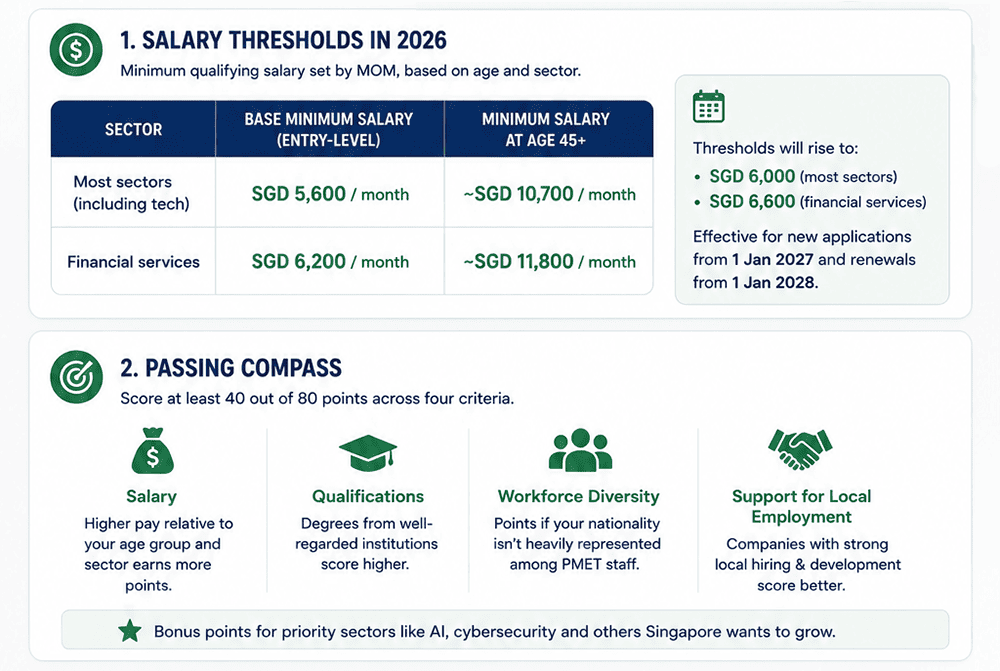
Passing COMPASS. Clearing the salary floor gets you through the first gate, not the whole application. Every EP candidate also needs to score at least 40 points out of 80 on COMPASS (the Complementarity Assessment Framework), which scores four criteria:
- Salary relative to your age group and sector - higher pay relative to local benchmarks earns more points
- Qualifications - degrees from well-regarded institutions score higher than degree-equivalent experience
- Workforce diversity - points awarded if your nationality isn't already heavily represented among the employer's PMET staff
- Support for local employment - companies with a strong track record of hiring and developing local PMETs score better here, and that score attaches to your application
On top of the four core criteria, roles in sectors Singapore is actively trying to grow - AI, cybersecurity, and a handful of other priority areas - can pick up bonus points, which is one of the few places where being a frontend developer working on, say, an AI product's interface gives you a genuine edge over an otherwise identical candidate.
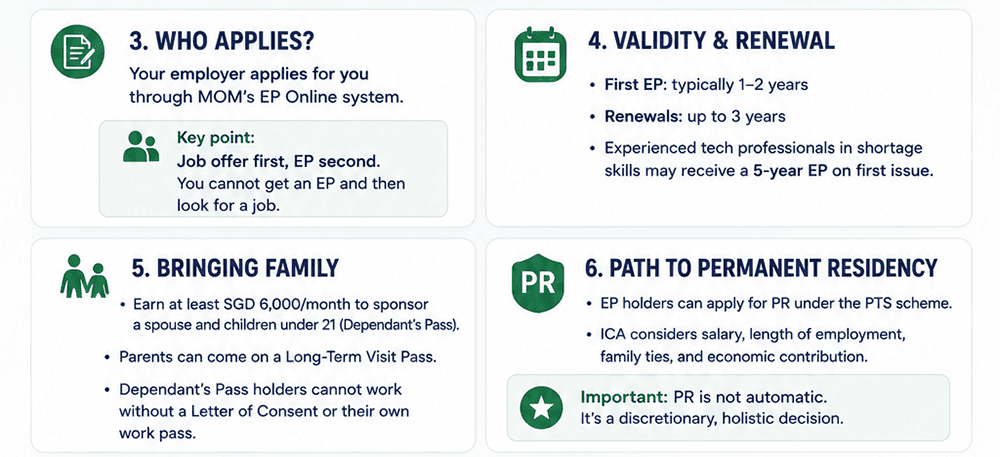
Who actually submits the application. This is the detail that trips people up most: you don't apply for an EP yourself. Your employer submits the application on your behalf through MOM's EP Online system. In practice, that means the sequence is always offer first, visa application second - there's no version of this process where you secure an EP and then go looking for a job with it, the way Tech.Pass allows. If you're job-hunting from outside Singapore, this is the single most important thing to internalize: the visa is not something you can get ahead of the offer.
Validity and renewal. A first-issue EP is typically granted for one to two years. Renewals can extend it up to three years at a time. There's one notable exception worth knowing if you're deep into a specialised tech career: experienced tech professionals with skills in shortage can be granted a 5 year EP on first issue, skipping the usual short initial term entirely.
Bringing family. An EP holder earning at least SGD 6,000 a month can sponsor a spouse and children under 21 on a Dependant's Pass, and can bring parents to Singapore on a Long-Term Visit Pass. Dependant's Pass holders don't automatically get the right to work - that requires either a Letter of Consent or a work pass of their own - but the pathway to bring family over exists and is well-established.
The path to Permanent Residency. Holding an EP puts you on a track that can lead to Permanent Residency through the PTS (Professionals/Technical/Skilled) scheme, administered by the Immigration and Checkpoints Authority. It's worth being direct about what this does and doesn't guarantee: PR approval is a discretionary, holistic decision. ICA weighs salary, length of continuous employment, family ties, and broader economic contribution - an EP gets you eligible to apply, not approved. Treat PR as a realistic long-term goal if you build a stable multi-year track record in Singapore, not as an automatic outcome of holding a work visa.
S Pass - a Realistic Entry Point for Junior/Mid-Level Roles Below the EP Salary Floor
Here's a practical reality that most relocation guides skip entirely: a meaningful share of junior and even some mid-level frontend roles in Singapore simply don't pay enough to qualify for an Employment Pass. Realistic junior offers often start at SGD 3,500-4,000 a month - well under the SGD 5,600 EP floor covered in 5.1. If that's the salary range you're looking at, the EP isn't the visa to research. The S Pass is.
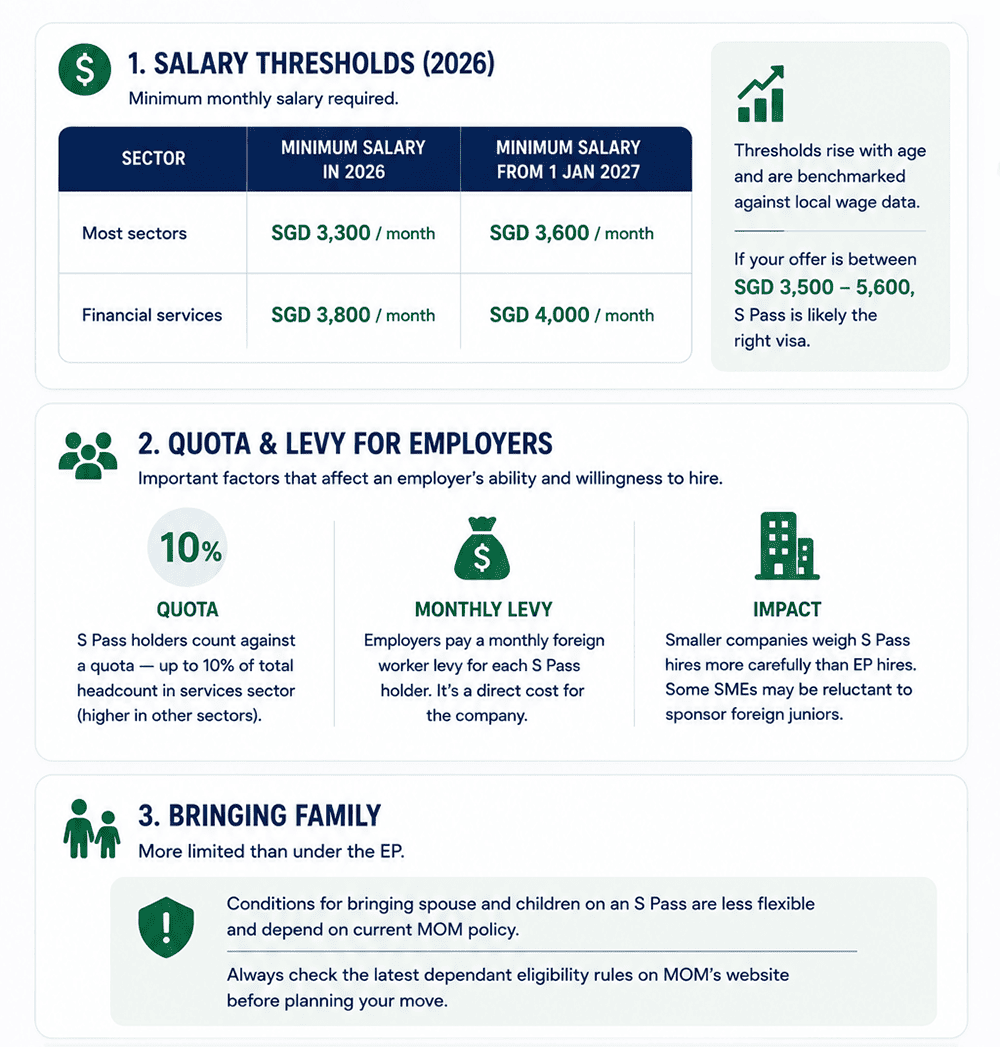
Salary thresholds in 2026. The S Pass is built for mid-skilled roles - associate professional and technical positions rather than senior specialist ones - and its salary floor sits well below the EP's:
| Sector | Minimum salary in 2026 | Minimum salary from 1 January 2027 |
| Most sectors | SGD 3,300/month | SGD 3,600/month |
| Financial services | SGD 3,800/month | SGD 4,000/month |
Like the EP, this threshold rises with the candidate's age, and MOM benchmarks it against local wage data rather than setting it arbitrarily. If your offer sits in the SGD 3,500-5,600 range, the S Pass - not the EP - is very likely the pass your employer will actually apply for.
The quota and levy your employer has to absorb. This is the part that shapes how willing a company is to hire you on an S Pass in the first place, and it's worth understanding before you get attached to an offer:
- S Pass holders count against a quota - up to 10% of total headcount in the services sector, higher in some other sectors - meaning a company that's already near its cap may simply be unable to hire you regardless of how strong your interview was.
- Employers pay a monthly foreign worker levy to MOM for every S Pass holder on staff. This is a direct cost the company absorbs, not something deducted from your salary, but it does mean smaller companies weigh S Pass hires more cautiously than EP hires, where no equivalent levy applies.
Practically, this means S Pass sponsorship is more of a genuine commitment for a small or mid-sized employer than an EP is, and it partly explains why some local SMEs are reluctant to sponsor foreign junior hires at all - the cost isn't just your salary.
Bringing family is more limited than under the EP. Don't take it as a given that an S Pass lets you bring a spouse and children the way an EP does - the conditions are meaningfully less flexible, and they're the kind of detail that changes based on current MOM policy. If family relocation is part of your plan, verify the current dependant eligibility rules directly with MOM before treating it as settled, rather than assuming S Pass and EP work the same way here. They don't.
Tech.Pass - Who It's Actually For (and Why It's Not the Pass for Most Frontend Developers)
"Tech Pass Singapore" is a phrase that shows up constantly in relocation searches, which is exactly why it needs to be addressed directly and honestly rather than left vague. The short version: Tech.Pass is not a visa for a working frontend developer, no matter how senior. It's built for people who've already reached the top of the industry - established tech leaders, founders, and C-suite operators - not for individual contributors, including experienced ones.
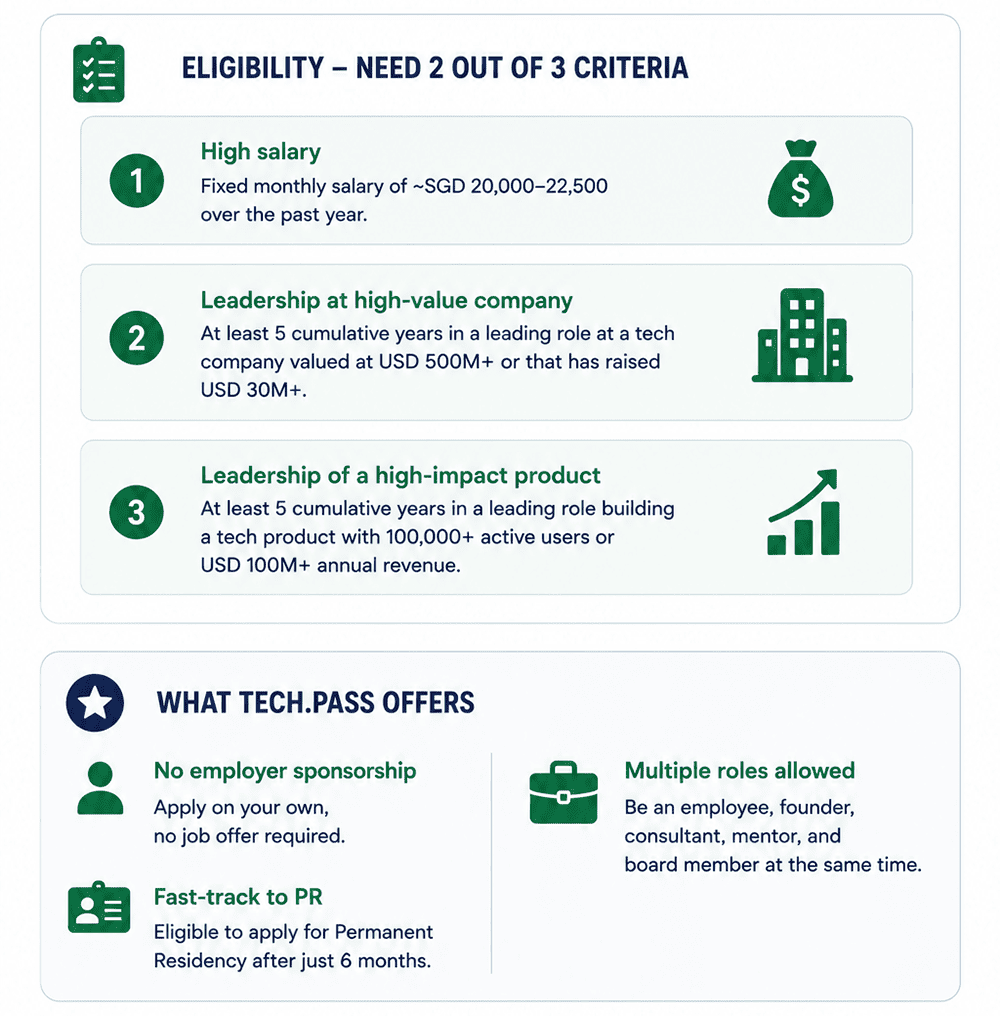
Eligibility is deliberately narrow. To qualify, an applicant needs to meet at least two of the following three criteria:
- A fixed monthly salary of roughly SGD 20,000-22,500 over the past year (sources on the exact current figure vary within this range - check the EDB's official Tech.Pass page for the precise threshold at the time you're reading this, since it's the kind of number that gets revised)
- At least five cumulative years in a leading role at a tech company valued at USD 500 million or more, or one that has raised at least USD 30 million in funding
- At least five cumulative years in a leading role building a tech product with more than 100,000 active users, or one generating at least USD 100 million in annual revenue
Notice what none of these criteria mention: years of frontend experience, framework expertise, or seniority as an individual contributor. This pass is scored on leadership track record and financial scale, not on engineering skill - which is precisely why it's the wrong target for almost everyone reading a "frontend developer salary" guide.
What Tech.Pass actually offers, for the small number of people who do qualify:
- No employer sponsorship required - you can apply on your own, without a job offer in hand, which is the opposite of how the EP works
- The freedom to hold multiple roles at once: employee, founder, consultant, mentor, and board member simultaneously, none of which an EP permits
- Eligibility to apply for Permanent Residency after just six months on the pass, far faster than the EP's typical track record requirement
The honest takeaway: for well over 95% of frontend developers, including senior engineers and tech leads, the Employment Pass - not Tech.Pass - is the visa that applies to you. Tech.Pass is worth serious consideration only if you're already operating at head-of-engineering or C-level, or if you're relocating to build your own company rather than to take a job. If that's not your situation today, read the EP section again rather than this one - it's the one that matters for your move.
Where to Find a Frontend Developer Job in Singapore?
Everything covered so far - salary ranges, the tech stack employers screen for, which visa actually applies to you - only matters once you're actually in front of a hiring manager. Getting there requires a slightly different approach than job hunting in a market where you don't need visa sponsorship, because the sponsorship question changes which job boards are worth your time and which applications are likely to go nowhere.
Generic global job boards work, but they're not calibrated for Singapore's specific market. A LinkedIn search for "frontend developer Singapore" returns thousands of postings, most from companies who've never sponsored an EP and have no intention of starting with you. What's more useful is a mix of tools built specifically around this market: niche tech-hiring platforms that show real, submitted salary data rather than posted ranges, recruiters who specialize in placing foreign tech talent into Singapore-based companies, and - worth checking directly - whether a target company participates in EDB's Tech@SG programme, which gives participating companies pre-approved, expedited EP processing for their core engineering hires. That last detail is rarely advertised in the job posting itself, but it's often findable with a few minutes of research, and it tells you a lot about how smoothly your own application is likely to move if you get an offer.
Here is a detailed table of where to find a Frontend Developer job in Singapore, including a dedicated column for remote options and practical pros/cons for each platform.
| Platform / Resource | Remote jobs column (key points) | Advantages for frontend candidates | Disadvantages & what to watch |
| LinkedIn (Singapore) | Filter by “Remote” + location “Singapore”; often includes cross-border remote roles (US/EU/Asia) with Singapore tags. | Strong network effect; direct contact with recruiters; many product companies and startups post here; easy to follow companies and see referrals. | High competition; many “ghost” postings; some roles are recruitment-heavy with weak technical detail; always check if “remote” is truly global or Singapore-only. |
| Indeed Singapore | Dedicated “Remote Front End Developer” section; many WFH listings from local and international employers. | Large volume of listings; simple search; good for junior/mid roles; filters for “Remote”, “Contract”, “Full-time”. | Lots of low-quality or outdated postings; salary info often missing; some roles are agency-only; verify company and role legitimacy before applying. |
| Jobstreet / Jora | Separate “Remote” tabs for Front End Developer; many APAC-based remote roles targeting Singapore residents. | Strong presence in Asia; good for local companies and traditional enterprises; often includes salary ranges and clear job descriptions. | UX can be clunky; some roles are mass-posted by agencies; remote options sometimes limited to specific countries; check visa/contract type carefully. |
| BeBee | Dedicated “Remote frontend developer Jobs in Singapore”; shows required skills and top remote employers. | Clear focus on remote roles; aggregates from multiple sources; shows skill tags (TypeScript, React, etc.) which help match to frontend profiles. | Smaller overall volume than LinkedIn/Indeed; some links may be outdated; employer quality varies; double-check company and job freshness. |
| Crossover | Fully remote roles with US software companies, often open to Singapore-based candidates; high-paying, long-term contracts. | High salaries (often USD); remote-first culture; structured interviews; access to US tech stacks and large-scale systems. | Very competitive assessments; strict time-zone expectations; contract-heavy (not always permanent); cultural fit and communication expectations can be demanding. |
| Company career pages + niche boards | Many tech companies (e.g., TikTok, Binance, Shopee) list “Remote” or “Flexible” options on their own sites; niche boards (e.g., remote-only communities). | Best for direct applications; often more accurate role info; possibility to bypass agencies; better insight into tech stack and team structure. | Requires more manual research; you must track multiple domains; some remote options are limited to specific regions; always check location/visa requirements explicitly. |
A few things worth doing differently than you would in a market where sponsorship isn't a factor:
- Search directly for the phrase "visa sponsorship available" or "EP sponsorship" in job postings, and treat its absence as a signal, not an oversight. Many local SMEs simply won't go through EP or S Pass paperwork for a foreign candidate when a local or PR hire solves the same problem with none of the process - silence on sponsorship in a posting usually means no, not "ask us."
- Check whether the company appears in EDB's Tech@SG programme before applying. Participating companies get pre-approved, faster EP processing for core engineering roles, which can cut real weeks off your timeline if you get an offer.
- Target company size and sector deliberately, not just role titles. Based on the salary and sponsorship patterns covered earlier in this guide, Big Tech, fintech, and banks sponsor far more readily than local SMEs - weight your applications accordingly instead of applying evenly across all three.
- Get your numbers straight before you negotiate, not after. Walk into a conversation already knowing where your experience level sits within the ranges covered earlier in this guide, so you're not anchoring to a lowball offer simply because you didn't have a benchmark.
- Ask about visa sponsorship directly and early - ideally by the first or second interview, not after a verbal offer. A company unwilling to answer clearly at that stage is telling you something about how prepared they are to actually go through with it.
Conclusion
Singapore rewards a specific kind of frontend developer: someone with enough experience to clear the Employment Pass salary floor, realistic expectations about where they actually sit in the market, and the patience to treat the visa process as a normal part of the job search rather than an afterthought. For that person, the case is genuinely strong - competitive pay, a tax system that keeps far more of your salary than most Western countries, and a seat on product teams shaping how millions of people across Southeast Asia use fintech and e-commerce platforms every day.
It's a weaker fit for anyone expecting an easy way in. Junior roles open to foreigners are real but limited, and they often fall below the EP threshold, which means the S Pass - not the EP - is the honest starting point for many early-career candidates. And despite how often "Tech Pass Singapore" shows up in searches, it isn't a shortcut for a working developer, however senior; it's built for founders and C-suite operators, and treating it as your target visa will waste time better spent on an EP application.
The practical path is the unglamorous one: get an offer that clears the relevant salary threshold, let your employer handle the EP application, and build a track record from there. Everything else in this guide - the salary ranges, the stack, the job platforms - exists to help you get to that offer with realistic expectations intact.
FAQ about Job in Singapore
Can a frontend developer get an Employment Pass in Singapore?
Yes, and for most frontend developers with a genuine job offer, the EP is the realistic visa to plan around rather than an exception. The core requirements are a job offer from a Singapore-registered employer, a fixed monthly salary that clears the age-adjusted threshold (SGD 5,600 for most sectors, SGD 6,200 for financial services in 2026), and at least 40 points on the COMPASS assessment, which scores salary relative to your age group, qualifications, workforce diversity, and the employer's track record hiring local talent. Frontend-specific roles don't face additional restrictions beyond these standard criteria, though roles tied to priority sectors like AI can pick up bonus COMPASS points. The one condition that trips people up: you can't apply for an EP on your own initiative. Your employer submits the application through MOM's EP Online system after you've accepted an offer, so the sequence is always offer first, visa second - there's no way to secure an EP in advance and job-hunt with it in hand.
What is the minimum salary for a work visa as a developer in Singapore?
It depends entirely on which pass applies to your offer. For the Employment Pass, the 2026 floor is SGD 5,600 a month for most sectors and SGD 6,200 for financial services, rising with the candidate's age to roughly SGD 10,700-11,800 at 45 and above. Those thresholds are already scheduled to increase to SGD 6,000 and SGD 6,600 respectively for new applications from 1 January 2027, and for renewals from 1 January 2028. If your offer sits below the EP floor - which a meaningful share of junior frontend roles do - the relevant threshold instead becomes the S Pass minimum: SGD 3,300 a month for most sectors in 2026, rising to SGD 3,600 from January 2027. There's no single "minimum salary for a developer visa" figure that applies universally; the right number depends on which pass your salary and role actually qualify for, so check both thresholds against your specific offer rather than assuming one applies.
Is Tech.Pass the right visa for a frontend developer?
For nearly all frontend developers, no - this is worth stating plainly because the phrase gets searched constantly with the opposite assumption. Tech.Pass is built for established tech leaders, founders, and C-suite operators, not individual contributors regardless of seniority. Qualifying requires meeting at least two of three criteria: a fixed monthly salary of roughly SGD 20,000-22,500 over the past year, at least five years in a leading role at a company valued above USD 500 million or with USD 30 million-plus in funding raised, or five years in a leading role building a product with 100,000-plus active users or USD 100 million-plus in annual revenue. None of these criteria reward frontend expertise or years of hands-on engineering specifically - they reward leadership scale and financial track record. A senior frontend engineer or even a tech lead almost never meets this bar through salary alone. The Employment Pass, not Tech.Pass, is the appropriate target for essentially every frontend developer reading this, with Tech.Pass worth a second look only if you're already at head-of-engineering level or relocating to build your own company.
How much does a frontend developer earn in Singapore in 2026?
The honest answer is a range that shifts significantly by seniority and, just as much, by company type. Junior developers with zero to two years of experience typically see SGD 3,500-6,500 a month; mid-level developers with three to five years, SGD 6,500-9,000; senior developers with six to nine years, SGD 9,000-13,000; and lead or staff-level engineers with a decade or more of experience, SGD 13,000-18,000 or higher. Company type shifts these numbers as much as seniority does: local SMEs sit at the bottom of each band, regional MNCs and banks/fintech sit above them, and Big Tech companies like Google, ByteDance, or Shopee pay a meaningful premium at every level, including junior. Different salary sources disagree by as much as 30% on any given figure, since job board scrapes, recruiter salary guides, and self-reported platforms all measure slightly different things - treat any of these numbers as a directional range to negotiate around, not a fixed quote.
Can I bring my family if I move to Singapore for a frontend developer role?
Yes, if you hold an Employment Pass and earn at least SGD 6,000 a month, you can sponsor a spouse and unmarried children under 21 on a Dependant's Pass, and bring parents over separately on a Long-Term Visit Pass, which is assessed under its own, generally stricter criteria. One detail that catches people off guard: a Dependant's Pass lets your family live in Singapore, but it doesn't automatically grant the right to work. A spouse who wants a job needs either a Letter of Consent - a simpler authorization tied to a specific employer - or their own independent work pass. If you're on an S Pass rather than an EP, family sponsorship is more limited and less standardized, so verify the current rules directly with MOM rather than assuming EP and S Pass work identically here, since this is an area where policy details shift.
How long does it take to get a Singapore work visa as a developer?
For an Employment Pass, standard processing typically takes a few weeks once your employer submits a complete application through EP Online, though timelines can extend if MOM requests additional documentation or your case needs manual review. A first-issue EP is usually granted for one to two years, with renewals extending it up to three years at a time; experienced tech professionals in shortage skill areas can occasionally be granted a five-year EP on first issue rather than the standard shorter term. For an S Pass, processing follows a broadly similar timeline, though applications are also subject to sector quotas, which can add delay if your prospective employer is close to their cap. What's hard to shortcut is the step before any of this: securing the offer itself, since neither pass can be applied for until an employer has committed to sponsoring you.
Do I need a Singapore employer to apply for an Employment Pass?
Yes, and this is one of the most important mechanical details in the entire process. The Employment Pass is employer-sponsored by design - you cannot submit an EP application yourself under any circumstances. Your employer applies on your behalf through MOM's EP Online system, and the pass itself remains tied to that specific employer; if you change jobs, your new employer has to submit a fresh EP application rather than transferring the existing one. This is a meaningful contrast with Tech.Pass, which explicitly doesn't require a sponsoring employer and lets you apply independently based on your own track record. For virtually every frontend developer, though, the practical implication is simple: focus your energy on securing a genuine job offer first. The visa application is a process your future employer manages once that offer exists, not something you can get ahead of on your own.