
Frontend Developer Job in Portugal 2026: Salary, IFICI Taxes & How to Land the Job
19 May 2026
371 views
This guide is up to date as of October 2026

Written by
Marcus Hale,
IT Talent Acquisition Specialist

Reviewed by
Miguel Pereira,
Tech Talent Acquisition Specialist, Portugal
Portugal has quietly become one of Europe's most compelling tech destinations - and in 2026, the conversation around frontend developer salary in Portugal is more nuanced than ever. Lisbon and Porto now host engineering offices for Cloudflare, Squarespace, and a wave of fintech unicorns. Cost of living remains 30-40% below London or Berlin. And the talent market, while growing fast, is still far less saturated than in Western Europe's traditional hubs.
But if you've been Googling "Portugal tax benefits for developers" and landing on articles about zero-tax regimes - stop. That information is outdated. The original NHR programme closed to new applicants on January 1, 2024. What replaced it - IFICI (NHR 2.0) - offers real advantages, but with stricter rules and a hard application deadline most guides don't mention.
This article cuts through the noise. Whether you're a junior developer considering your first move abroad, a senior engineer running the numbers on a Lisbon relocation, or a digital nomad evaluating the D8 visa, you'll find actionable data here: salary ranges by level and stack, a plain-English breakdown of the IFICI tax regime, the top companies actively hiring frontend developers in Portugal, and a step-by-step job search plan.
Last updated: May 2026. Salary data sourced from PayScale, Glassdoor, SalaryExpert, and devitjobs.com.
The Job Market - Why Portugal?
Portugal's rise as a European tech hub isn't accidental - it's the result of converging factors that make the country genuinely attractive for frontend developers, not just lifestyle influencers with laptops.
- Nearshore economics work in your favour. Development costs in Portugal run 40-60% below equivalent talent in Germany, the Netherlands, or Sweden. That gap has driven a steady stream of international companies - particularly from the UK, the US, and Northern Europe - to open engineering offices in Lisbon and Porto rather than hire locally at home. For developers, this translates into internationally structured roles with competitive salaries, right in the heart of Southern Europe.
- English is the working language in tech. The vast majority of tech companies operating in Portugal - especially those with international ownership - run entirely in English. Portuguese is genuinely helpful for daily life and can strengthen your candidacy at local firms, but it is not a barrier to entry for most junior and mid-level roles. You can build a career here without speaking a word of Portuguese from day one.
- The timezone is a quiet competitive advantage. Portugal operates on WET/WEST (UTC±0/+1) - the same as the UK, and only 5 hours ahead of the US East Coast. For developers working with distributed teams or remote-first companies, this alignment is a real operational benefit that countries further east simply can't match.
- Infrastructure is solid across the country. High-speed fibre broadband is widely available in Lisbon, Porto, and increasingly in smaller cities and coastal towns. The coworking scene has matured significantly - Lisbon in particular has a dense network of well-equipped spaces, from budget-friendly neighbourhood options to premium venues in the Parque das Nações and Belém districts.
- The cost of living gap is real, and it matters for quality of life. Renting a one-bedroom apartment in central Lisbon runs approximately €1,100-1,600 per month in 2026. Porto remains notably cheaper. For developers earning a salary benchmarked against Western European rates - or working remotely for a UK or US employer - the purchasing power difference is substantial. This isn't just a lifestyle story; it directly affects how far a €35K-€45K salary actually goes.
Frontend Developer Salaries in Portugal 2026. What Developers Actually Earn?
Salary data for Portugal can be misleading at a glance. Glassdoor figures are often pulled down by a small response pool and older submissions. PayScale and SalaryExpert tend to lag the market slightly. The most reliable picture in 2026 comes from cross-referencing multiple sources - and, where possible, looking at active job postings rather than self-reported surveys.
The ranges below aggregate data from PayScale, SalaryExpert, Glassdoor, and devitjobs.pt as of May 2026. They reflect gross annual salary for locally employed developers on Portuguese contracts. Remote positions with foreign employers follow a different logic - covered separately in the table.
One important caveat before the numbers: stack matters more than seniority level alone. A mid-level React + TypeScript developer in Lisbon will consistently out-earn a mid-level developer working in vanilla JavaScript or a less in-demand framework. Where the gap is meaningful, it's called out explicitly.
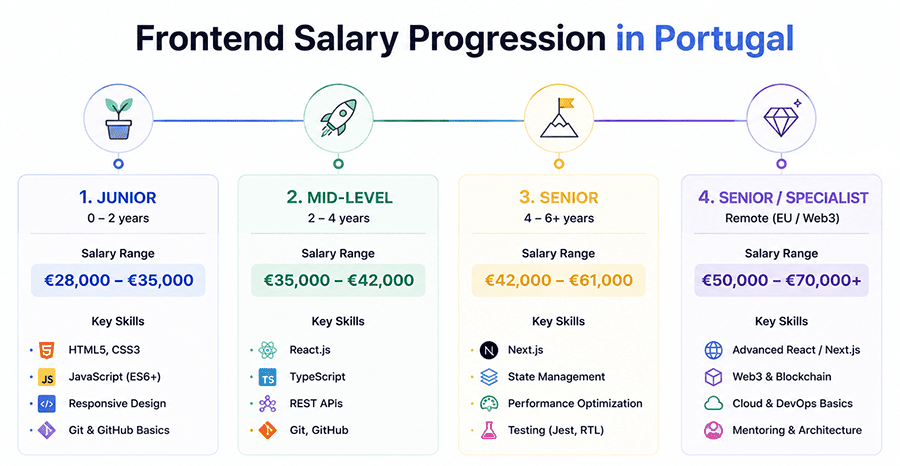
Frontend developer salaries in Portugal - 2026 (by level)
| Experience level | Approx. salary range (EUR/year) | Typical midpoint / median (EUR/year) | Source(s) & date note |
| Junior / Entry‑level (0-2 years) | €28,000 - €35,000 | Around €30,000-31,000 |
PayScale: “Front End Developer / Engineer in Portugal”, average total compensation ~€31,214; SheCodes‑style estimate for entry‑level Front‑End Developer ~€30,600; Talent.io headline base ~€39,2k is for overall “Frontend Developer”, closer to early‑career . |
| Early‑career / Mid‑1 (2-4 years) | €35,000 - €42,000 | Around €38,000-40,000 |
PayScale: early‑career Front End Developer / Engineer ~€27,7-28,9k total comp, rising to ~€39,5k for mid‑career 5-9 years; SheCodes mid‑level Front‑End Developer ~€44,1k; englishjobs.pt / similar portals list many frontend roles in this band . |
| Mid‑level / Senior‑1 (4-6 years) | €42,000 - €52,000 | Around €48,000 |
SheCodes senior‑level Front‑End Developer ~€52,4k; Glassdoor‑style data for Frontend Engineer in Portugal shows an average ~€60,5k (≈$60,500), which is closer to solid mid‑senior; Talent.io / englishjobs.pt role listings cluster heavily in the €45k-60k band . |
| Senior / Senior‑2 (6-8+ years) | €52,000 - €75,000+ | Around €60,000-65,000 |
Glassdoor “Senior Frontend Developer in Portugal” reports average ~€53k in Lisbon; talent‑/salary‑aggregator platforms show senior roles often advertised €50k-75k, with outliers above; Web3/frontend‑heavy roles sometimes reach €85k-120k+ . |
| Top‑tier / niche (e.g. Web3 / EU‑remote) | €75,000 - €120,000+ | Around €90k-100k |
Web3‑focused frontend data (BeInCrypto) cites average ~$102k (~€93k-95k) in Portugal, with highs past €110k; levels‑style and remote‑comp platforms (e.g., 46k-60k USD ranges) align with 60k-100k+ EUR for strong senior / remote‑EU frontend profiles . |
Here is a concise section on salaries by technology stack for frontend developers in Portugal in 2026, based on current job‑market signals (LinkedIn‑style roles, Glassdoor‑style estimates, and Web3/freelance‑heavy data).
- React + TypeScript is the most in‑demand stack in 2026 in Portugal, especially for product‑driven web and Web3 roles. In many listings, combining React with TypeScript pushes salaries about 10-20% higher vs a plain JavaScript frontend role at the same level (e.g., mid‑level React + TS in Lisbon often sits around €45k-60k, versus ~€40k for weaker‑tech‑stack or junior‑only JS roles).
- Angular (enterprise‑oriented) remains strong in enterprise and fintech / banking companies in Portugal, often in Lisbon and Porto. Senior Angular roles in Porto frequently start around €45k-55k, with some enterprise and remote‑EU listings reaching €60k+. Angular alone rarely commands extremely high premiums, but it pairs well with .NET / C# ecosystems that can push total comp into the upper mid‑range and senior bands.
- Vue.js (startup‑leaning) is less common than React or Angular in Portugal but appears in SaaS‑style startups and smaller product companies. Salaries are broadly similar to React for the same experience level (mid‑level around €40k-52k), but there are fewer advertised Vue‑only positions, which can slightly reduce negotiating power unless the developer also brings extra backend or UX skills.
- Next.js / React‑based “full‑stack‑leaning” frontend roles are growing fast, especially for teams that want one person to handle SSR, routing, API glue, and UI. Companies explicitly looking for Next.js + some Node.js / TypeScript skills often offer €45k-65k for mid‑senior profiles, and in Web3 or remote‑EU settings can reach €70k-100k+. This stack effectively turns a frontend role into a pipeline into full‑stack / SWE salaries, which in Portugal can range €50k-80k+ overall.
- Typescript‑heavy / Web3 frontend roles (React + TypeScript + Web3 stack) are among the best‑paid in Portugal, driven by international remote‑first companies. Public salary‑style reports show TypeScript‑heavy frontend / Web3 roles averaging around $100k-102k USD (~€92k-95k) in Lisbon, with some senior / niche roles reported up to €110k-120k+. These are outliers compared with standard non‑Web3 frontend roles but show a strong ceiling for candidates betting on React + TypeScript + Web3.
Taxes in Portugal for Tech Professionals in 2026 - IFICI (NHR 2.0)
Taxation is the first thing most developers research when Portugal comes up. It's also the topic with the most outdated, misleading, and flat-out wrong information circulating online. Before getting into the numbers, one fact needs to be stated clearly: the original NHR (Non-Habitual Resident) regime closed to new applicants on January 1, 2024. If you've read about "10 years of tax-free foreign income in Portugal" - that programme no longer exists for newcomers.
What replaced it is IFICI (Incentivo Fiscal à Investigação Científica e Inovação) informally called NHR 2.0. It offers genuine benefits, but the conditions are more targeted, the application process has a hard deadline, and it is not automatic. Here's what frontend developers actually need to know.
Standard Progressive Tax Scale (When IFICI Doesn't Apply)
Most new residents in 2026 who don't qualify for or don't apply to IFICI will pay income tax on a standard progressive scale. The brackets as of 2026 are as follows.
- Income up to €7,703 is taxed at 14.5%. This is the entry level and typically only applies to part-time or very junior positions.
- Income between €7,703 and €11,623 moves into the 23% bracket. At this range you're still below the junior average for most tech roles.
- Income between €11,623 and €16,472 is taxed at 28.5%. This covers the lower end of junior salaries in Portugal.
- Income between €16,472 and €21,321 sits at 35%. Most junior developers earning €18K-€21K will land partially in this bracket.
- Income between €21,321 and €39,791 carries an effective rate of 43.5-45%. This is the bracket that affects the bulk of mid-level frontend developers on local contracts.
- Income above €81,199 reaches 48%, plus a solidarity surcharge on top. This range applies primarily to senior engineers at international companies or those on remote contracts with foreign employers.
The practical takeaway: a middle developer earning €31K-€38K on a Portuguese contract will see an effective combined rate somewhere in the 28-38% range depending on deductions. That's broadly comparable to Germany or France - not the tax haven Portugal is sometimes marketed as, without IFICI.
IFICI (NHR 2.0): The 20% Flat Rate for Qualified Professionals
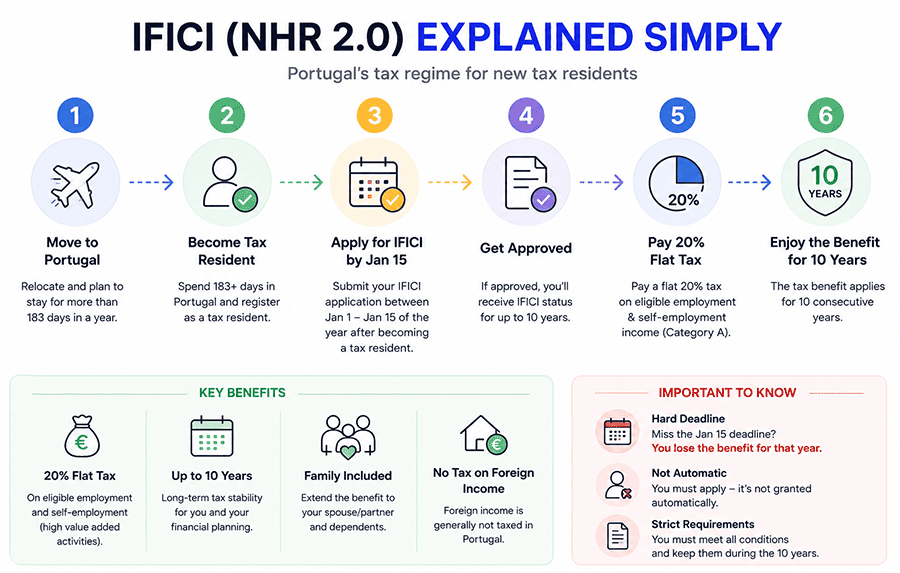
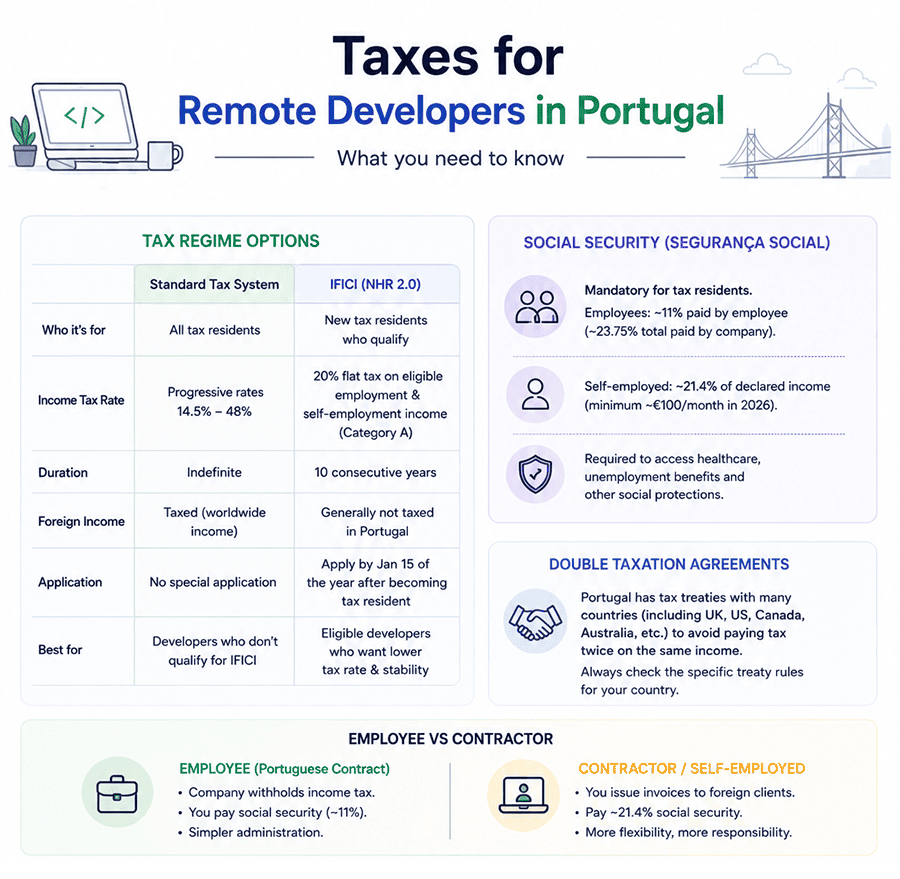
IFICI is the regime that genuinely changes the tax picture - for those who qualify. It replaces the progressive scale with a flat 20% rate on Portuguese-sourced income for a period of ten years, starting from the year you become a tax resident.
Who qualifies is the critical question. The regime targets professionals working in activities considered strategically valuable to Portugal's economy: scientific research, technology innovation, and highly qualified technical functions. Frontend developers, as a rule, qualify - provided the role can be substantiated as falling within the qualifying activity categories defined by Portuguese tax law. React engineers, TypeScript specialists, and developers working on digital products at recognised companies have consistently been accepted. That said, the classification is assessed on a case-by-case basis, and working with a local tax advisor before applying is not optional - it's the difference between getting the status and losing it on a technicality.
How the 10-year clock works matters more than most guides explain. The countdown begins in the first year you are recognised as a Portuguese tax resident - not the year you apply, and not the year you receive confirmation. If you arrive in Portugal in late 2025, establish tax residency for that year, and apply for IFICI in January 2026, your ten-year window runs from 2025. Miss the deadline, and that year is simply gone - you cannot retroactively claim it.
Foreign income treatment under IFICI follows the logic of Portugal's double taxation agreements. Income that is taxable in your country of source under an applicable DTA is generally exempt from Portuguese tax. For a developer contracting remotely for a UK or US employer while residing in Portugal, this can be highly advantageous - but the specifics depend on the agreement between Portugal and the relevant country, the nature of the employment relationship, and how the income is structured. This is not a blanket exemption; it requires proper analysis.
The application deadline is January 15 of the year following the year in which you first became a tax resident. This is a firm deadline. There is no grace period and no appeal process for missed submissions. If you establish residency in 2025 and miss the January 15, 2026 deadline, you lose the ability to apply for that tax year entirely and your ten-year window still starts ticking - meaning you've lost year one of the benefit.
Digital Nomad Visa D8: What Changed in 2026
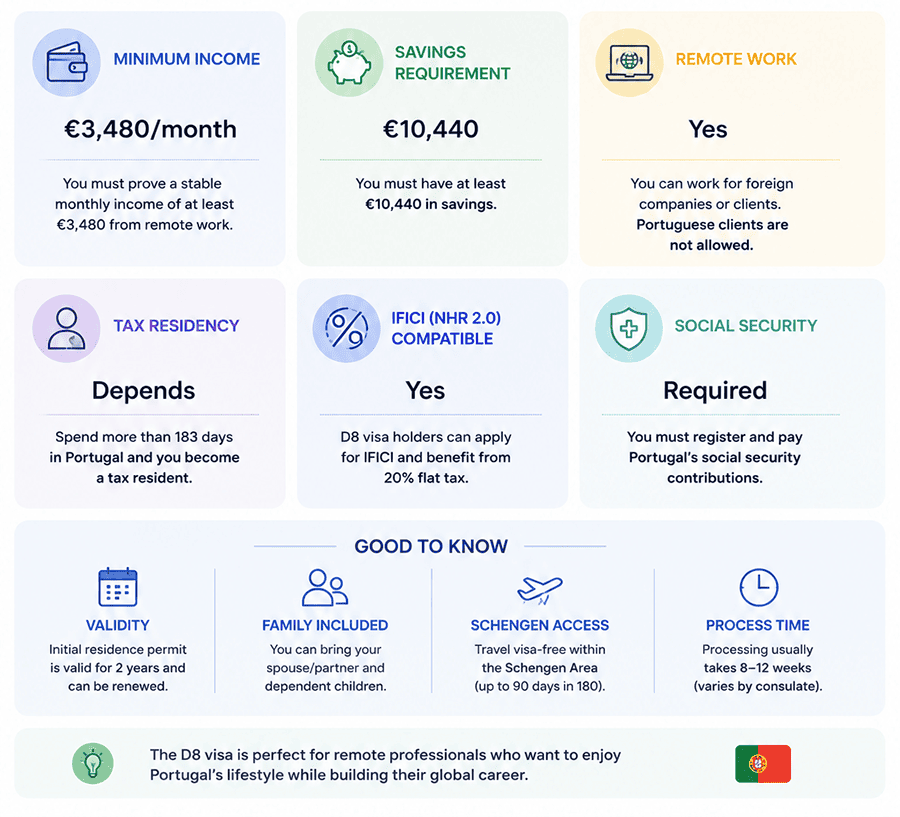
The Digital Nomad Visa D8 remains the most common legal pathway for non-EU frontend developers who want to live and work in Portugal without a local employer sponsoring them. Several conditions have been updated for 2026. The minimum income threshold now stands at €3,680 per month - four times Portugal's 2026 national minimum wage. This reflects the ongoing adjustments to the minimum wage baseline and is higher than figures cited in most pre-2025 guides.
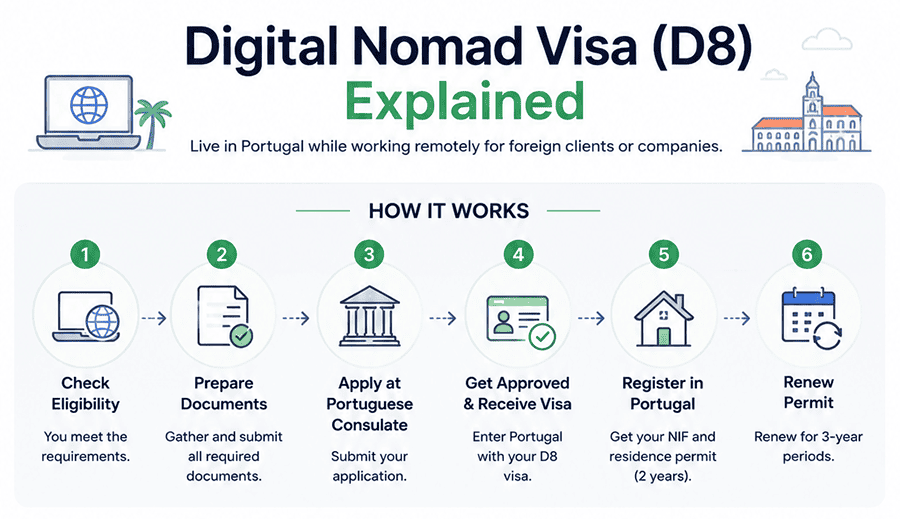
Proof of financial reserves is required at the point of application. The current requirement is approximately €11,040 held in a bank account, representing three months of the minimum income threshold. Tax liability under D8 is a separate question from visa eligibility. Holding a D8 visa does not automatically grant IFICI status or any other preferential tax treatment. A developer arriving on a D8 visa and working remotely for a foreign employer will pay Portuguese income tax - either at the progressive rate or at the IFICI flat rate if they applied and qualified. For most frontend developers earning €30K-€45K without IFICI, the effective tax burden lands between 28% and 35%.
Social security contributions apply regardless of tax regime. Neither the original NHR nor IFICI provides an exemption from Portuguese social contributions. Self-employed developers typically pay around 21.4% on declared income. Employment contracts on a local basis involve a split between employer and employee, with the employee contribution sitting at approximately 11%.
A Practical Note Before You Apply
IFICI is not a loophole and it is not administered loosely. Portuguese tax authorities have tightened scrutiny on applications since the regime launched, and the qualifying activity requirements are interpreted with increasing rigour. The developers who benefit most are those who apply early, document their role carefully, and work with a Portuguese tax professional - not those who self-assess eligibility based on forum posts or outdated blog articles.
Top Companies Hiring Frontend Developers in Portugal
Portugal's tech employer landscape in 2026 is more layered than a simple list of company names suggests. You have three distinct categories worth understanding before you start applying.
The first is international corporations with established engineering offices in Lisbon or Porto. These are companies like Cloudflare, Squarespace, or Wolters Kluwer that chose Portugal as a nearshore hub and hire locally at salaries benchmarked closer to their home markets than to the Portuguese median. Competition for these roles is real, but so are the compensation packages.
The second is Portuguese-born tech companies and scaleups - firms like Feedzai, Talkdesk, or Teya that started locally and grew into international players. They typically offer strong engineering culture, equity or bonus structures, and salaries that sit above the local average while remaining below the multinational ceiling.
The third is IT staffing and nearshore consultancies - companies like KWAN or Growin that place developers with end clients across Europe. These roles offer fast entry into the Portuguese market, broad exposure to different stacks, and a reliable path to permanent positions. The tradeoff is that you're often working on client projects rather than a single product.
Understanding which category you're targeting shapes everything from how you write your CV to what salary you should negotiate.
Lisbon
- Cloudflare (Lisbon office) - hires Senior Frontend Engineers for products like Email Service and dashboards. Stack: React, TypeScript, JavaScript. Global tech company with competitive salaries, hybrid work, and a strong engineering culture.
- Squarespace (Lisbon‑linked roles) - international SaaS company that runs frontend‑heavy product teams. In Portugal, they target Aveiro / Lisbon‑area hybrid roles using React, Angular, TypeScript for domains and website‑builder‑related UIs.
- Critical Techworks (BMW Group subsidiary) - large automotive‑tech center in Lisbon, part of the BMW ecosystem. Builds digital services, connected‑car platforms, and cloud tools with stacks like React and Angular. Stable, corporate‑backed environment with many engineering roles and a strong office in Lisbon.
- Growin - leading Portuguese IT company and consultancy that places talent in global projects. Runs many frontend‑developer roles (React, Angular, Vue) in Lisbon, mostly hybrid and mid‑senior. Very active on LinkedIn with regular postings.
- Teya (fintech) - fast‑growing fintech company (formerly Salt Pay) serving Europe, including Portugal. Expands with Senior Frontend Engineer roles heavy on React and Next.js for web‑based payment and financial dashboards. Roles span Lisbon and Porto tech hubs, with startup‑like growth and modern product‑focused stacks.
- Air Apps - mobile‑first startup building an AI‑powered personal‑and‑entrepreneurial resource planner. Hires frontend web developers in Lisbon who work with React, Vue, or Angular to build web‑based UIs for millions of users. Onsite in Lisbon, fast‑paced, with global reach and frequent product iterations.
Porto
- Wolters Kluwer - large international enterprise‑software group. In Portugal, it runs Lisbon‑centric but Porto‑linked teams with Senior Frontend Product Software Engineer roles built on React and TypeScript for legal, tax, and compliance‑focused platforms. Corporate‑level structure with long‑term projects and stable hiring.
- Feedzai (fintech unicorn) - one of the largest and best‑known Portuguese fintechs, headquartered in Lisbon but with strong presence and projects visible in Porto. Hires frontend engineers to build data‑heavy dashboards for fraud‑detection and AI‑powered financial analytics (React‑based UIs, often with TypeScript and D3‑style visualization stacks).
- KWAN - tech talent network focused on Portugal, with a base in Lisbon but strong ties to Porto‑area companies. It helps frontend‑skilled engineers land roles in big corporations and nearshore projects via consultancy / contract placements. Good entry point if you want to try several product environments without direct company‑specific branding always visible.
Remote Positions: Working for Foreign Employers from Portugal
Remote work for a foreign employer - living in Lisbon or Porto while earning a UK, US, or Northern European salary - remains one of the most financially attractive scenarios for frontend developers in Portugal. The cost-of-living advantage is fully in your favour, and if you qualify for IFICI, the tax picture improves further.
Finding these roles requires working different channels than a standard local job search. The platforms below are where this market actually lives in 2026.
- englishjobs.pt is the most practical starting point for Portugal-based remote searches. The platform aggregates English-language listings from companies that explicitly target Portuguese residents or are open to candidates relocating to Portugal. Frontend-specific filters make it easy to narrow by stack.
- LinkedIn remains the highest-volume channel but requires deliberate filtering to surface genuine remote opportunities. The most effective approach is combining a location filter for Portugal with the Remote work type toggle, then sorting by date to avoid stale listings. Setting up a job alert with the query "frontend developer Portugal remote" eliminates the need to repeat the search daily.
- Jobgether - Focused on remote‑first and hybrid roles that accept candidates based in Portugal. It lists Frontend‑Developer / Front‑End Developer positions with companies that allow work‑from‑home or flexible schedules.
- Crossover - Remote‑job marketplace where US‑ and EU‑based tech companies hire full‑time frontend developers in Portugal. Many listings are for Front‑end Developer or Frontend Engineer positions with 100% remote work and structured evaluation exams.
- Wellfound (formerly AngelList Talent) is particularly strong for remote-first startups. Its listings consistently display salary range and equity upfront - a practical advantage when you're comparing multiple opportunities across different markets. The majority of companies on the platform are either fully remote or explicitly remote-friendly, which makes it more signal-dense than LinkedIn for this specific use case.
- Toptal and Andela operate differently from job boards - they function as vetted talent networks that match developers with companies on a contract or project basis. Entry requires passing a technical screening process, but accepted developers gain access to clients paying rates significantly above the Portuguese market average. For senior frontend engineers open to contract work, the effective hourly rates can substantially exceed what a local full-time role would yield.
- Remote OK and We Work Remotely are broader remote job aggregators, not Portugal-specific, but both carry consistent volumes of frontend listings from companies that are genuinely location-agnostic. Filtering by React, TypeScript, or Angular surfaces relevant opportunities quickly.
One practical note on remote work and legal status: working remotely for a foreign employer while residing in Portugal requires a valid legal basis for your stay - either EU citizenship, the D8 digital nomad visa, or another applicable permit. The employment relationship itself is typically governed by your employer's home country contract, but your tax obligations are Portuguese once you establish residency. This distinction matters and is worth clarifying before you sign anything.
How to Land a Frontend Developer Job in Portugal?
Getting hired as a frontend developer in Portugal in 2026 is a structured process - but it's more accessible than many candidates expect, particularly for those coming from markets where competition is fiercer. The Portuguese tech market is still absorbing international talent at a steady pace, and companies with international ownership are accustomed to hiring remotely, onboarding candidates from abroad, and running interviews entirely in English.
Applications without a portfolio rarely progress past the first screen. Take-home technical tasks are standard at mid-level and above. And companies - especially local ones - place noticeable weight on communication skills and cultural fit alongside technical ability. Showing up with clean code and a clear ability to articulate your decisions will consistently outperform candidates who are technically stronger but harder to work with.
Stack Requirements in 2026
The data below is drawn from analysis of active frontend job listings on LinkedIn, Glassdoor, englishjobs.pt, and devitjobs.pt as of May 2026. These are not aspirational requirements - they reflect what Portuguese and Portugal-based international employers are consistently asking for right now.
- React or Angular appears in over 80% of frontend listings. React dominates in product companies, startups, and international firms. Angular is more prevalent in enterprise environments - banking, insurance, logistics, and fintech. Knowing one well is non-negotiable; knowing both makes you significantly more placeable.
- TypeScript is listed as a hard requirement in roughly 60% of positions and as a strong preference in most of the remainder. Writing vanilla JavaScript alone in 2026 will not close you out of the market entirely, but it will meaningfully narrow your options - particularly at the senior level, where TS proficiency is effectively assumed.
- Git, REST APIs, and Agile/Scrum are baseline expectations across all seniority levels. These are not differentiators; their absence is a disqualifier. Every listing at every level includes them, and interviewers will assume competence without dedicating significant time to testing it.
- Testing frameworks - Jest, Vitest, and Cypress - are expected from middle-level candidates upward. Junior roles occasionally list testing as a nice-to-have, but mid and senior positions treat it as standard. Candidates who can speak confidently about testing strategy, not just syntax, stand out consistently.
- English at B2 level or above is a practical requirement for the majority of tech roles in Portugal. Most international companies conduct interviews, write documentation, and run daily standups entirely in English. Portuguese language skills are an asset - particularly at local companies and in client-facing roles - but the absence of Portuguese will not disqualify you from the bulk of the market.
- Figma literacy is increasingly listed as a requirement rather than a bonus. Frontend developers are expected to work directly from design files, flag inconsistencies with designers, and understand spacing, component logic, and responsive behaviour as specified in Figma. You don't need to be a designer - but you need to read their work fluently.
- Next.js and fullstack-adjacent skills are showing up more frequently in 2026 listings, particularly at smaller companies and startups where headcount is lean. The expectation isn't deep backend engineering - it's the ability to handle API routes, server-side rendering, and basic data-fetching patterns without requiring a dedicated backend developer for every task.
Platforms to find frontend‑developer jobs in Portugal
- BuiltIn (Portugal frontend‑focused feed) - Curated selection of Front End Developer jobs in Portugal, with profiles from startups and scale‑ups. Useful for discovering niche companies and growth‑oriented product teams.
- Web3.Career (frontend‑focused Web3 roles) - If you’re targeting React‑plus‑Web3 stacks (wallets, dashboards, fintech/UIs), this site collects front‑end Web3 jobs in Portugal, often with high salaries and remote‑EU options.
- Upwork (freelance frontend work) - While not local‑only, Upwork’s Portugal‑filter helps you find freelance frontend projects that accept Portuguese‑based developers, especially for React, Vue, and Angular gigs.
- Glassdoor (Portugal) - Great for checking Front‑end Developer and Frontend Developer roles in Portugal with salary ranges and company reviews. You can see 100-250+ openings at any time, many in Lisbon and Porto, from startups to large corporates.
Step-by-Step Plan to Getting an Offer
| Step | Action | What to Focus On |
| 1. Build your portfolio | Prepare 2-3 deployed projects hosted on GitHub with clean READMEs | Code quality and documentation matter more than complexity. Portuguese market employers read READMEs carefully. Include live demo links wherever possible |
| 2. Optimise your LinkedIn | Set your headline to reflect your stack and openness to Portugal | Example: Frontend Developer · React · TypeScript · Open to Portugal. Add Lisbon or Porto as a location or enable "Open to relocation". Recruiters search by location first |
| 3. Set up targeted job alerts | Create alerts on englishjobs.pt, LinkedIn, and Wellfound | Use queries like "frontend developer Portugal", "React developer Lisbon", "frontend remote Portugal 2026". Sort by date, not relevance |
| 4. Apply with volume and discipline | Target 5-10 applications per day during active search | Focus on companies with explicit English-language listings and Portugal-based or remote roles. Customise the first paragraph of your cover message per application - the rest can be templated |
| 5. Prepare for the technical process | Understand the standard hiring flow for Portuguese tech companies | Most processes follow: HR screen (30 min) → take-home task or live coding (1-3 days) → technical interview → culture fit. Prepare to explain your decisions, not just your code |
| 6. Sort your legal groundwork early | Get your NIF (Portuguese tax number) and clarify your visa situation before accepting an offer | EU citizens need no visa. Non-EU developers should research the D8 digital nomad visa or employer-sponsored D3 work visa. NIF can be obtained remotely through a fiscal representative |
| 7. Understand your IFICI window | If you plan to establish Portuguese tax residency, apply for IFICI before the January 15 deadline | The ten-year benefit clock starts the year you become a resident - not when you apply. Missing the deadline costs you an entire year of the flat 20% rate. Engage a local tax advisor before you arrive |
| 8. Negotiate with market data | Use salary ranges from this article, Glassdoor, and devitjobs.pt as anchors | International companies in Portugal often have room above their posted range. Local companies less so. Always negotiate - the Portuguese tech market expects it at mid and senior level |
FAQ: Frontend Developer Jobs and Salaries in Portugal 2026
How much does a frontend developer earn in Portugal in 2026?
Frontend developer salaries in Portugal in 2026 range from approximately €15,000-€27,000 per year at junior level, €27,000-€42,000 at mid-level, and €42,000-€61,000 for senior engineers on local contracts. The top 10% of senior developers at international companies can reach €75,000 or above.
Developers working remotely for UK or US employers while residing in Portugal frequently earn €45,000-€100,000+, depending entirely on the employer's home market rates. Stack matters significantly - React and TypeScript specialists consistently sit at the upper end of each range.
Is Portuguese required to work in tech in Portugal?
For the majority of tech roles at international companies and Portugal-based startups with foreign ownership, no. English is the working language across most engineering teams, and interviews, documentation, and daily communication are conducted entirely in English. Portuguese becomes more relevant at locally owned companies, in client-facing roles, and for navigating daily life outside the office. Learning basic Portuguese will improve your experience of living in the country, but it is not a barrier to building a serious tech career there.
Can I work remotely for a foreign employer while living in Portugal?
Yes, and this is one of the most common arrangements among international developers in Portugal in 2026. You live in Lisbon or Porto, maintain a contract with a UK, US, or Northern European employer, and benefit from the cost-of-living differential. The legal basis for your stay is either EU citizenship or - for non-EU nationals - the D8 digital nomad visa. Your tax obligations become Portuguese once you establish residency, which means your foreign income is subject to Portuguese tax law, either at the progressive rate or at the IFICI flat rate if you qualify and applied on time.
Is it true there are zero taxes in Portugal for developers?
No. This is one of the most persistent myths about Portugal and it has been outdated since January 1, 2024, when the original NHR regime closed to new applicants. The replacement - IFICI (NHR 2.0) - offers a genuine benefit: a flat 20% income tax rate for ten years for qualifying professionals in technology and research. That is meaningfully lower than the standard progressive scale, which reaches 48% at higher income levels. But 20% is not zero, IFICI is not automatic, and not everyone qualifies. Developers who arrive without applying for IFICI pay standard Portuguese income tax from day one.
How long does it take to find a frontend developer job in Portugal?
At mid-level, active candidates with a strong portfolio and React or TypeScript experience typically receive their first offer within four to eight weeks of starting a structured search. Junior developers may take longer - eight to twelve weeks is realistic, particularly without prior work experience in Europe. Senior engineers with in-demand stacks and English fluency often move faster, especially when targeting international companies with offices in Lisbon or Porto. The single biggest variable is application volume: candidates applying to five or more positions per day consistently outperform those waiting for the perfect listing.
Is it better to work for a Portuguese company or a foreign one?
It depends on your seniority level and what you're optimising for. International companies with Portuguese offices typically pay 20-40% above local market rates and offer more structured career progression, stronger engineering culture, and exposure to larger-scale technical problems. The tradeoff is higher competition and more demanding hiring processes. Portuguese companies - particularly startups and nearshore consultancies - are more accessible for junior developers and candidates without prior European work experience. They also tend to offer faster onboarding, more flexibility, and a lower bar on the technical interview. For senior developers, the financial case for targeting international employers is clear. For juniors, a local company is often the faster and more realistic first step.
What visa do I need to work in Portugal as a non-EU frontend developer?
The two most relevant options in 2026 are the D8 digital nomad visa and the D3 highly qualified worker visa. The D8 is designed for remote workers and freelancers earning income from foreign sources - it requires a minimum monthly income of €3,680 and proof of financial reserves.
The D3 is employer-sponsored and requires a job offer from a Portuguese company willing to initiate the process. EU and EEA citizens require no visa and can work in Portugal freely. Whichever route applies to you, sorting the legal groundwork before signing an employment contract - not after - avoids significant administrative complications.
Does IFICI cover social security contributions?
No. IFICI is an income tax regime only. Social security contributions in Portugal are entirely separate and apply regardless of which tax regime you fall under. Employees on local contracts contribute approximately 11% of gross salary, with the employer contributing a further 23.75%. Self-employed developers and freelancers pay around 21.4% on their declared professional income. This is a meaningful addition to your overall tax burden and should be factored into any salary or rate calculation when comparing Portugal to other markets.