
Frontend Developer Job in Saudi Arabia
12 August 2026
331 views
This guide is up to date as of October 2026

Written by
Marcus Hale,
IT Talent Acquisition Specialist

Reviewed by
Faisal Al Harbi,
Technical Recruitment Consultant, Saudi Arabia
Five years ago, a frontend developer plotting a move abroad ran through the usual list - Berlin, Amsterdam, Toronto, maybe Dubai if the money was right. Riyadh wasn't on it. If it came up at all, it came up next to warnings: rigid sponsorship rules, no real information on pay, a market nobody outside the region could actually verify.
That list looks different now. Saudi banks are rebuilding their apps from scratch, government services have moved almost entirely online, and companies that used to cover Saudi Arabia out of a Dubai office are opening dedicated Riyadh teams instead. None of that happened because of a marketing push - it happened because a government sitting on a digitization mandate needs people who can actually build the interfaces. This guide skips the Vision 2030 slogans. It covers what matters if you're the one deciding whether to move: real salary ranges by employer type, the stack Saudi teams are hiring for, and the exact visa process for a frontend developer specifically - not a general immigration overview.
Frontend Developer Salary in Saudi Arabia (2026)
Search "frontend developer salary Saudi Arabia" and you'll get numbers that don't agree with each other. Glassdoor's self-reported data for Riyadh puts the average frontend developer salary around SAR 10,300 a month (as of July 2026). SalaryExpert's employer-survey data puts the average annual package closer to SAR 200,000 a year - nearly double, depending on how you convert it. Both numbers are real. They're just measuring different markets.
The gap comes down to who's answering. Glassdoor's Riyadh sample leans toward smaller local companies and IT services firms, with employees self-reporting anonymously. SalaryExpert pulls from employer payroll data, which skews toward multinationals and product companies - where pay is higher, more structured, and more likely to be tracked by an actual HR department in the first place. Neither figure is "the" Saudi Arabia frontend developer salary. They're two ends of a spread you'll land on depending on who hires you. The breakdown below separates that spread by employer type and experience level, cross-checked against Glassdoor, SalaryExpert (ERI), and CV Pro Maker's dedicated Saudi Arabia salary guide.
Salary Table by Level and Employer Type
| Level | Local Companies / Agencies (SAR/month) | Product Teams & Vision 2030 Contractors (SAR/month) |
| Junior (0-2 years) | 5,500 - 10,000 | 10,000 - 14,000 |
| Middle (3-6 years) | 8,000 - 16,500 | 14,000 - 24,000 |
| Senior (7+ years) | 14,000 - 16,500* | 24,000 - 38,000 |
Important Notes on Data Sources and Methodology
- Glassdoor figures are based on self-reported user submissions and tend to reflect local agency and smaller-company salaries. For example, Glassdoor lists average frontend developer base pay in Riyadh at SAR 6,000-16,000/month, with senior roles at SAR 8,000-16,000/month.
- SalaryExpert and similar employer-survey-based sources report much higher annual averages (e.g., ~SAR 195,415/year ≈ SAR 16,285/month average for frontend developers in KSA as of August 2026), reflecting broader market coverage including large product companies.
- PayScale and WorldSalaries show wide ranges (SAR 3,000-194,000/year on PayScale; SAR 72,700-249,600/year on WorldSalaries), highlighting how methodology (self-reported vs. employer surveys vs. aggregated job data) affects results.
Active Source Links:
- SalaryExpert - Front End Developer Salary in Saudi Arabia (2026)
- Glassdoor - Front End Developer Salary in Riyadh, Saudi Arabia
- PayScale - Front End Developer / Engineer Salary in Saudi Arabia
- WorldSalaries - Average Front End Web Developer Salary in Saudi Arabia (2026)
What Pushes Pay Higher
The gap between the bottom of that range and the top isn't random - it tracks a handful of specific factors employers are actually screening for. A developer with the right combination of these can move from the agency tier into product-company pay within a single job change, without necessarily changing seniority level.
- Proven experience with TypeScript and Next.js/React tied to design-system work - banks and fintechs are rebuilding client interfaces around Vision 2030 digitization mandates, and that's where the budget is going
- Experience on multinational teams and working-level English - a hard requirement for most product-company roles, not a nice-to-have
- Willingness to relocate to Riyadh rather than work remotely - most product-company openings require being in the office, and remote arrangements are the exception, not a fallback option
Required Tech Stack in Saudi Arabia
Ask what stack gets you hired in Riyadh and the honest answer is: mostly the same one that gets you hired anywhere else, with two additions most Western job posts never mention. React and Next.js dominate, TypeScript is close to non-negotiable at any bank or fintech, and Tailwind shows up in the majority of design-system-driven teams. What's different isn't the core toolkit - it's a handful of specifics tied to how Saudi products actually get used, and teams filter candidates on these details whether or not the job post spells them out.
The following stack reflects what KSA employers actually list in 2025-2026 job postings, not generic “modern frontend” checklists.
| Skill / Technology | Why It’s Required in KSA (2026) |
| React / Next.js | Explicitly required in most product-company and fintech vacancies (Salla, PwC, Infosysta, UMATR, Flint, Fullstack SA Tech). Next.js is specified for SSR/SSG/ISR, App Router, and API routes. |
| TypeScript | Listed as “solid” or “deep” TypeScript experience in banks, fintech, and enterprise digital-product roles. Often 1+ year minimum for mid/senior roles. |
| RTL & Arabic Localization | Many KSA-specific roles explicitly require experience with RTL/LTR localization and Arabic interface development (government, fintech, enterprise). This is a key differentiator vs. Western markets. |
| Design Systems / Tailwind CSS | Repeatedly mentioned alongside Material UI and component libraries. Employers reference “design systems, shared UI component libraries, and branding guidelines” as part of core responsibilities. |
| Mobile Performance & Accessibility | Job posts emphasize responsive/mobile-first design, frontend performance optimization, accessibility standards, and cross-browser compatibility-critical in a high-mobile-traffic region. |
| Flutter Web / Cross-Platform (Plus) | Some agency and integrator roles value cross-platform skills when the product spans mobile + web, especially for clients wanting unified codebases. This is more common in agency/outsourcing segments. |
Active Source Links:
- GulfTalent - Front End Developer Jobs in Saudi Arabia (React, Angular, Vue.js, TypeScript, RESTful APIs — live listings, updated continuously)
- Bayt - Frontend Developer React Jobs in Saudi Arabia (React.js, modern frontend architecture, performance optimization, cross-functional collaboration)
- Naukrigulf - Front End Developer Jobs in Saudi Arabia (strong South Asia candidate base, IT and engineering-focused listings)
What sets Saudi Arabia apart from a typical Western frontend role:
- RTL (right-to-left) layout experience - Arabic-language interfaces need bidirectional text handling, and this is the single most concrete skill gap between a Western-market frontend developer and one who's actually shipped an Arabic-facing product. Job posts rarely list it explicitly, but interviewers ask about it directly.
- Mobile-first performance under real network constraints - mobile traffic share in the region runs high, and Saudi teams weigh load performance and responsiveness more heavily than teams optimizing primarily for desktop.
- Design-system fluency over framework novelty - banks and government-adjacent projects are standardizing interfaces across products, so teams look for developers who can work inside an existing system cleanly rather than ones chasing the newest framework.
- Cross-platform exposure (Flutter-web or similar) as a plus, not a requirement - mainly relevant if you're targeting the agency segment, where the same team often covers both mobile app and web frontend for one client.
Vision 2030 and the IT Sector: What Actually Changed for Hiring
Vision 2030 gets treated as a marketing slogan in most articles about Saudi Arabia, and that's fair - a lot of what gets published under that name is press-release language about "transformation" and "giga-projects." Strip that away and what's left is a set of concrete shifts in how tech companies hire in the Kingdom, and those shifts are the reason a frontend developer's job search here looks different than it did five years ago.
- The clearest change is where the offices are. Regional tech companies that used to cover the Saudi market from a Dubai base have opened dedicated Riyadh operations instead. That's not a symbolic move - it means headcount, local hiring budgets, and roles that didn't exist as standalone positions before. International players who previously handled Saudi clients remotely now have people on the ground in the Kingdom, and a meaningful share of that headcount at the mid-to-senior technical level is still being filled by expats, because the local talent pipeline hasn't caught up to the pace of hiring yet.
- The second driver is government digitization. Public-sector services - from basic administrative processes to citizen-facing platforms - have moved online at a pace that created sustained demand for people who build and maintain those interfaces. This isn't a one-time push; it's an ongoing program, and it functions less like a project with an end date and more like a standing pipeline of frontend and full-stack work.
- The third is the financial sector. Saudi banks are in the middle of rebuilding client-facing products - mobile banking apps, web portals, internal dashboards - largely because they're competing for the same digitally-native customer base that fintech startups are chasing. That competition has translated directly into frontend hiring, and it's one of the more reliable sources of product-company-tier roles described in the salary section above.
None of this means the Saudi tech sector has some fixed, quotable size - any specific figure about "X thousand new IT jobs" you find online is almost certainly outdated by the time you read it, because hiring volume here moves fast and unevenly across sectors. What's verifiable is the pattern: more foreign companies establishing a real Riyadh presence, a public sector that keeps digitizing rather than finishing a single project, and a banking sector rebuilding its software stack. For a frontend developer, that pattern matters more than any headline number - it tells you where the actual roles are coming from, and it's the difference between a market propped up by one project and a market with several independent reasons to keep hiring.
How to Relocate to Saudi Arabia as a Frontend Developer: Visas and Requirements
This is the section most guides get vague on, so it's worth being precise from the start: everything below is written for a frontend developer specifically, not as a general Saudi Arabia immigration overview. The process runs through your employer in nearly every case - there's no independent work-visa application a developer can file on their own, and understanding that upfront saves a lot of wasted research. What follows are the steps in the order they actually happen, the quota system that can slow things down for reasons that have nothing to do with your resume, and the one alternative route worth knowing about if you're further along in your career. None of the figures here are fixed forever - Saudi immigration policy has moved fast over the past few years, so treat every threshold and fee below as "verify before you commit," not as a guarantee.
The Main Route: Employment Visa and Iqama
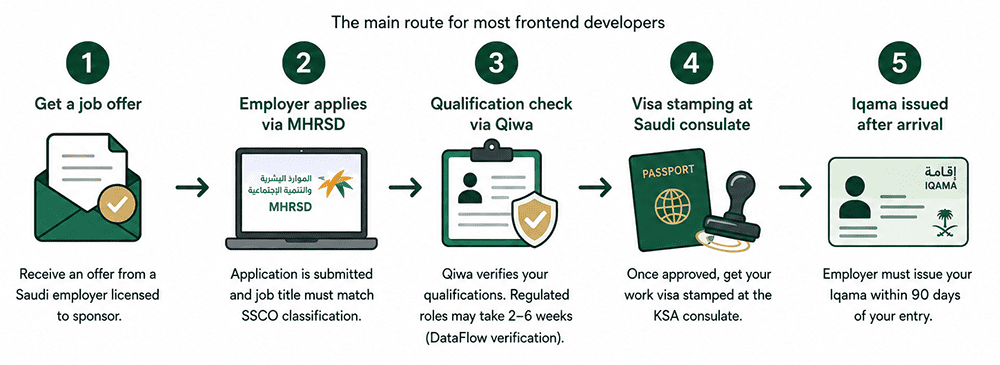
For the overwhelming majority of frontend developers, this is the only route that matters. It starts with an offer and ends with a residency permit, and it runs entirely through your employer - referred to formally as your sponsor, or kafeel.
- Get an offer from a Saudi employer. Nothing else in this list happens without this step. There's no visa category that lets you enter the country to look for frontend work once you're already there - the offer has to come first, from a company licensed to sponsor foreign workers.
- Your employer files the work visa application through MHRSD.The Ministry of Human Resources and Social Development processes the request, and the job title on your contract has to match an official category in the Saudi Standard Classification of Occupations (SSCO). This sounds like a formality until it isn't - a mismatch between your actual title and its SSCO equivalent is one of the more common reasons applications stall for weeks with no clear explanation.
- Qualification verification through Qiwa. Qiwa is the government labor platform that checks your professional qualifications against the role. For most standard frontend positions this is quick, but if your role falls under a regulated classification, factor in an extra 2-6 weeks for DataFlow verification of your degree.
- Visa stamping at a Saudi consulate. Once approved, you complete the visa stamp at the KSA consulate in your country of residence - this is the step that actually lets you enter the country to work.
- Iqama issuance after arrival. Your employer is required to issue your Iqama, the residency permit, within 90 days of your entry. Until it's issued, you're technically in the country on the strength of your entry visa alone.
Budget realistically for the full cycle: visa processing and stamping typically takes 4-12 weeks, work visa fees run around SAR 100, and Iqama issuance costs roughly SAR 650 per year - though your employer usually covers this, so confirm it's in your offer rather than assuming. The Iqama itself is valid for 1-2 years and gets renewed by your employer, not by you. Switching employers is possible but not immediate: most contracts require a minimum of one year with your current sponsor, or you wait until the contract term ends.
Saudization and Nitaqat: Why This Affects You Even If You're Qualified
Nitaqat is the part of this process that has nothing to do with your skills, and it's worth understanding before you assume a slow hiring process means you did something wrong.
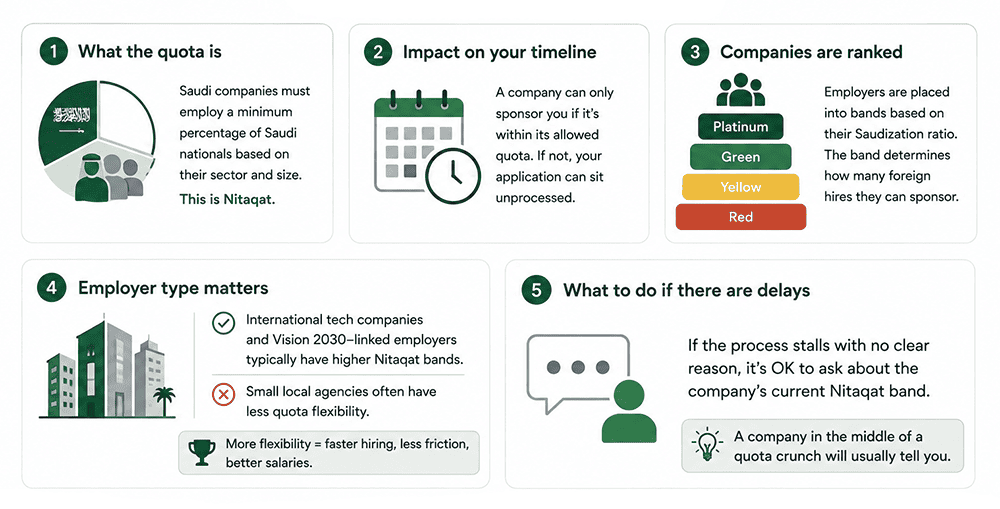
- What the quota actually is. Every Saudi company is required to employ a minimum percentage of Saudi nationals relative to its total headcount, benchmarked against its sector and size. This program is called Nitaqat, and it's the mechanism behind the broader Saudization policy you'll see referenced constantly in relocation guides.
- What it means for your hiring timeline. A company can only sponsor a new foreign hire - you - if it's within its allowed quota. If it isn't, your application can sit unprocessed for reasons that have nothing to do with your interview performance or your CV.
- Companies are ranked into bands. Nitaqat classifies employers into tiers - from Platinum and Green down to Yellow and Red - based on how their Saudization ratio compares to sector norms. A company's band determines how much room it has to sponsor new foreign workers or renew existing ones.
- This is where employer type matters again. International tech companies and Vision 2030-linked employers generally sit in higher Nitaqat bands than small local agencies, which gives them more flexibility to hire foreign developers without quota friction - one more reason product-company roles tend to move faster and pay better, as covered in the salary section.
- A practical read on delays. If a process stalls for weeks with no clear reason after an offer's been extended, it's worth asking your recruiter or future employer directly about their current Nitaqat standing. It's a legitimate question, and a company mid-quota-crunch will usually just tell you.
Premium Residency (Iqama Mumayyazah): A Path for Experienced Developers
Premium Residency is the one route that removes that tie - but it's worth being upfront about who this actually fits, because most articles present it as a universal option when it realistically isn't.
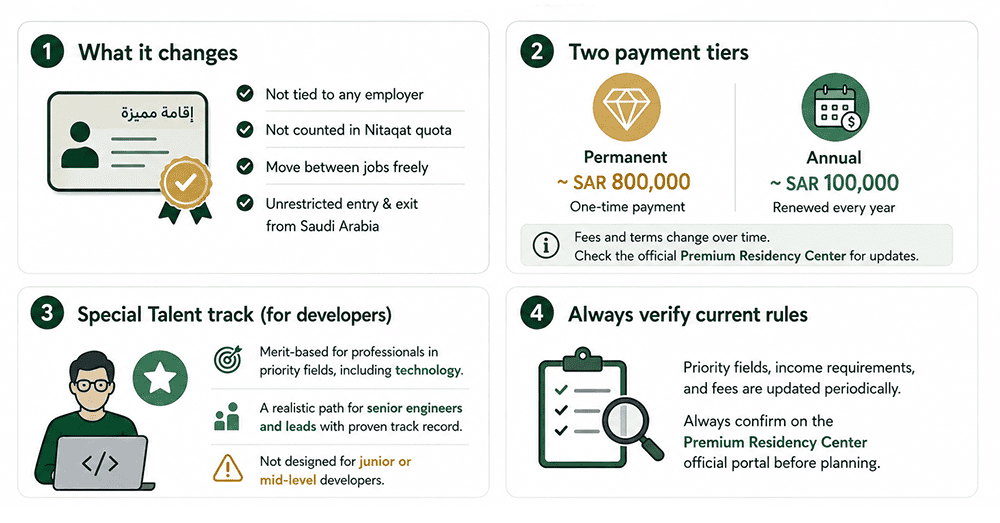
- What it changes. Premium Residency, known locally as Iqama Mumayyazah, decouples your residency status from any single employer. You're no longer counted against a company's Nitaqat quota, you can move between jobs without the one-year sponsor lock described above, and you get unrestricted entry and exit from the Kingdom - none of which apply under a standard employer-sponsored Iqama.
- Two payment tiers exist. There's a one-time payment, historically around SAR 800,000, for permanent status, and a lower annual fee, around SAR 100,000, that requires renewal each year. Both figures move - Saudi authorities have adjusted Premium Residency terms more than once since the program launched, so confirm current numbers directly on the Premium Residency Center's official portal before factoring either into your planning.
- The Special Talent track is the realistic entry point for developers. Outside the flat-fee tiers, there's a merit-based category for professionals in priority fields, including technology, who can demonstrate strong verified expertise. This is the track that actually applies to frontend developers - but it's built for senior engineers and leads with a solid track record, not something a junior or mid-level developer should expect to qualify for on their first application.
- Treat every threshold here as provisional. Priority-field definitions, income requirements, and fee amounts under this program get revised periodically. Whatever you read here or anywhere else, verify it against the Premium Residency Center before treating it as a plan rather than an option worth investigating.
Relocating With Family
If you're moving with a spouse or children, family sponsorship runs as a separate process layered on top of your own Iqama - it doesn't happen automatically alongside it.
- You need an active Iqama first. Family sponsorship isn't available at the point of your own visa application - it opens up once your Iqama is issued and active, not before.
- Your income has to clear a separate threshold. Sponsoring dependents requires your salary to meet a minimum set for family visas, which sits above whatever qualifies you for your own work visa alone. This threshold is one more figure to verify at application time rather than assume from older sources.
- There's an ongoing dependent fee, not a one-time cost. Each sponsored dependent carries an annual levy, paid through the SADAD payment system. This fee has been adjusted by Saudi authorities before and is likely to move again, so get the current figure from an official source rather than relying on a number from a blog post.
- Budget for this before you negotiate your offer, not after. Because the dependent levy is recurring and per-person, it's worth factoring into your salary negotiation if you're relocating with a family of three or four - it's a real ongoing cost, not a one-line administrative fee.
Conclusion
The Saudi Arabia frontend market rewards developers who do their homework rather than chase the headlines. NEOM makes for a good story, but Riyadh's banks, telecoms, and government digitization projects are where the actual hiring volume sits - and the gap between local-company and product-company pay is wide enough that knowing which segment you're targeting matters more than any single salary figure.
The visa process is straightforward on paper and slower in practice, mostly because of Nitaqat quotas and classification details that have nothing to do with your skills. None of the numbers in this guide - salary ranges, visa fees, Premium Residency thresholds - are fixed for good. Saudi policy has moved fast over the past few years and will likely keep moving, so treat every figure here as a starting point for your own verification, not a guarantee. If the fundamentals fit - a React/TypeScript background, willingness to relocate to Riyadh, and realistic expectations about the sponsorship process - this is a market worth taking seriously in 2026, not just watching from a distance.
Frequently Asked Questions about Relocation to Saudi Arabia
Do I need a university degree to get a work visa in Saudi Arabia as a frontend developer?
In most cases, yes - but it's rarely about a specific credential and more about clearing the paperwork. Saudi employers typically require a bachelor's degree for the standard employment visa process, largely because your qualifications get checked against your role classification through Qiwa. For regulated job categories, that includes DataFlow verification of your degree, which adds real time to the process. If you don't hold a formal degree but have a strong portfolio and several years of verifiable experience, some employers will still sponsor you - but expect more scrutiny and don't assume it's the default path.
Can I move to Saudi Arabia as a frontend developer without a job offer first?
No. There's no visa category that lets a frontend developer enter the country to search for work once already inside Saudi Arabia. The employment visa process described earlier in this guide starts with an offer from a licensed sponsor - everything else, from the MHRSD application to your Iqama, depends on that offer existing first. The one exception, Premium Residency, isn't a way around this for most developers; as covered above, it's realistically a route for senior professionals with an established track record, not an entry point.
Does a frontend developer pay income tax in Saudi Arabia?
No personal income tax applies to salaries in Saudi Arabia, for citizens or foreign workers. What you see on your contract is close to what lands in your account, aside from a GOSI contribution of roughly 2% for foreign employees. There's no equivalent of the income tax brackets you'd find in most Western countries - the tradeoff shows up elsewhere, in the 15% VAT on goods and services and in costs like the dependent levy if you're sponsoring family.
What's the difference between working at NEOM and working in Riyadh as an IT professional?
NEOM offers higher pay for the roles it does have, plus covered housing and meals, but comes with life in a remote desert camp, long hours, and six-day weeks - and frontend-specific openings there are limited compared to the project's construction and engineering hiring. Riyadh is where the actual volume of frontend work sits: banks, telecom, government digitization projects, and fintech startups, with a normal office environment and access to city life.
How long does the entire relocation process take for a frontend developer?
From signed offer to holding an active Iqama, plan for roughly 2-4 months under normal conditions. Visa processing and stamping alone typically runs 4-12 weeks, and your employer then has up to 90 days after your arrival to issue the Iqama - though in practice, most employers move faster than the legal maximum. Add 2-6 weeks if your role requires DataFlow degree verification. None of these timelines are guaranteed; delays tied to Nitaqat quota status or SSCO title mismatches can add weeks with little warning, so it's worth building in buffer time rather than planning around a fixed start date.
Where should I actually look for frontend developer jobs in Saudi Arabia?
A handful of platforms cover most of the real hiring activity, and each serves a different purpose:
- Bayt - the largest general job board in the region, with the broadest volume of Saudi IT listings. Good for a first sweep of what's out there, though postings can stay live well past when they're actually filled.
- GulfTalent - skews toward mid-to-senior and specialist roles, with employer listings that go through a verification step. A better fit once you're past entry level.
- Naukrigulf - strong specifically in IT and engineering roles, with a large base of candidates from South Asia; useful if you're applying from that region.
- LinkedIn Jobs - where recruiters actively search for passive candidates, especially for mid-to-senior roles. Worth keeping an updated profile here even if you're not actively applying.
Company career pages are worth adding on top of all four - several recruiters in the region note that major Saudi employers post openings first, and sometimes exclusively, on their own sites before they reach the aggregators.