
Frontend Developer Jobs in Australia: Visa Sponsorship (482) and How to Get Hired
15 July 2026
351 views
This guide is up to date as of October 2026


Written by
Marcus Hale,
IT Talent Acquisition Specialist

Reviewed by
Ethan Murray,
Technical Recruitment Manager, Australia
Frontend developer salaries in Australia range from roughly A$58,000 for entry-level roles to over A$170,000 for senior positions, depending heavily on which source you trust and which city you're looking at. That range is wide enough to be almost useless on its own - which is exactly the problem with most advice on this topic. Articles either quote a single averaged salary figure with no context, or they explain the visa process in isolation, as if pay and immigration eligibility were two separate conversations. They aren't. Since December 2024, the old Temporary Skill Shortage (subclass 482) visa has operated under a new name - the Skills in Demand (SID) visa - and your salary now directly determines which visa stream you qualify for, how fast your application gets processed, and whether you need to be on an occupation list at all.
This guide covers three things together, because in practice they're the same decision: what frontend developers actually earn in Sydney and Melbourne in 2026, broken down by experience level rather than flattened into one number; how the subclass 482 / Skills in Demand visa works for frontend roles, including the income thresholds that changed on 1 July 2026; and how contract or freelance rates compare to a permanent salary once you account for the work you're not being paid for - leave, sick days, and the gaps between contracts.
None of this is migration advice, and nothing here replaces a conversation with a registered migration agent once you have a specific offer in hand. What it does give you is a way to read a job offer or a recruiter's message and immediately know whether the number on the table clears the visa threshold, matches the market rate for your level, and is worth relocating for - instead of finding that out after you've already said yes.
Frontend Developer Salaries in Australia in 2026
Salary data for frontend developers in Australia is inconsistent by nature, not by accident. Job boards like SEEK and Indeed pull numbers from actual job ads employers post, which tend to reflect what companies are genuinely willing to pay for a role right now. Self-reported platforms like Glassdoor and PayScale rely on individuals entering their own figures, which skews toward people motivated to report - often because their salary is notably high, notably low, or they're benchmarking against a specific offer. Neither method is wrong, but treating them as interchangeable is how you end up with headlines claiming "the average frontend developer salary" as if it were one settled number.
The more useful way to read this data is by experience level. A junior developer in Melbourne and a senior developer in Sydney aren't being paid from the same pool of budgets, and lumping them into a single national average erases the information you actually need - whether the offer in front of you is competitive for someone at your level, in your city, right now.
| Level | Typical annual range (AUD) | Representative midpoint / average |
| Junior / Entry (0-2 yrs) | 58,000-90,000 | 74,000 |
| Mid-level (2-5 yrs) | 82,000-120,000 | 101,000 |
| Senior (5-10 yrs) | 100,000-150,000 | 125,000 |
| Lead / Tech Lead | 130,000-180,000 | 155,000 |
| Principal / Engineering Manager | 150,000-220,000 | 185,000 |
Ranges reflect aggregated market data from job boards, salary sites and recruitment guides; midpoints are illustrative averages of those ranges. City and employer significantly affect pay (Sydney/Canberra typically at the top of ranges).
Sources:
- Indeed - Front end developer salary in Australia
- PayScale - Front End Developer / Engineer Salary in Australia
- Jobted - Front End Developer Salary in Australia
- RealPay - Frontend Developer Salary Australia 2026 (city breakdown)
- Clicks IT Recruitment - Salary & rates guide
- Morgan McKinley - 2026 Salary data for Sydney
The table below breaks out the current ranges by city and seniority, pulling from job-board data where available and flagging self-reported figures where they diverge meaningfully. Treat the low end of each range as your floor for negotiation and the high end as what's achievable once you have local experience and a strong portfolio behind you - not as a starting expectation.
| City | Typical annual salary range (AUD) | Representative average / midpoint |
| Sydney | 120,000-150,000 | 140,000 |
| Melbourne | 105,000-135,000 | 120,000 |
| Brisbane | 95,000-125,000 | 110,000 |
| Perth | 95,000-120,000 | 107,500 |
| Adelaide | 90,000-115,000 | 102,500 |
| Canberra | 110,000-140,000 | 125,000 |
| Remote / Australia-wide | 100,000-140,000 | 120,000 |
Sources:
- RealPay - Frontend Developer Salary Australia 2026
- Morgan McKinley - 2026 Front End Developer Salaries in Sydney
- Indeed - Front end developer salary in Australia
Visa 482 / Skills in Demand - What Frontend Developers Need to Know
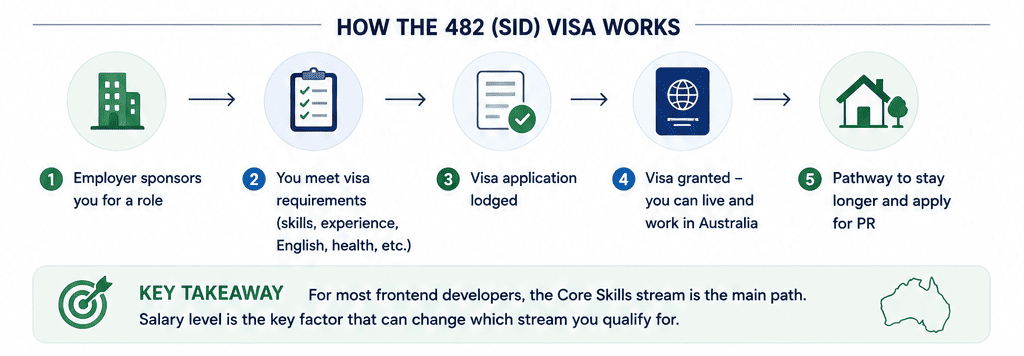
If you're applying for a frontend role in Australia as a non-citizen, the visa most employers will sponsor you under is the subclass 482 - officially renamed the Skills in Demand (SID) visa when it replaced the Temporary Skill Shortage (TSS) visa on 7 December 2024. The subclass number stayed the same, which is why you'll still see "482" everywhere, including in job ads and on the Department of Home Affairs page for the visa itself. What changed underneath that number is what actually matters to you: the streams, the salary thresholds, and how fast an application moves.
Core Skills vs Specialist Skills stream - which applies to frontend roles
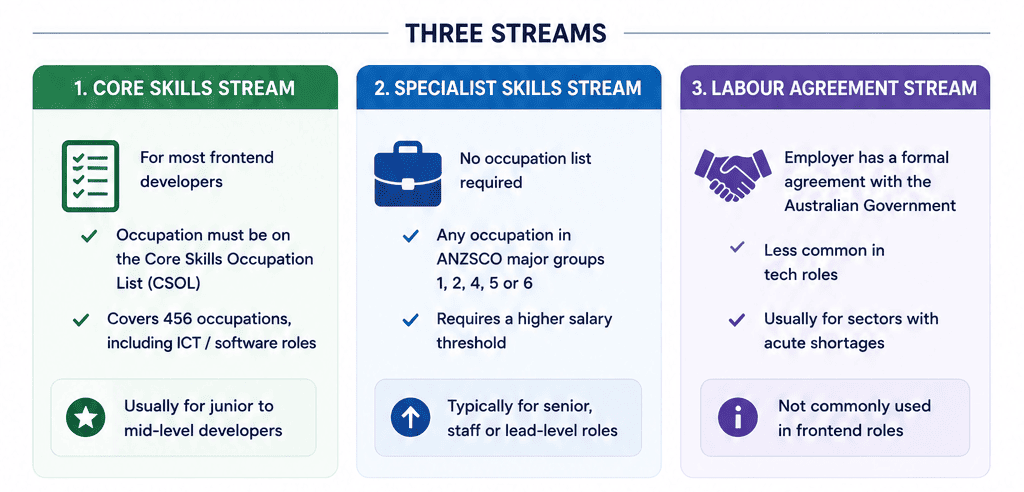
The SID visa has three streams, and which one applies to you is mostly decided by your salary, not your job title.
Core Skills stream is where almost every frontend developer lands. It requires your occupation to sit on the Core Skills Occupation List (CSOL), which covers 456 occupations identified as facing genuine workforce shortages, and ICT/software roles are included. You can check the current Core Skills stream requirements directly on the Department's site .
Specialist Skills stream doesn't require your occupation to appear on any list at all - it's open to any occupation in ANZSCO major groups 1, 2, 4, 5, or 6, provided your income clears the threshold. For most frontend developers this only becomes relevant once you're earning well above the Core Skills level - senior, staff, or lead-level compensation, sometimes with equity factored into guaranteed earnings. Details are on the Specialist Skills stream page .
There's also a Labour Agreement stream , used when an employer has negotiated a specific agreement with the Australian Government - this is uncommon for tech roles and mostly shows up in sectors with acute, government-recognised shortages.
For a junior or mid-level frontend developer, the practical answer is: you'll almost certainly go through Core Skills. The only reason to end up in Specialist Skills is salary, which is exactly why the next section matters more than the stream name.
Salary thresholds and how they affect your visa eligibility
This is the part most visa guides skip, and it's the one that actually decides whether an offer is sponsorable.
For the Core Skills stream, your salary has to clear the Core Skills Income Threshold (CSIT) - currently $76,515, rising to $79,499 from 1 July 2026. But clearing the CSIT alone isn't enough: your salary must also meet the Annual Market Salary Rate (AMSR) for the role and location - whichever figure is higher. In practice, this means a company can't sponsor you on paper at the bare minimum threshold if the going rate for a frontend developer in Sydney is well above that; they have to pay what the role actually commands in that market.
Compare that threshold to the salary data in the section above: a junior frontend developer's typical starting salary sits close to, or occasionally below, the CSIT - which is one of the practical reasons junior overseas hires are less common than mid-to-senior ones. A mid-level or senior frontend salary in Sydney or Melbourne clears the CSIT comfortably, which is why most sponsored frontend roles you'll see advertised are mid-level and above.
The Specialist Skills Income Threshold (SSIT) sits much higher - $141,210, rising to $146,717 from 1 July 2026. Very few individual-contributor frontend roles clear this on base salary alone; it's more realistic for staff-level, engineering-lead, or roles with substantial guaranteed bonuses or equity counted as income.
One detail worth knowing before you negotiate: these thresholds are indexed annually and rise every 1 July in line with wage growth. A salary that clears the threshold today could fall short next year if you're negotiating a contract that starts a few months out - worth flagging with your employer if your start date is close to a July 1 boundary.
Timeline - from job offer to visa grant
Processing times are the least predictable part of this process, and they've moved in the wrong direction recently. As of mid-2026, Core Skills stream cases are taking up to eight months to process, a noticeable slowdown from 2024-2025. Other estimates put the total timeline from sponsorship to visa grant for Core Skills applicants at 6 to 14 months, with the single biggest lever being whether your employer is already an approved sponsor before you apply - sponsorship approval alone can take up to five months for a first-time sponsor.
Specialist Skills applications move far faster: the Department's own target is a median processing time of 7 business days for decision-ready applications, though this only applies once you clear the much higher SSIT threshold.
A few things worth knowing if you're timing a relocation around this:
- Work experience requirement dropped. You now need at least one year of relevant work experience in the past five years, down from the previous two-year requirement - this opened the door for less experienced candidates than the old TSS visa allowed.
- Visa length. Once granted, the SID visa runs for up to four years, or five years for Hong Kong passport holders.
- Changing employers is more forgiving now. If your job ends, you get a 180-day grace period to find a new sponsor while keeping full work rights - up from the 60-90 days allowed under the old TSS visa. One catch worth knowing: time worked during that grace period doesn't count toward your two-year permanent residency requirement if your new employer's nomination hasn't been approved yet - sometimes called "dead time" by migration lawyers.
- Permanent residency comes next. After two years of full-time work with your sponsor, you become eligible for the Employer Nomination Scheme (subclass 186) visa through its Temporary Residence Transition stream, which leads to permanent residency.
The practical takeaway: budget for this to take the better part of a year from offer to landing in Australia, not weeks. If a recruiter tells you otherwise for a Core Skills role, treat that as optimistic rather than typical.
Frontend Developer Freelance Rates in Australia
Freelance and contract rates for frontend developers vary widely depending on client type, engagement length, and whether you're working through an agency or direct with a client - widely enough that a single "average day rate" figure is more misleading than useful. Rather than quoting one number that will be outdated by the time you read this, here's how to work out what you should actually be charging.
How to calculate your rate. Start from the annual salary a permanent employee at your level would earn (see the salary section above), then adjust upward - contractors typically charge 15-30% more than the equivalent salaried role, because that premium is covering what a permanent employee gets for free: paid leave, sick days, superannuation contributions, and the gaps between contracts when you're not earning at all. Divide your target annual figure by roughly 1,600-1,800 billable hours a year - not 2,080 (a full-time work-year), because you won't bill every hour of every week once you account for admin, downtime between contracts, and unpaid pursuit of new work. That gives you a realistic hourly baseline you can adjust from based on demand for your stack and how in-demand your specific skills are.
Where to look for freelance and contract work:
- SEEK and LinkedIn - filter specifically for "contract" roles rather than permanent; the volume is smaller but the listings tend to state day rates more often than permanent job ads state salaries.
- Specialist tech recruitment agencies - firms that place contractors regularly (rather than general staffing agencies) usually have a clearer sense of current market rates and won't waste your time with roles outside your rate range.
- Direct client relationships and referrals - a large share of ongoing freelance work in Australia's tech scene comes through word of mouth rather than job boards, particularly once you've delivered for one client who then refers you to another.
- Platforms like Upwork or similar freelance marketplaces - useful for building an initial portfolio or bridging gaps, but rates here are typically well below what direct clients or agency-sourced contracts pay, especially once platform fees are factored in.
What to watch for before signing anything:
- ABN vs employee-like arrangement. Most contract work in Australia requires you to operate under an Australian Business Number (ABN) as a sole trader or through your own company structure. If a "contract" role in practice controls your hours, tools, and work location the way an employee's would, it may not legally qualify as genuine contracting - this affects your tax obligations and protections, so it's worth understanding before you commit, not after.
- GST registration. If your annual turnover from contracting is likely to exceed the GST threshold, you'll need to register for GST and add it to your invoices - factor this into your rate rather than discovering it's expected to come out of what you already quoted.
- Superannuation. As a genuine contractor, you're generally responsible for your own superannuation contributions - this isn't automatically paid on your behalf the way it is for an employee, and it's a common blind spot for developers moving from full-time roles into contracting for the first time.
- Payment terms. Get these in writing before starting - 30-day payment terms are common, but some clients push for 45 or 60 days, which materially affects your cash flow if you're relying on that income to live on.
- Scope creep. Fixed-price contracts without a clearly defined scope are where freelance work quietly stops paying what it should. A day-rate or hourly arrangement protects you far better than a fixed project price when requirements are likely to shift.
- Visa status matters here too. Not every visa that permits salaried employment automatically permits self-employed contracting - if you're on a sponsored visa like the 482/Skills in Demand visa, check your visa conditions before taking on contract work outside your sponsoring employer, since sponsorship is generally tied to a specific employer and role.
If you're new to contracting in Australia, it's worth a short paid consultation with an accountant before your first contract - the tax and structuring decisions you make early are much easier to set up correctly from the start than to unwind later.
Companies Sponsoring Frontend Developers in Sydney and Melbourne
Not every company hiring frontend developers in Sydney or Melbourne is set up to sponsor a visa - becoming an approved Standard Business Sponsor involves its own paperwork and ongoing compliance obligations, and plenty of employers simply don't bother unless they're consistently short on local talent. That's worth knowing before you start applying broadly: a job ad with no mention of visa sponsorship usually means the company isn't set up for it, not that they've forgotten to mention it.
The employers that do sponsor tend to cluster into a few recognisable types rather than being spread evenly across the market - large multinational tech companies with a Sydney or Melbourne office, banks and fintechs with sizeable in-house engineering teams, consulting and systems-integration firms staffing client projects, and homegrown Australian SaaS companies that have scaled past the point of hiring locally only. The table below breaks these down along with what each type is typically looking for and which visa stream they tend to sponsor under.
| Company | City | Role |
| DECK2 Employment Services Pty Limited | Sydney (Manly) | Front End Developer |
| SolveXia | Sydney | Front End Developer |
| Martian Logic (MyRecruitment+) | Sydney | Frontend Developer |
| Stockland | Sydney | Front End Developer - 12 Month Contract |
| Avanade | Sydney | Front-end Developer |
| Hey Frank.io | Melbourne | Frontend Developer {URGENT} |
One caveat before you use it: sponsor status isn't permanent. A company that sponsored visas last year may have changed policy, and one that didn't may have started. Treat this table as a starting point for research, not a guarantee - check a company's current sponsorship activity on their careers page or a recent job ad before assuming it applies to you.
What each type of employer is usually looking for:
- Large multinational tech companies tend to hire for React or Vue-based product teams, often at mid-to-senior level, and expect strong fundamentals in TypeScript, testing, and component architecture over familiarity with any one specific framework version.
- Banks and fintechs frequently look for frontend developers comfortable working inside larger, more regulated codebases - Angular still shows up here more than in startups - with an emphasis on accessibility, security awareness, and working alongside dedicated QA and compliance teams.
- Consulting and systems integration firms hire across a wider range of seniority and stacks, since the work changes project to project. They tend to value adaptability and client-facing communication as much as pure technical depth.
- Australian-grown SaaS companies usually want developers who can move fast in a smaller team, often with a modern stack (React/Next.js, TypeScript), and who are comfortable owning a feature end-to-end rather than working within a large, siloed frontend team.
How to Get a Frontend Developer Job in Australia?
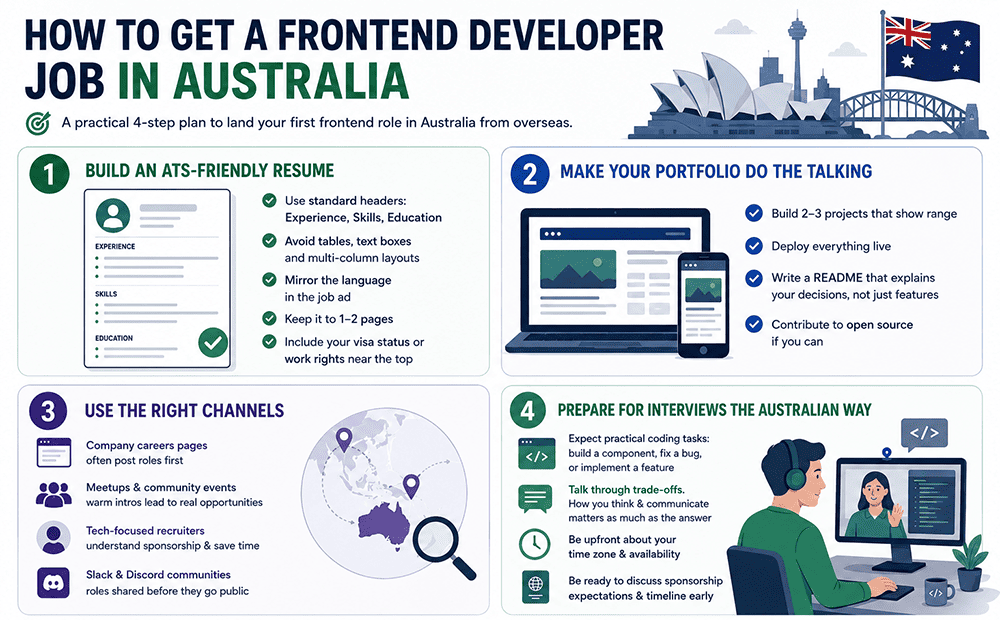
Getting a frontend job in Australia from overseas isn't fundamentally different from getting one anywhere else - but the market has specific expectations around how you present yourself, and skipping them is the fastest way to get filtered out before a human even reads your application. Here's the sequence that actually works.
Step 1: Build a resume that passes ATS screening
Most mid-size and large Australian employers run applications through an applicant tracking system before a recruiter sees them. A resume that reads well to a person but confuses the parser gets discarded regardless of how strong your experience is.
- Use standard section headers (Experience, Skills, Education) - creative labels like "My Journey" get misread or skipped entirely.
- Avoid tables, text boxes, and multi-column layouts. ATS parsers frequently scramble or drop content inside them.
- Mirror the language in the job ad. If the listing says "React" and you wrote "ReactJS," the keyword match can fail on an exact-string parser.
- Keep it to one or two pages. Australian recruiters skim fast, and a bloated resume signals you haven't prioritised what matters.
- List your visa status or work rights explicitly near the top if you're applying from overseas - recruiters need this to decide whether to even open the rest of the application.
Step 2: Make your portfolio do the talking
A GitHub profile full of tutorial clones doesn't tell an employer anything they can't get from a hundred other candidates. What gets attention is evidence you can own a real problem end-to-end.
- Pick two or three projects that show range - one that demonstrates UI/interaction polish, one that shows you can work with real data or an API, one that reflects the kind of stack the roles you're targeting actually use.
- Deploy everything live. A link to a working app beats a link to a repo someone has to clone and run locally.
- Write a short README explaining the decisions you made, not just what the project does. Employers care more about why you chose a state management approach than that you used one.
- If you don't have production experience yet, contributing to an open-source project used by real teams carries more weight than another solo build.
Step 3: Use the right channels - not just job boards
SEEK and LinkedIn are the obvious starting points, and you should be on both, but they're also where every other applicant is looking. A few channels punch above their weight for tech specifically:
- Company careers pages directly - many mid-size tech companies post roles there before or instead of SEEK.
- Meetup and community events in Sydney and Melbourne, even attended remotely or followed online - a surprising number of frontend hires in Australia come through warm introductions rather than cold applications.
- Recruiters who specialise in tech, not general staffing agencies - they understand visa sponsorship constraints and won't waste your time on roles that were never going to sponsor.
- Slack and Discord communities for Australian developers, where companies sometimes post roles before they go public.
Step 4: Prepare for interviews the Australian way
Technical interview formats in Australia broadly follow the same pattern as the UK and Canada - less algorithmic whiteboarding than the US big-tech style, more emphasis on practical coding, system design at a smaller scale, and a genuine culture-fit conversation that isn't just a formality.
- Expect a take-home or live coding exercise built around a realistic UI task - building a small component, fixing a bug in existing code, or implementing a feature from a spec - rather than abstract algorithm puzzles.
- Be ready to talk through trade-offs out loud. Interviewers are often evaluating how you think and communicate as much as whether you land on the "right" answer.
- If you're interviewing from a different time zone, be upfront about availability early - Australian teams are used to working with candidates across APAC and beyond, but scheduling friction left unaddressed can quietly cost you a slot.
- For visa-sponsored roles, expect a direct conversation about sponsorship expectations and timeline fairly early in the process - companies that sponsor want to know you understand what you're both signing up for.
The stack that actually matters in Australia
- React remains the dominant framework across the majority of frontend roles, from startups through to enterprise
- TypeScript is close to a baseline expectation now, not a nice-to-have, even at mid-level
- Next.js shows up frequently in product companies and SaaS businesses building anything with server-rendered pages
- Angular still has a real footprint in banking, government, and larger enterprise environments
- Vue appears less often than React but shows up consistently in specific pockets, particularly agencies and some SaaS teams
- Testing tools - Jest, React Testing Library, Playwright, or Cypress - are commonly expected, not optional, even for mid-level roles
- Tailwind CSS has become the default styling approach at a large share of product companies, ahead of CSS-in-JS alternatives
- Basic familiarity with accessibility standards (WCAG) is increasingly checked for in interviews, particularly at banks, government-adjacent employers, and larger companies
- GraphQL and REST API integration experience is expected as standard, with GraphQL more common at larger or more mature engineering teams
- Git and standard CI/CD workflows are assumed baseline knowledge, rarely tested directly but expected to be second nature
Conclusion
The frontend job market in Australia rewards developers who show up with specifics, not enthusiasm. A recruiter or hiring manager can tell within a few messages whether you understand that your target salary needs to clear a visa threshold, whether your portfolio reflects the stack their team actually uses, and whether you know the difference between a contract rate and a sponsored salary - versus someone who's applying broadly without having done that homework.
Salary thresholds reindex every 1 July, processing times shift as the Department's caseload changes, and a company's sponsorship status this year says nothing about next year. Treat the numbers here as a starting point for your own research, not a final answer - and treat any visa-specific question that has real consequences for you as a reason to talk to a registered migration agent, not a blog post.
If there's one thing worth taking away, it's this: the salary you're offered and the visa you qualify for aren't two separate conversations. A number that looks generous on its own might sit right at the edge of what a sponsor can actually support, or well above what the role needs to clear. Knowing where your offer sits against the current thresholds - before you negotiate, not after - is the difference between a smooth relocation and a stalled one.
FAQ about Frontend Developer Job in Australia
Do I need a visa to work as a frontend developer in Australia?
Yes, unless you're an Australian or New Zealand citizen, or already hold a visa with work rights (such as a partner or graduate visa). Most overseas developers work under an employer-sponsored visa, typically the subclass 482 Skills in Demand visa. Without a visa granting work rights, you can't legally take paid employment in Australia, regardless of the offer on the table.
What is the difference between the old 482 (TSS) visa and the Skills in Demand visa?
The subclass number stayed the same, but the structure changed completely on 7 December 2024. The old Temporary Skill Shortage visa had two streams tied to separate occupation lists. Skills in Demand replaced these with three salary-based streams, a single consolidated 456-occupation list, required work experience dropped from two years to one, and the employer grace period extended from 60-90 days to 180.
What salary do I need to qualify for visa sponsorship as a frontend developer?
For the Core Skills stream, which covers most frontend roles, your salary needs to clear the Core Skills Income Threshold - $76,515, rising to $79,499 from 1 July 2026 - or the market rate for your role and location, whichever is higher. Reaching the much higher Specialist Skills threshold ($141,210, rising to $146,717) opens a separate, faster-processing stream, but that's out of reach for most individual-contributor roles.
How long does it take to get an employer-sponsored visa in 2026?
Budget for 6 to 14 months from job offer to visa grant under the Core Skills stream, with some cases now taking up to 8 months as processing has slowed since 2024. If your employer isn't already an approved sponsor, add up to 5 months for that approval alone. Specialist Skills applications move far faster, often within days, but only apply above the higher salary threshold.
Can I apply for the 482 visa without a job offer?
No. The Skills in Demand visa is entirely employer-sponsored - you can't lodge an application independently or speculatively. An Australian business must first become an approved sponsor, then nominate you for a specific role before you can apply. This means the job search comes first; the visa process only starts once an employer has committed to sponsoring you.
Should I look for contract work or a permanent role in Australia?
It depends on what you're optimising for. Contract roles typically pay 15-30% more on paper but come with no paid leave, no job security between contracts, and generally aren't eligible for visa sponsorship. Permanent roles offer sponsorship pathways, stability, and a route to permanent residency through the 186 visa - which makes them the more practical option if relocation is the goal.
Can I work remotely for an Australian company without living in Australia?
Yes, and this is increasingly common - many Australian companies hire frontend developers remotely as contractors or through an Employer of Record, without any visa involved, since you're not physically working in the country. This won't lead to Australian residency or a visa pathway, but it's a realistic way to work with Australian teams, build local references, and earn in AUD before pursuing relocation separately.