
Frontend Developer Jobs in Sweden: A 2026 Relocation Guide
19 August 2026
330 views
This guide is up to date as of October 2026

Written by
Marcus Hale,
IT Talent Acquisition Specialist

Reviewed by
Elin Lindberg,
Senior IT Recruiter, Sweden
Stockholm has more unicorns per capita than London, New York, or Los Angeles - a fact that surprises most developers researching Sweden for the first time. Beyond the eye-catching stat, the practical draw for frontend engineers is simpler: a large share of tech job postings run entirely, and companies like Spotify, Klarna, and Ericsson have built engineering cultures where you can work, interview, and get promoted without speaking a word of Swedish.
This guide breaks down what a frontend developer actually needs to know before applying: realistic salary numbers, the 2026 work permit rules, which companies are hiring, and where to find listings that don't require local language fluency.
Why Sweden Is a Strong Option for Frontend Developers?
Sweden solves a problem that trips up developers considering other European markets: the language barrier. In most tech companies here, English isn't a courtesy extended to foreign hires - it's the default. Spotify runs its engineering org in English. So does Klarna. Ericsson, despite being a century-old Swedish institution, staffs its Kista R&D hub with engineers from dozens of countries and conducts technical work in English as a matter of course. This matters more than it might seem: it means you can clear interviews, read documentation, join stand-ups, and get code reviewed without a language course standing between you and the job.
The second reason is Stockholm itself. According to StartupBlink, the city's combined startup value sits at roughly $132.9 billion, and all eight of Sweden's unicorns - Spotify, Klarna, King, Mojang, Truecaller, Voi, Northvolt, and Tink among them - are headquartered there. The European Commission named Stockholm Europe's most innovative region in 2025, and the density of high-value startups per resident outpaces every other region in the world except Silicon Valley. For a frontend developer, that density translates into something concrete: a large, active pool of companies competing for the same relatively small talent supply, which keeps hiring appetite high even when other markets slow down.
The third piece is the employer base itself. This isn't a market where a handful of companies absorb all the demand - it spans global consumer platforms, fintech unicorns, gaming studios, and a steady stream of well-funded scaleups, all of which are covered in detail further down.
Frontend Developer Salaries in Sweden in 2026
Salary data for frontend roles in Sweden varies more than you'd expect from one source to the next, and it's worth understanding why before looking at numbers. Sweden's largest employers are bound by collective bargaining agreements negotiated between unions like Unionen and employer associations such as Almega, and these agreements tend to compress senior-level pay bands rather than let them stretch upward freely.
Frontend developer salaries in Sweden vary substantially by source, seniority, location, company type, and whether the figure includes bonuses or benefits. A reasonable nationwide estimate is approximately SEK 445,000-588,000 per year, with a median close to SEK 471,700.
Figures below are gross annual compensation unless stated otherwise. EUR conversions use an approximate rate of SEK 11.5 = €1, so they are indicative rather than exact.
Sweden-wide salary ranges
| Level | Salary range (SEK/year) | Approx. EUR |
| Entry-level, 1-3 years | SEK 410,000-419,000 | €35,700-€36,400 |
| Junior to mid-level | SEK 445,000-520,000 | €38,700-€45,200 |
| Mid-level, typical market range | SEK 500,000-600,000 | €43,500-€52,200 |
| Overall market average | SEK 445,000-588,000 | €38,700-€51,100 |
| Overall median estimate | Around SEK 471,700 | Around €41,000 |
| Senior, 8+ years | SEK 660,000-716,000 | €57,400-€62,300 |
| Senior, upper market / top 10% | SEK 700,000+ | €60,900+ |
Sources:
- SalaryExpert - Front-End Developer Salary in Sweden
- ERI SalaryExpert - Front-End Developer Salary in Stockholm
- PayScale - Front-End Developer / Engineer Salary in Sweden
- WorldSalaries - Front-End Developer Salary in Sweden
SalaryExpert’s Sweden estimate is higher than some other datasets: it reports approximately SEK 599,292 as the average, SEK 418,603 for entry-level developers, and SEK 743,980 for senior developers. WorldSalaries lists a lower nationwide benchmark of roughly SEK 445,100 for a frontend developer. These figures illustrate why a range is more useful than a single “average.”
Stockholm salary ranges
Stockholm generally pays more than the Swedish average, particularly for developers working at internationally oriented product companies, fintechs, SaaS companies, and large technology employers.
| Level | Salary range (SEK/year) | Approx. EUR |
| Entry-level frontend developer | SEK 430,000-500,000 | €37,400-€43,500 |
| Mid-level frontend developer | SEK 550,000-650,000 | €47,800-€56,500 |
| Stockholm median estimate | SEK 626,000-635,000 | €54,400-€55,200 |
| Senior frontend developer | SEK 700,000-900,000 | €60,900-€78,300 |
| Senior / staff at highly competitive firms | SEK 1,000,000-1,800,000 total compensation | €87,000-€156,500 |
Sources:
- SalaryExpert - Front-End Developer Salary in Stockholm
- ERI SalaryExpert - Front-End Developer Salary in Stockholm
- WorldSalaries - Front-End Developer Salary in Stockholm
- Jobnet - Frontend Developer Salary Statistics
SalaryExpert reports a Stockholm frontend developer average of approximately SEK 634,808-635,273 in 2026. Other datasets show lower figures, including a Stockholm median around SEK 539,800, which likely reflects differences in job definitions, sample composition, and whether benefits are included.
Stockholm’s cost of living is approximately 22% higher than the Swedish national average, so the salary premium does not translate directly into equivalent additional purchasing power.
Stockholm software engineer context
For comparison, the broader software engineer market in Stockholm has a median total compensation of approximately SEK 620,000 per year, or around €54,000. This category includes backend, platform, infrastructure, and full-stack roles, so it is not directly interchangeable with frontend salary data.
At the upper end of the market, senior and staff engineers at companies such as Spotify, Klarna, Stripe, and Databricks can reach approximately SEK 1.0-1.8 million in total annual compensation, particularly when bonuses, equity, and other benefits are included. Reported examples include senior compensation ranges of roughly SEK 900,000-1,500,000 at Spotify and SEK 1,100,000-1,600,000 at Databricks.
The salary figures should be treated as market estimates, not official government statistics. The sources use different methodologies and may measure base salary, total compensation, job-title categories, or different groups of employees. For that reason, the tables intentionally present ranges such as SEK 445,000-588,000 nationally and SEK 626,000-635,000 for the Stockholm median/benchmark, rather than presenting one number as universally correct.
Frontend Stack for Swedish IT Companies
The most transferable stack for frontend roles in Sweden is TypeScript + React, supported by modern testing, API integration, cloud deployment, and CI/CD practices. Vue.js and Angular are also valuable, especially in enterprise companies and consulting environments.
| Stack area | Technologies to learn | Why it matters in Sweden |
| Core frontend development | HTML5, CSS3, JavaScript, TypeScript | These are the foundation of almost every modern frontend role. TypeScript is especially important for maintainable applications, typed APIs, large teams, and enterprise-scale codebases. Swedish job postings commonly request strong JavaScript/TypeScript skills together with semantic HTML and responsive CSS. |
| Primary framework | React, Next.js, React Native | React is the safest primary choice for Stockholm product companies, fintechs, SaaS companies, and international employers. Next.js is useful for SEO, server-side rendering, performance, and full-stack web applications; React Native adds value for companies building mobile products. Spotify, Fairlo, Lysa, and other Swedish employers reference React-based development. |
| Alternative frameworks | Vue.js, Angular, Svelte | Vue.js and Angular remain relevant in Swedish enterprise, consulting, logistics, telecom, and public-sector projects. Svelte is less dominant but can differentiate a candidate in smaller product teams. Job-market listings show Swedish roles using React, Angular, Vue.js, and occasionally Svelte, so framework flexibility is valuable. |
| State management and data fetching | Redux, Zustand, TanStack Query, RxJS, GraphQL/Apollo | Large frontend applications require predictable state management and efficient server-state handling. TanStack Query and GraphQL are particularly useful for dashboards, fintech products, data platforms, and complex SaaS applications. Swedish frontend postings mention Redux, Zustand, TanStack Query, RxJS, GraphQL, and Apollo Federation. |
| Backend and API integration | Node.js, Express/NestJS, REST, GraphQL, PostgreSQL | Frontend engineers in Sweden are frequently expected to work across team boundaries and understand the APIs behind their interfaces. Node.js is useful for full-stack roles, backend-for-frontend services, and tooling, while REST and GraphQL are essential for integrating product and platform services. |
| Testing and quality | Vitest, Jest, React Testing Library, Playwright, Cypress, ESLint | Automated testing is a common expectation in mature Swedish engineering organizations. Unit, integration, and end-to-end tests help teams ship safely, especially in fintech, healthcare, telecom, and high-traffic consumer products. Swedish job descriptions specifically mention Vitest, Jest, React Testing Library, Playwright, and testing-focused CI workflows. |
| Cloud, DevOps, and delivery | Git & GitHub, Docker, AWS/Azure/GCP, Vite/Webpack, CI/CD | Production frontend work includes builds, deployments, observability, caching, and collaboration with platform teams. AWS, Azure, and GCP are all relevant; GitHub Actions and other CI/CD systems are common for automated testing and deployment. Vite, Webpack, Rollup, Docker, and infrastructure-as-code knowledge are useful supporting skills. |
For the strongest employability across Swedish product companies, build your skills in this order:
- TypeScript, React, HTML, and CSS.
- Next.js and modern frontend architecture.
- REST APIs, GraphQL, Node.js, and PostgreSQL.
- Testing with Vitest or Jest, React Testing Library, and Playwright.
- GitHub Actions, Docker, and one major cloud platform.
- Vue.js or Angular as a second framework.
- Performance, accessibility, SEO, and design-system development.
Sweden's Work Permit Rules for IT Professionals (2026 Update)
Sweden overhauled its work permit system on 1 June 2026, and the changes go deep enough that anything you read pre-reform - including plenty of articles still ranking in search results - is describing a system that no longer exists. If a source you're reading cites a SEK 13,000 or SEK 27,000 monthly salary floor, that's the old regime. Treat those numbers as historical, not current, and check everything below against the primary sources linked at the end of this section before you act on it.
The standard salary threshold
As of 1 June 2026, a work permit application must show a monthly salary of at least SEK 33,390, calculated as 90% of the median salary in Sweden. This is the figure that governs the overwhelming majority of applications, and for a frontend developer, it's almost always the number to plan around - most mid-level and senior frontend salaries in Stockholm clear this threshold comfortably, but it's worth checking your specific offer against it rather than assuming.
The threshold isn't a fixed policy number set once and left alone. It's derived from Statistics Sweden's ongoing median salary calculation, which gets updated periodically, and the government has signaled it will keep reviewing the figure going forward. That means the SEK 33,390 number is accurate as of this writing but not guaranteed to still be current a year from now. If you're job hunting several months out from reading this, it costs nothing to re-check the figure before your employer files.
One detail worth being precise about: this is a salary floor, not a target. Employers aren't required to pay exactly SEK 33,390 - they need to pay at least that much, and the actual number on your contract needs to reflect real market terms, since Migrationsverket also checks that the offered salary and conditions match Swedish collective agreements or industry standards, not just the bare legal minimum.
The lower threshold - and why it usually doesn't apply to frontend roles
A separate, reduced threshold of SEK 27,825 per month - 75% of the median - exists for a government-published list of 27 occupations experiencing documented labour shortages. It's tempting to assume "IT" as a broad category qualifies, but the list is narrower and more operational than that: it leans toward IT operations staff, systems administrators, network technicians, and comparable infrastructure roles, along with a scattering of other shortage professions like welders and maintenance mechanics. Frontend and software development roles generally aren't on it.
There are two additional low-threshold pathways worth knowing about even though most frontend candidates won't use them. One covers employees joining startups in tech or life-science that are under five years old and have fewer than 100 staff, vetted through Vinnova, Sweden's innovation agency - relevant mainly if you're joining a very early-stage company rather than an established employer. The other applies to foreign-trained health professionals working toward Swedish licensure, which has no real overlap with software roles. For a frontend developer evaluating an offer from a typical Swedish tech employer, the practical takeaway is simple: build your expectations, and your negotiation, around the standard SEK 33,390 threshold rather than assuming a shortage-occupation exception will apply.
EU Blue Card
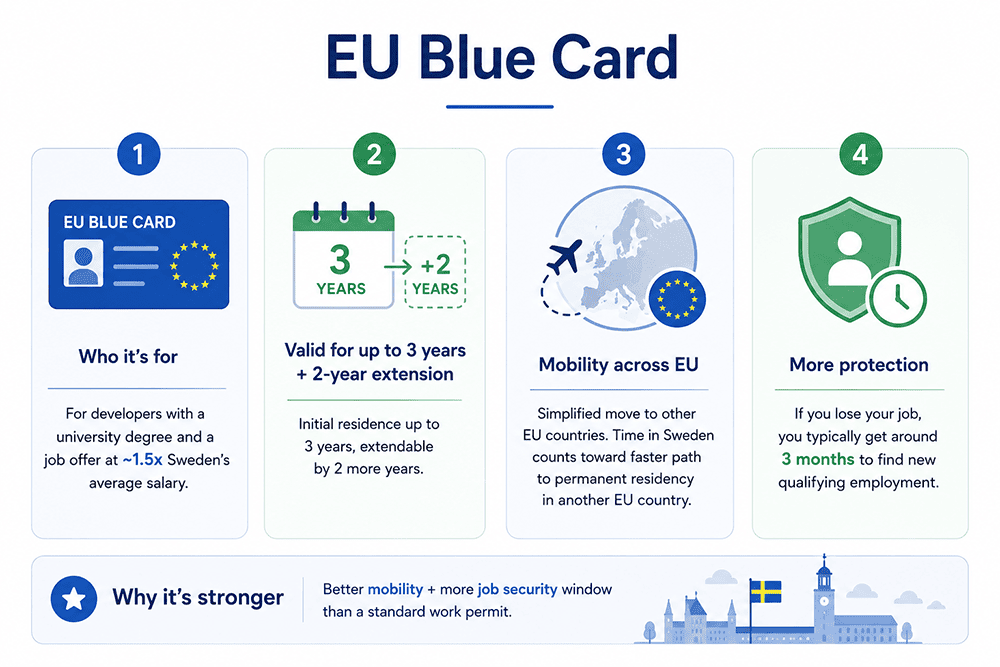
For developers with a university degree and a job offer at roughly 1.5 times Sweden's average salary, the EU Blue Card is usually the stronger route compared to a standard work permit, and it's worth asking your prospective employer which one they intend to file under. It grants an initial residence period of up to three years, with a further two-year extension available, and it carries a meaningful advantage the standard permit doesn't: simplified mobility rights across other EU countries. If your career takes you elsewhere in Europe a few years down the line, time spent in Sweden under a Blue Card counts differently than time under a standard permit, which can shorten the path to permanent residency in a second EU country.
The Blue Card also extends some protections that matter in practice, not just on paper. If you lose your job partway through the permit period, you typically get a window - commonly cited as around three months - to find new qualifying employment before your status is affected, which gives more breathing room than losing a standard work permit tends to.
Certified employers and processing speed
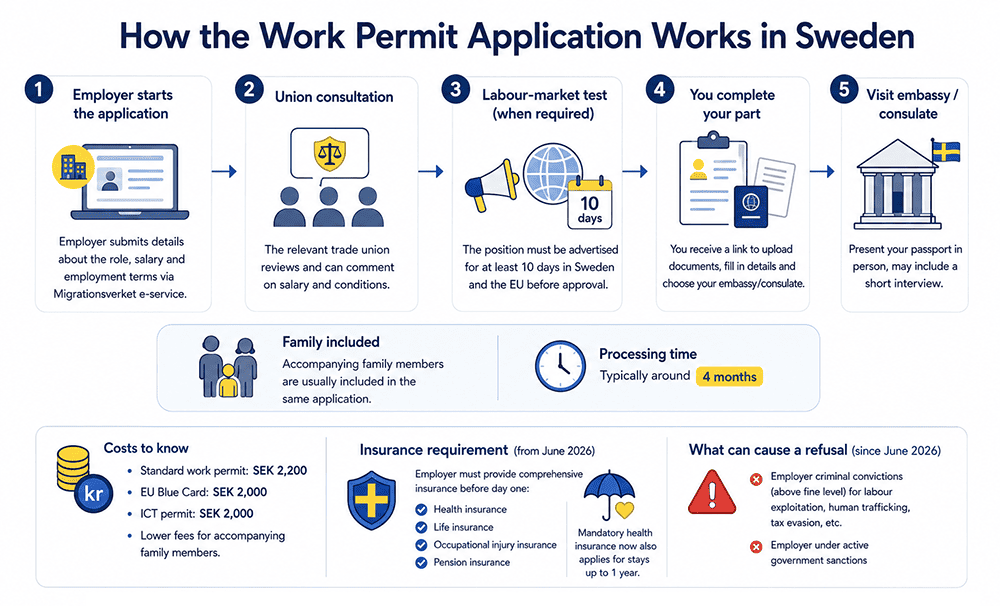
Processing time depends heavily on who's hiring you, and the gap between the slow and fast paths is large enough to factor into how you evaluate competing offers. A standard application currently takes around four months to decide. If your employer holds "certified employer" status with the Swedish Migration Agency, the same application can be processed in roughly 30 days instead.
Certification isn't something a candidate applies for - it belongs to the company, and it signals that Migrationsverket has already reviewed the employer's track record on things like paying correct salaries, meeting insurance obligations, and following labour-market rules for previous hires. Larger, established tech employers are more likely to hold this status than small startups making their first international hire, though it's not guaranteed either way. It's a reasonable, non-awkward question to raise during the interview process - "are you a certified employer with Migrationsverket?" - especially if you're weighing a move against a fixed timeline, like a lease ending or a visa expiring elsewhere.
How the application actually works
The employer initiates the process, not the candidate. Once you've signed an employment agreement, your employer starts the application through Migrationsverket's e-service and submits information about the role, the salary, and the employment terms. Before the application can move forward, the relevant Swedish trade union for that industry is given the opportunity to review and comment on the salary and conditions - a formal consultation step with no real equivalent in most non-European hiring processes, and one that occasionally surprises candidates who assume a private employer can simply set terms unilaterally.
Unless the employer is certified or another exemption applies, the position also has to clear a labour-market test: it must be advertised for at least 10 days across both Sweden and the EU before a non-EU candidate can be approved for it. This is meant to demonstrate the role genuinely couldn't be filled locally or from within the EU/EEA first, and it's one reason the standard timeline runs to four months rather than something shorter.
Once the employer's side of the application is complete, you receive an email with a link to your portion of the e-service, where you fill in personal details and upload supporting documents - typically a passport copy and evidence of your education or relevant work experience. You'll also indicate which Swedish embassy or consulate-general you want to use to present your passport in person; in some cases, that visit includes a short interview rather than just document verification. If family members are relocating with you, their information and applications are typically handled alongside yours in the same process.
A few practical costs worth budgeting for: the application fee for a standard work permit is SEK 2,200, with EU Blue Card and ICT permit applications each carrying a SEK 2,000 fee; accompanying adult family members and children have separate, lower fees. As of the June 2026 reform, employers are also required to arrange comprehensive insurance coverage for the employee - health, life, occupational injury, and pension insurance - before the first day of work, and mandatory health insurance now applies specifically for stays of up to one year.
It's also worth knowing what can sink an otherwise straightforward application. Since 1 June 2026, employers with criminal convictions above fine-level - for labour exploitation, human trafficking, or tax evasion, for example - can have applications refused outright, as can cases involving employers under active government sanctions. This is a check on the employer, not the employee, but it underscores why researching a company's standing before accepting an offer isn't just about culture fit - it can affect whether the permit goes through at all.
Renewing an existing permit
If you already hold a Swedish work permit and are extending it, there's a transitional window worth understanding rather than assuming the new rules apply immediately across the board. Extension applications registered between 1 June and 1 December 2026 are still evaluated under the pre-reform rules, not the new SEK 33,390 threshold - a six-month grace period built into the reform specifically to avoid disrupting people already living and working in Sweden under the old terms. Anything registered from 2 December 2026 onward falls under the new requirement regardless of when your original permit was first issued.
There's also a longer-term path worth keeping in mind if Sweden is a multi-year plan rather than a short stint: if you've worked in Sweden on a work permit for at least four years within the past seven, you can apply for a permanent residence permit at the same time as your extension application, rather than treating the two as separate processes down the line.
Work permit rules are also one of the areas most likely to shift again after this guide is published - reforms of this size tend to get refined in the following one to two years as edge cases surface. Before making any decisions based on the figures above, verify them directly against the Swedish Migration Agency's official pages for employees applying for a work permit and the Swedish government's official guide to work permits at sweden.se.
Swedish IT Companies Hiring Frontend Developers
Frontend hiring in Sweden isn't concentrated in one or two flagship names - it spans a genuinely wide range of company types, and that variety matters when you're deciding where to focus a job search.
At the top sit global consumer platforms like Spotify and King, where frontend teams work on products used by hundreds of millions of people. Alongside them are homegrown fintech and B2B players such as Klarna and Tink, still hiring aggressively despite years of maturity. Legacy engineering institutions like Ericsson continue recruiting frontend developers for internal tooling and product interfaces, often overlooked by candidates chasing startup names.
A layer of well-funded scaleups - Truecaller, Voi, Sana, and others - offers a different kind of role: smaller teams, faster iteration, and more individual ownership over what ships. International companies with a Stockholm presence, including Stripe and Databricks, round out the picture with roles that pay closer to global bands than local Swedish ones.
Large technology and product companies
| Company | Company context |
| Spotify | Stockholm-founded global audio-streaming company with a large engineering organization and strong product-engineering culture. Its engineering roles commonly cover web applications, platform products, design systems, and full-stack development; English is widely used in international teams. Spotify’s careers listings include Stockholm-based engineering positions and frontend-related roles such as Frontend Engineer, Music. jobs. |
| Klarna | International fintech company focused on payments, shopping, and consumer finance. It is a relevant target for React, React Native, TypeScript, JavaScript, Node.js, and full-stack developers working on customer-facing financial products. Klarna’s Stockholm engineering roles include client-platform and JavaScript-focused positions. |
| Ericsson | Major telecommunications and networking company with its Swedish headquarters in Kista, Stockholm. Frontend opportunities may appear within cloud platforms, network-management tools, developer portals, internal products, and enterprise software. Ericsson recruits across software, product, security, and verification disciplines. |
| King | Stockholm-based game developer owned by Microsoft through Activision Blizzard. King’s Stockholm studio employs hundreds of people and develops large-scale mobile games, making it relevant for UI, web tooling, game-platform, and product-engineering roles. |
| Mojang Studios | Microsoft-owned creator of Minecraft, founded in Stockholm. Frontend opportunities may be less frequent than gameplay or platform roles, but the company is relevant for engineers interested in creator tools, web-based experiences, game services, and internal development platforms. Mojang’s Stockholm engineering roles use a hybrid model and collaborate internationally. |
Startups and scaleups
| Company | Company context |
| Truecaller | Stockholm-based communication and caller-identification platform with a global user base. It is a particularly relevant target for web engineers because its career listings have included staff-level web roles involving frontend architecture, Vue.js, TypeScript, performance optimization, API integration, and responsive UI development. |
| Voi Technology | Stockholm-headquartered micromobility company operating shared electric scooters and bikes across Europe. Frontend roles may be connected to rider applications, fleet-management dashboards, operations software, maps, payments, and internal tools. Voi’s R&D organization includes software engineers, product developers, and data specialists in Stockholm and Gothenburg. careers. |
| Tink | Stockholm-founded open-banking platform owned by Visa. Tink builds financial-data connectivity and payment infrastructure, creating potential opportunities for frontend engineers working on dashboards, developer tools, financial interfaces, and enterprise products. Its careers page directs applicants to current Tink and Visa openings. |
| Sana | Stockholm AI and learning-technology scaleup building AI-powered tools for workplace learning, knowledge access, and productivity. Frontend developers may be relevant for its web products, AI interfaces, design systems, and application experience. Sana explicitly recruits engineers for its Stockholm office and operates a flexible hybrid model. |
| Northvolt | Battery and energy-technology company rather than a conventional frontend employer. It is worth monitoring for frontend work on manufacturing dashboards, operational systems, data visualization, logistics platforms, and internal enterprise applications. Northvolt’s hiring has included international recruitment and support for relocation and immigration processes. |
| Einride | Swedish transport-technology company developing electric and autonomous freight systems. Frontend opportunities are more likely to involve fleet-management platforms, logistics dashboards, route planning, telemetry, and customer-facing operations software than consumer websites. |
International companies in Stockholm
| Company | Company context |
| Stripe | Global payments infrastructure company with a strong focus on developer-facing products and high-quality web interfaces. Its frontend engineers work on complex dashboards, payment workflows, design systems, and merchant-facing tools; Stripe’s official listings explicitly describe frontend work on the Dashboard product. |
| Databricks | International data, analytics, and AI platform company with a presence in Stockholm. Frontend work can involve data-intensive enterprise interfaces, notebooks, dashboards, visualization, developer tools, and product experiences for data teams. The company’s official careers page lists current openings by location and discipline. |
Where to Find Frontend Developer Job Listings?
Finding a Swedish frontend role from outside the country comes down to knowing which platforms actually surface English-language listings, rather than scrolling through job boards built primarily for the domestic Swedish market. A few categories of resources consistently work better than a generic search.
International job boards with a Sweden filter
- LinkedIn Jobs - Sweden - the most reliable starting point for mid-to-senior roles; most Swedish tech companies post here first, and job descriptions posted in English are a strong signal that English is the actual working language, not just a translation courtesy.
- EURES - the European Union's official job mobility portal. Listings carrying an EURES label specifically indicate the employer welcomes applications from candidates outside Sweden, which is a useful filter in itself.
- Relocate.me - Web/Frontend jobs in Sweden - a smaller, niche board, but every listing on it comes from a company that has already committed to visa sponsorship and relocation support, which saves time compared to boards where that has to be confirmed manually.
Local Swedish platforms with a meaningful share of English listings
- The Local Jobs - run by an English-language news outlet aimed at Sweden's expat community, and one of the few Swedish-based boards where English postings are the norm rather than the exception, across IT, engineering, and other skilled sectors.
- Jobs in Stockholm - focused specifically on Stockholm-based roles for professionals and expats working in English, which makes it a tighter, less noisy alternative to a broader national search.
- Platsbanken (Arbetsförmedlingen) - Sweden's official, government-run job bank. Most listings default to Swedish, but it's worth checking directly: it's also where the Swedish Public Employment Service publishes the current list of shortage occupations, so it's a useful reference point for confirming whether a role you're eyeing could qualify for the reduced work permit salary threshold.
Company career pages, directly
For the larger employers named above, going straight to the source is often more productive than any job board. Spotify, Klarna, and Ericsson all maintain dedicated sections for international candidates - usually labeled something like "International candidates," "Relocation support," or "Working at [company] from abroad" - that spell out visa sponsorship, relocation packages, and what to expect from the hiring process as a non-EU applicant. These pages tend to be more current than third-party aggregators and often surface roles before they appear elsewhere.
One habit worth building regardless of where you search: check whether the listing itself states "visa sponsorship available" or equivalent language. Roles that don't mention it aren't necessarily closed to non-EU candidates, but confirming sponsorship before investing time in a tailored application avoids the frustration of getting through several interview rounds only to learn the company isn't set up to sponsor a work permit.
Conclusion
Sweden remains one of the few European markets where a frontend developer can build a full career in English, working at companies with the reach of Spotify and Klarna without ever needing fluent Swedish to do the job well. That opportunity comes with real trade-offs in 2026: the work permit salary threshold is higher than it used to be, and the process now demands more precision in how an application is put together.
At the same time, processing has gotten meaningfully faster for qualified candidates working with certified employers, which offsets some of that added friction. For developers weighing Sweden against other options, the combination of Stockholm's startup density, a genuinely English-speaking tech scene, and a clearer (if stricter) visa framework makes it worth serious consideration.
If you're comparing destinations, the rest of our relocation series covers frontend opportunities in several other countries worth putting side by side with Sweden.
Frequently Asked Questions
Do I need to speak Swedish to work as a frontend developer in Sweden?
Not to get hired or to do the job itself. English functions as the actual working language at most Stockholm tech companies, from Spotify and Klarna down to early-stage startups - code reviews, stand-ups, documentation, and Slack all run in English by default at most employers in this space. Where Swedish starts to matter is everything around the job rather than the job itself: casual conversation with colleagues at lunch, dealing with landlords and utility providers, reading mail from the tax authority, or navigating healthcare appointments.
Most international developers don't arrive fluent and aren't expected to. They pick up conversational Swedish gradually over their first year or two, treating it as something that improves daily life rather than a gate they need to clear before applying for roles.
How long does it take to get a Swedish work permit in 2026?
Timing depends almost entirely on your employer's status with the Swedish Migration Agency. A standard application currently takes around four months from submission to decision, which includes the mandatory labour-market test and trade union consultation built into the process. If your employer holds "certified employer" status, the same application can be resolved in roughly 30 days instead - a difference large enough to change how you plan a move, a lease, or a resignation date at a current job. Certification isn't something you control as a candidate, so it's worth asking directly during interviews whether the company holds this status, rather than discovering the timeline only after signing an offer and starting the paperwork.
What is the minimum salary required for a Sweden work permit?
As of 1 June 2026, the standard threshold for most work permit applications is a monthly salary of at least SEK 33,390, set at 90% of Sweden's national median salary and reviewed periodically as that median shifts. A separate, lower threshold of SEK 27,825 exists for a government-published list of 27 shortage occupations, but that list skews toward operational IT roles - systems administration, network technicians, IT operations - rather than software development.
Frontend developers shouldn't assume they qualify for the reduced figure based on a general "IT" label; the safer approach is building salary expectations and offer negotiations around the standard SEK 33,390 threshold, since most legitimate frontend offers in Stockholm clear it without difficulty.
Is Stockholm the best city for frontend developer jobs, or should I consider Gothenburg or Malmö?
For most candidates, yes - Stockholm holds the largest concentration of frontend roles, the highest salaries, and by far the deepest startup and scaleup ecosystem in the country, which means more employer variety and more room to move between companies later. Gothenburg and Malmö are worth serious consideration if lower rent and a quieter job market are acceptable trade-offs for you. Gothenburg's tech scene leans toward automotive and IoT work, anchored by Volvo Cars and Scania, which suits developers interested in that industry specifically. Malmö benefits from its proximity to Copenhagen, effectively giving residents access to two countries' job markets, plus a King office locally. Neither city offers Stockholm's density of pure frontend opportunities, but both come with a meaningfully lower cost of living.
Can I apply for Swedish frontend jobs without an existing offer, or do I need sponsorship lined up first?
You're free to search, apply, and interview for Swedish roles without any offer or sponsorship arrangement in place - nothing about the work permit process starts until an employer has actually extended you an offer and you've both signed an employment agreement. The practical constraint shows up in sequencing rather than eligibility: Swedish employers generally won't begin filing the work permit paperwork until after that agreement is in place, since the application itself requires details about your specific role, salary, and terms.
That means the visa process runs in parallel with, not ahead of, your job search - budget several additional months after accepting an offer before you're actually cleared to move and start work.