
Frontend Developer Salary in Austria in 2026: Complete Guide
05 August 2026
266 views
This guide is up to date as of October 2026


Written by
Marcus Hale,
IT Talent Acquisition Specialist

Reviewed by
Anna Gruber,
Senior IT Recruiter, Austria
Austria draws frontend developers with a stable economy, low unemployment, and one of the highest standards of living in the European Union. Vienna, Graz, and Linz host a growing mix of local product companies, banking and insurance firms, and international tech offices, giving frontend engineers steady demand across both enterprise and startup environments.
Salaries tell a more mixed story. Compared to Germany, Switzerland, or the Netherlands, Austrian frontend pay sits noticeably lower, and Vienna's cost of living - particularly rent - closes much of that gap in real terms. A developer weighing a move to Austria needs realistic numbers rather than marketing language, since the difference between gross salary figures and what actually lands in a bank account each month is substantial.
Frontend Developer Salary in Austria: 2026 Overview
Salary data for frontend developers in Austria varies sharply depending on the source, and the spread matters more than any single headline figure. Glassdoor reports an average of €58,000 per year, with a typical range between €52,500 and €73,500, while ERI's compensation data puts the average considerably higher, at €69,543 annually, spanning €47,776 to €84,912. WorldSalaries estimates a lower average of roughly €39,800, with a broader range from about €20,940 to €58,280, and DEVworkplaces places junior developers between €35,000 and €45,000, with seniors reaching €50,000 to €70,000 or more. The divergence comes down to methodology: employer-submitted survey data (ERI) tends to skew higher than self-reported crowdsourced figures (Glassdoor, WorldSalaries), and sample sizes for a niche role like frontend development in a country of Austria's size remain small. Reading these figures together, €40,000-€70,000 gross per year is a defensible working range for most working professionals, with junior roles at the bottom and senior specialists at established companies pushing past it.
Gross figures only tell half the story. Austria applies a progressive income tax that reaches roughly 48-50% at the top brackets, on top of mandatory social security contributions of around 18%. A developer earning €55,000 gross typically takes home somewhere in the region of €36,000-€38,000 net per year , depending on marital status and deductions. Complicating direct comparisons further, most Austrian employment contracts follow the Kollektivvertrag (collective bargaining agreement) system, which mandates a 13th and 14th salary - Urlaubsgeld (holiday pay) and Weihnachtsgeld (Christmas bonus) - effectively spreading annual pay across 14 installments rather than 12. Any salary comparison against other countries needs to account for this structure, since a nominal monthly figure in Austria understates true annual compensation.
Salary by Experience Level in Austria (2026)
Experience remains the single strongest predictor of frontend salary in Austria, often outweighing city, industry, or even the specific tech stack a developer works with. Employers typically distinguish between three tiers - junior, middle, and senior - based on years of hands-on production experience rather than formal titles alone. It's worth noting that the Kollektivvertrag sets a legal salary floor for each experience level, not a market ceiling, so actual offers from competitive employers frequently exceed the collective agreement minimum. The breakdown below reflects gross annual figures reported across multiple salary sources for 2026.
| Experience level | Typical gross annual salary | Notes |
| Junior (0-2 years) | €35,000-€45,000 | Entry-level offers in Austria’s IT market commonly sit around this range. |
| Middle (2-5 years) | €45,000-€60,000 | For developers with solid delivery ownership and several years of experience. |
| Senior (5+ years) | €60,000-€85,000+ | In international companies, offers can be higher, especially for high-impact or specialized roles. |
In Austria, the IT Kollektivvertrag sets the legal minimum salary floor, not the market ceiling. Real offers are often above the collective agreement minimum, especially in Vienna and in international companies. The 2026 IT collective agreement publishes monthly minimum basic salaries by grade, and market salary benchmarks for IT roles are higher than those minimums.wko+1
Sources:
- IT collective agreement 2026 (minimum basic salaries, effective 1 Jan 2026)
- Austrian IT salary benchmark 2026
Salary of Frontend Developer by City in Austria
Location plays a secondary but still meaningful role in frontend compensation across Austria, largely tracking each city's cost of living and concentration of tech employers. Vienna, as the country's largest job market and economic center, consistently commands the highest salaries, while Graz, Linz, Salzburg, and Innsbruck trail behind with correspondingly lower living costs. Reported figures for regional cities vary more between sources than Vienna's, reflecting smaller sample sizes rather than genuine market volatility. The city-by-city comparison below should be read as directional rather than precise, since a single employer or role type can shift a small city's average considerably.
| City | Typical gross annual salary | Cost of living | Notes |
| Vienna | €50,000-€65,000+ | Highest in Austria | Biggest job market, highest salaries, but also the highest living costs. |
| Graz | €42,000-€54,000 | Lower than Vienna | Strong tech and university city; salaries usually a bit below the national top. |
| Linz | €43,000-€56,000 | Lower than Vienna | Industrial and tech-oriented market, with solid but not top-tier pay. |
| Salzburg | €42,000-€55,000 | High, but still below Vienna in many estimates | Tourism-driven market; salaries tend to be slightly below Vienna and often around or a bit under the national average. |
| Innsbruck | €41,000-€54,000 | High for a regional city | Alpine city with a smaller market; pay is usually moderate rather than premium. |
| Klagenfurt | €38,000-€50,000 | Lower than Vienna | Smaller market, generally lower pay than the main urban hubs. |
| Villach | €38,000-€49,000 | Lower than Vienna | Smaller regional labor market with more modest salary levels. |
Vienna usually offers the highest salaries and the most vacancies, but it also has the highest cost of living. Graz, Linz, Salzburg, and Innsbruck are typically cheaper to live in than Vienna, while salaries are often somewhat below the national top; however, regional salary data can be inconsistent across sources, so it is safer to use ranges rather than exact numbers.
Sources:
- Betternship - Average Salary in Austria
- WTE - Austria Cost of Living 2026
- CheckEverything - Cost of Living in Austria 2026
Essential Tech Stack for Frontend Developers in Austria
Austrian employers evaluate frontend candidates against a fairly consistent technical baseline, shaped heavily by the country's enterprise-heavy economy - banking, insurance, and government contracts make up a large share of the job market alongside a smaller but active startup scene. Understanding which technologies carry weight in each segment saves candidates from over-preparing for the wrong type of employer.
- Core languages. HTML5 and CSS3 remain the foundation, but Austrian job postings increasingly specify modern CSS features by name - CSS Grid, Container Queries, and custom properties appear in mid-to-senior listings as explicit requirements rather than assumed knowledge. JavaScript expertise is expected to extend through current ES202x syntax, including modules, optional chaining, and async patterns. TypeScript has moved from a nice-to-have to a near-mandatory skill for any position above junior level; the majority of middle and senior frontend roles in Vienna and Graz list it as a hard requirement, not a preference.
- Frameworks and libraries. React dominates hiring in startups and product-focused companies, reflecting broader European trends toward its ecosystem and hiring pool. Angular holds a distinct and durable position in Austria's enterprise sector - banks, insurers, and public-sector IT departments favor it, a pattern tied to the German-speaking enterprise software market's long-standing preference for Angular's structured, opinionated architecture. Vue.js appears less frequently across the market overall but maintains a loyal presence in specific companies and agencies, making it worth knowing rather than mastering unless a candidate is targeting a particular employer.
- Meta-frameworks. Next.js has become a standard expectation for React-based roles at the middle and senior levels, since most product teams now build on it rather than raw React for routing, server-side rendering, and performance optimization. Nuxt fills the equivalent role for Vue-based teams. Job postings that once listed "React" alone increasingly specify "React with Next.js" as the actual requirement.
- State management. Redux Toolkit remains the default choice in React codebases with complex application state, though Zustand has gained ground for its lighter footprint in newer projects. Vue teams rely on Pinia as the current standard, having largely replaced Vuex. Angular applications typically use NgRx, reflecting the framework's own architectural conventions.
- Styling approaches. Tailwind CSS has seen the fastest adoption growth among Austrian frontend teams over the past two years, valued for development speed and consistency. CSS Modules remain common in established codebases, particularly in Angular and enterprise projects. Styled-components appear with declining frequency, largely confined to older React projects that haven't migrated to newer styling approaches.
- Testing. Testing expectations have risen sharply, especially in banking and insurance environments where regulatory and quality standards are strict. Jest remains the incumbent for unit testing, with Vitest gaining traction in Vite-based projects. Testing Library is the standard companion for component-level testing. For end-to-end coverage, Playwright and Cypress both appear regularly in job postings, with Playwright increasingly preferred for new projects due to its cross-browser support and speed.
- Build tools and tooling. Vite has become the default build tool for new React and Vue projects, prized for its development speed. Webpack persists mainly in legacy codebases and larger enterprise applications that haven't migrated. ESLint and Prettier are treated as baseline hygiene rather than optional extras, and package manager preference has shifted noticeably toward pnpm for its speed and disk efficiency, though npm remains common.
- Adjacent employer expectations. Frontend roles in Austria rarely stop at framework knowledge. Employers expect a working understanding of CI/CD pipelines, with GitLab CI appearing more often than Git and GitHub Actions across Austrian enterprise environments - a reflection of GitLab's stronger foothold in the DACH region generally. Solid Git workflow fluency (branching strategies, pull request discipline) is assumed rather than taught on the job. Accessibility knowledge, specifically WCAG standards, has moved from a specialty skill to a baseline expectation in several public-sector and government-adjacent postings, where compliance is a legal requirement rather than a best practice.
Language requirements function as an unlisted part of the technical stack. Enterprise employers - banks, insurers, government-linked organizations - typically expect working German, usually at a B1-B2 level, even for technical roles where daily coding happens independently of language. Product-driven startups and international teams, by contrast, operate predominantly in English and rarely require German at all. This split matters practically: a developer targeting Austria's enterprise segment should treat German proficiency as seriously as any framework on this list, while a developer aiming at startups or remote-friendly product companies can reasonably prioritize technical depth over language study.
How to Relocate to Austria as a Frontend Developer
Relocating to Austria as a frontend developer follows a legally defined path, not a set of vague promises. Austria runs a criteria-based immigration system for non-EU nationals, meaning eligibility depends on documented salary thresholds, formal qualifications, and - in some categories - a points score rather than employer discretion alone. The route a candidate takes depends heavily on the job offer already secured, the salary attached to it, and whether the specific role falls under the country's shortage-occupation list for that year. EU, EEA, and Swiss citizens bypass this entire system and only need to register their residence. For everyone else, understanding which visa category actually fits their situation before applying saves months of wasted paperwork. What follows is a breakdown of each route, along with the practical steps and honest limitations that apply to a typical frontend developer's case.
Main Visa Routes
Austria offers several distinct residence permits for skilled non-EU workers, and picking the wrong one is the most common mistake candidates make.
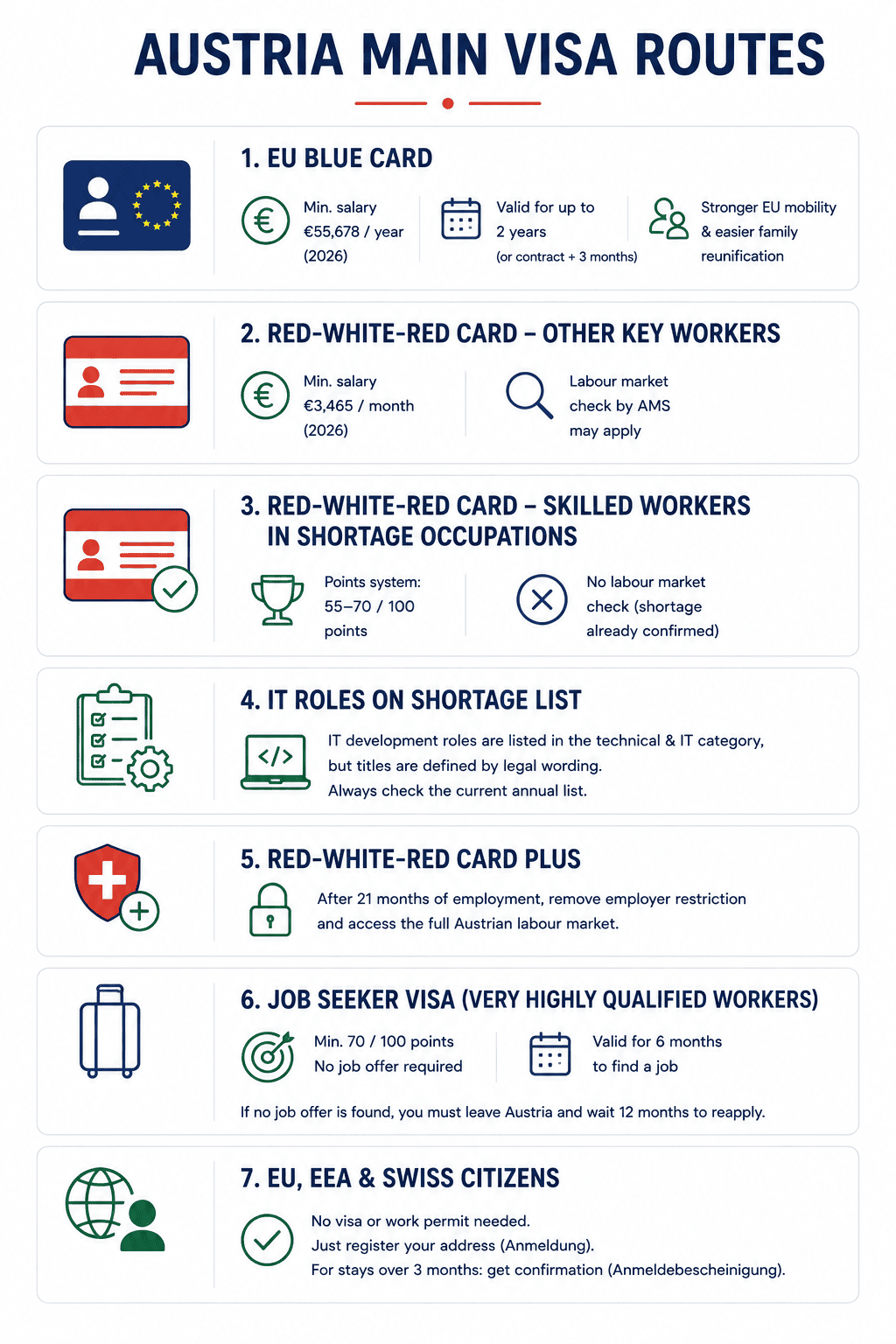
- EU Blue Card. Built for candidates with a completed university degree and a binding job offer, the EU Blue Card requires a minimum gross salary of €55,678 per year for 2026, paid across 14 installments in line with Austrian employment norms. It grants stronger EU-wide mobility than national permits and a simplified process for bringing family members. The card is capped at two years initially, or matched to the length of the underlying employment contract plus three months if shorter, and the application still goes through a labour market assessment by the Public Employment Service Austria (AMS).
- Red-White-Red Card - Other Key Workers. This is the standard route for developers who already have a job offer that doesn't fall under a shortage occupation. The Red-White-Red Card for Other Key Workers sets a 2026 salary floor of €3,465 gross per month, and the AMS is entitled to run a labour market check on the specific application, meaning approval isn't automatic even when the salary threshold is met.
- Red-White-Red Card - Skilled Workers in Shortage Occupations. For candidates whose exact occupation appears on Austria's annual shortage list, this category replaces the salary threshold with a points system. Applicants typically need 55 to 70 points out of 100, scored across qualifications, work experience, age, and language skills, and the Skilled Workers in Shortage Occupations route skips the labour market check entirely since the shortage is already established government-wide.
- Shortage occupation status for IT roles. The Fachkräfteverordnung (Skilled Workers Ordinance), reissued annually by Austria's Federal Ministry of Labour and Social Affairs, lists 64 nationwide shortage occupations for 2026, alongside additional regional lists covering individual federal states. IT development positions do appear within the current list's technical and IT category, but the ordinance defines occupations by precise legal wording rather than everyday job titles. A candidate needs to check the current list against their exact job classification at the time of application, not assume a generic "frontend developer" or "web developer" title automatically qualifies - the designation can shift from one annual ordinance to the next.
- Red-White-Red Card Plus. After 21 months of continuous employment on a standard Red-White-Red Card, holders become eligible to apply for the Red-White-Red Card Plus, which removes the restriction tying the permit to a single employer and grants unrestricted access to the Austrian labour market. This is the practical bridge between an employer-sponsored visa and long-term settlement.
- Job Seeker Visa (Very Highly Qualified Workers). Candidates who score at least 70 out of 100 points on Austria's qualification scale - without needing a job offer in hand - can apply for a six-month Job Seeker Visa to search for work inside Austria. This route demands a genuinely strong profile: advanced degrees, substantial professional experience, and often language points, and it is not the typical path for a mid-career frontend developer without an unusually decorated CV. Those who don't secure a matching job offer within the six months are required to leave the country and must wait 12 months before reapplying.
- EU, EEA, and Swiss citizens. Citizens of these countries need no visa or work permit at all. The only requirement is registering the residence address (Anmeldung) with the local authority, and - for stays beyond three months - obtaining a confirmation of registration (Anmeldebescheinigung) as documented on oesterreich.gv.at .
Austria Work Permit Comparison (2026)
| Criterion | EU Blue Card | Red-White-Red Card (Other Key Worker) | Red-White-Red Card Plus | Job Seeker Visa |
| Salary threshold (2026) | €55,678 gross/year. | €3,465 gross/month. | No salary threshold of its own; it is a follow-on residence/work permit. | No fixed salary threshold; this is a job-search permit. |
| Education requirement | Higher education qualification is required. | No university degree is mandatory; the route is tied to qualification, points, and a qualifying job offer. | No new education requirement if you already qualified for the preceding permit. | Very highly qualified status is required, usually with strong academic/professional credentials. |
| Labour market check | Generally no full labour market test for the Blue Card route, but the job and salary must meet the legal threshold. | Yes, employer-side review applies through the Austrian system and permit conditions. | No labour market check. | No labour market check, because the visa is for job search. |
| Path to RWR Plus / PR | Can lead to RWR Card Plus after 2 years in Austria if conditions are met; permanent residence is possible after 5 years of legal residence. | Can lead to RWR Card Plus after 2 years; after 5 years of legal residence, permanent residence / Daueraufenthalt-EU is possible. | This is already the “plus” stage; after 5 years of continuous legal residence, Permanent Residence-EU is possible. | Not a direct path; you must switch into a work/residence permit after finding a qualifying job. |
A practical way to read this: the EU Blue Card is the higher-salary, degree-based route; the Red-White-Red Card for Other Key Workers is the more common employer-tied route; the RWR Card Plus removes labour market restrictions after the qualifying period; and the Job Seeker Visa is only for entering Austria to look for work. Salary thresholds and eligibility details can change, so for 2026 it is best to rely on the official pages below rather than on blog estimates alone.
According to sources:
- workinaustria.com - Work Visa in Austria 2026: Red-White-Red Card & EU Blue Cardworkinaustria
- oesterreich.gv.at - Red-White-Red Card plusoesterreich
- migration.gv.at - Red-White-Red Card plusmigration
- migration.gv.at - Permanent immigrationmigration
- workinaustria.com - Austria Job Seeker Visaworkinaustria
Step-by-Step Process for Non-EU Candidates
The application process runs through several sequential stages, and skipping the order - for instance, entering Austria first and hoping to sort out documentation later - routinely backfires. Each stage depends on the previous one being properly completed.
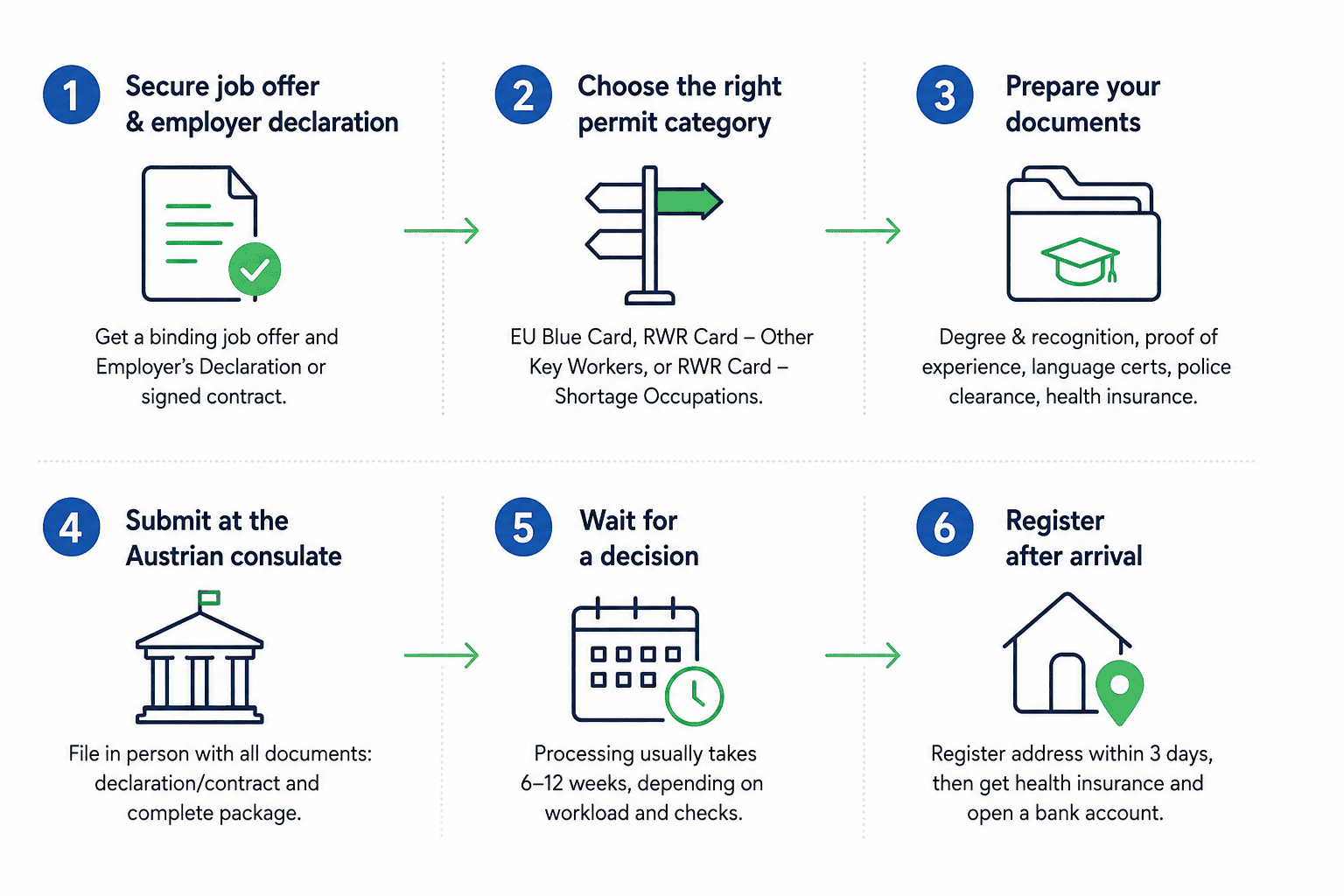
- Step 1: Secure a job offer and employer declaration. Everything starts with a binding job offer from an Austrian employer willing to formalize it through an Arbeitgebererklärung (Employer's Declaration), covering the exact job description, salary, collective-agreement classification, and working hours. A signed employment contract can substitute for, or accompany, this declaration. Without this document in hand, none of the subsequent visa categories are accessible.
- Step 2: Determine the correct permit category. Salary level, educational background, and whether the role falls under the current shortage-occupation list all determine which route applies - EU Blue Card, Red-White-Red Card for Other Key Workers, or Red-White-Red Card for Skilled Workers in Shortage Occupations. Getting this wrong at the outset means restarting the process under a different category, so it's worth running the official points calculator before submitting anything.
- Step 3: Assemble the document package. This is typically the slowest step. Candidates need a university degree with formal equivalence recognition where required - third-country degrees go through nostrification or an assessment via ENIC NARIC AUSTRIA , a process that can take weeks to a few months depending on the field and country of origin. Alongside this: documented proof of professional experience, language certificates if points are being claimed for German or English proficiency, a police clearance certificate (usually required to be no older than three months), and evidence of valid health insurance coverage.
- Step 4: File the application at the competent consulate. Applications generally must be submitted in person at the Austrian embassy or consulate responsible for the candidate's country of residence - entering Austria on a tourist visa first and applying from inside the country is not the standard route and isn't available for most candidates. The Employer's Declaration, salary contract, and full document package all go in at this stage.
- Step 5: Wait for a decision. Processing typically takes 6 to 12 weeks, though this is a working estimate, not a guarantee. Timelines shift with consulate workload, the completeness of the submitted file, and how quickly the AMS completes its labour market check where one applies. Candidates planning a specific start date should build in a buffer rather than assuming the fastest-case scenario.
- Step 6: Register after arrival. Once in Austria, new arrivals have a legal obligation to register their residential address (Meldezettel) with the local authority within three days, a step documented on oesterreich.gv.at . This registration confirmation then unlocks the next practical steps - enrollment in Austria's public health insurance system (ÖGK) through the employer, and opening a local bank account, which most Austrian banks require proof of registered address to process.
Practical Nuances
Vienna dominates Austria's frontend job market, but it also carries the country's highest cost of living by a clear margin, and rent accounts for most of that gap. A one-bedroom apartment in central Vienna regularly costs 40-50% more than the same unit in Graz or Linz, and this single expense line does more to determine real purchasing power than any salary difference between cities. A developer comparing a Vienna offer against a Graz offer should weigh net take-home pay against actual rent in each city rather than relying on the headline salary figure, since a lower nominal salary in a smaller city can leave more disposable income at the end of the month.
Degree recognition works differently in practice than the formal rules suggest. Regulated engineering professions in Austria - where a specific licensed title is legally required to practice - do need formal nostrification through a public university or an ENIC NARIC AUSTRIA assessment, and skipping this step blocks employment outright. Frontend development isn't a regulated profession in this sense. Austrian employers hiring frontend developers overwhelmingly evaluate candidates on portfolio quality, GitHub activity, and practical interview performance rather than the pedigree of the underlying degree. A computer science degree helps with visa points calculations, particularly for the Red-White-Red Card and Blue Card categories that weight formal education, but it rarely functions as a hard gatekeeping requirement for the job itself the way it might in medicine or civil engineering.
German language ability occupies a similarly nuanced position. Nothing in the visa system makes German mandatory - candidates can reach the required points threshold through other criteria such as work experience, age, or qualifications even with no German at all. That said, treating English as sufficient across the board would be misleading. Enterprise employers, particularly banks, insurers, and public-sector organizations, routinely list working German as a practical job requirement even when it isn't a visa requirement, and daily life outside the office - dealing with landlords, local authorities, and everyday bureaucracy - moves noticeably faster with at least conversational German. A candidate targeting Austria's international startup scene can realistically operate in English long-term; a candidate targeting enterprise employers should plan for German study as a serious, ongoing commitment rather than an optional nice-to-have.
One caveat applies across this entire relocation process: none of the figures or classifications here are fixed guarantees. Processing timelines, the exact composition of the shortage-occupation list, and points thresholds are all set and revised through annual government ordinances, and the details current as of 2026 may shift in future years. A candidate's specific job title may or may not match the precise wording used in that year's Fachkräfteverordnung, and consulate processing speed varies by location and caseload in ways no general guide can predict with certainty. Verifying the current list and thresholds directly with official sources at the time of application remains a necessary step, not an optional one.
Conclusion
Frontend salaries in Austria in 2026 land in a wide range, from roughly €35,000 for junior roles to €85,000 or more for senior specialists, with Vienna commanding the highest figures and the highest rent to match. TypeScript, React or Angular depending on the employer, and working German for enterprise roles form the practical baseline most job postings expect. For developers considering relocation, the EU Blue Card and Red-White-Red Card each fit different profiles - degree and salary level determine which applies - and neither guarantees a fixed timeline. The numbers and requirements here reflect the current 2026 landscape; verifying thresholds and shortage-occupation status at the time of application remains essential.
Frequently Asked Questions
How much does a junior frontend developer earn in Austria in 2026?
Junior frontend developers in Austria typically earn between €35,000 and €45,000 gross per year, based on multiple 2026 salary surveys covering the market. This range applies to developers with roughly zero to two years of hands-on production experience, and it sits noticeably below the country-wide average for the role, which climbs higher once middle and senior positions are factored in.
Location within Austria shifts this range somewhat - Vienna-based junior roles tend toward the upper end given the concentration of employers and higher living costs, while smaller cities like Graz or Linz often land closer to the lower bound. It's also worth remembering that Austrian salaries include a 13th and 14th monthly payment under the collective bargaining system, so a junior developer's effective annual income already reflects 14 payments rather than 12, even though the headline figure is presented as a single yearly number. Candidates evaluating an offer should always confirm whether the quoted figure already accounts for this structure.
Do you need to speak German to work as a frontend developer in Austria?
German isn't a strict requirement for the job itself, and this is truer in Austria's frontend market than in many other technical fields. International product companies, startups, and remote-friendly teams in Vienna and Graz frequently operate entirely in English, and plenty of frontend developers build long careers in Austria without fluent German.
That picture changes in the enterprise segment. Banks, insurers, and public-sector employers - a substantial share of Austria's tech job market - commonly expect working German, typically at a B1 to B2 level, even for roles where the actual coding happens independently of language. Beyond the workplace, day-to-day life moves considerably more smoothly with at least conversational German: dealing with landlords, government offices, and local bureaucracy in English alone gets frustrating fast. A realistic approach treats English as sufficient for landing many jobs, but German as a genuine asset for both career flexibility and quality of life, worth building over the first year or two rather than dismissing entirely.
Can a frontend developer get a Red-White-Red Card without a computer science degree?
Yes, a formal computer science degree isn't an absolute requirement, though its absence changes which path makes sense. The Red-White-Red Card for Other Key Workers depends primarily on having a qualifying job offer and meeting the salary threshold - currently €3,465 gross per month for 2026 - rather than mandating a specific degree. Employers hiring frontend developers in Austria generally weigh practical skills and portfolio strength over academic credentials, which mirrors how the broader industry evaluates frontend talent globally.
Where a degree matters more is the points-based categories, such as the Red-White-Red Card for Skilled Workers in Shortage Occupations or the Job Seeker Visa route, since formal education contributes points toward the required threshold. A self-taught developer without a degree can still reach the minimum score through other criteria - professional experience, age, and language skills - but it typically requires stronger performance in those other categories to compensate. The practical takeaway: a job offer at the right salary level is usually more decisive than a diploma.
What's the difference between the EU Blue Card and the Red-White-Red Card for an IT specialist?
The core difference lies in eligibility criteria and mobility. The EU Blue Card requires a completed university degree and a higher minimum salary - €55,678 gross per year for 2026 - but in exchange offers stronger mobility rights across the European Union and a more streamlined process for bringing family members along. It's built around the EU's harmonized framework for highly qualified migration rather than being an Austria-specific instrument.
The Red-White-Red Card, particularly the Other Key Workers category, sets a lower monthly salary threshold and doesn't require a university degree as a hard prerequisite, making it accessible to a wider range of frontend developers, including those without formal CS credentials. It is, however, a national Austrian permit without the same EU-wide mobility benefits, and it can involve a labour market check by the AMS that the Blue Card route generally skips. For most working frontend developers with a solid job offer but no degree, the Red-White-Red Card ends up being the more practical route; for degree-holders earning above the Blue Card threshold, the broader EU mobility can be worth the higher salary bar.
Can you work remotely for an Austrian employer without relocating?
Legally, yes, though it changes the employment relationship substantially. If a developer stays in their home country and works for an Austrian company, that person typically doesn't need an Austrian visa or residence permit at all, since no relocation is taking place. The employer, however, faces a different set of obligations - hiring someone based abroad usually means engaging them through a local entity, a cross-border employment arrangement, or an employer-of-record service rather than a standard Austrian employment contract, since Austrian labour law and payroll systems are built around residents.
Tax residency in this setup generally stays with the developer's home country rather than shifting to Austria, though this depends heavily on both countries' tax treaties and the specifics of the arrangement. Some Austrian companies, especially in the startup and product space, do hire remote contractors or use EOR platforms for exactly this purpose, but it's worth confirming directly with a prospective employer how they intend to structure the arrangement before assuming full remote work is on the table.