
Frontend Developer Salary in Canada (2026): Pay by City, Level and Tech Stack
08 July 2026
290 views
This guide is up to date as of October 2026


Written by
Marcus Hale,
IT Talent Acquisition Specialist

Reviewed by
Sophie Mitchell,
Senior Tech Recruiter, Canada
Frontend developer salaries in Canada range from $70,000 to $120,000 CAD - and that gap isn't noise, it's the distance between a junior developer's first offer and what a senior React developer commands in Toronto. Anyone searching for "frontend developer salary Canada 2026" and landing on a single average number is getting half the picture. The real answer depends on where you work, how many years you have, and - increasingly - whether your stack matches what employers are actually paying for in 2026.
This guide skips the vague caveats and gets into the numbers: salary breakdowns by city (Toronto, Vancouver, Montreal, Calgary, and remote), by experience level, and by the specific technologies that move your rate up or down. It also covers something most career sites gloss over entirely - how the NOC code assigned to frontend developers affects your Express Entry application, and why picking the wrong one can cost you points or get your profile flagged. If you're weighing a move to Canada or just want to know what you're worth in the current market, this is the reference to work from.
How Much Do Frontend Developers Earn in Canada in 2026?
Frontend developer salary in Canada 2026 isn't a single figure - it's a range shaped by two variables that matter more than anything else: how much experience you bring, and where you're working from. A junior developer in Montreal and a senior developer in Toronto aren't playing in the same market, even though both show up under the same job title. Rather than quoting one national average and calling it a day, this section breaks the numbers down the way employers actually think about them: first by experience level, then by city, so you can find the range that reflects your actual situation instead of a blended figure that fits no one.
The biggest single factor in your paycheck isn't your city or even your framework of choice - it's years of experience. A junior frontend developer in Canada in 2026 typically starts in the mid-$50Ks, while a senior developer with a strong track record can clear six figures with room to spare. What's less obvious is how wide the range gets at each stage: junior frontend Canada salary offers can swing by $15,000-$20,000 depending on whether you're joining a bootstrapped startup or a bank's digital team, and that spread only grows as you move up.
The table below breaks down realistic ranges for junior, mid-level, senior, and lead frontend roles, based on current market data rather than a single blended average.
| Level | Range | Median / Benchmark |
| Junior (0-2 years) | CAD 47,000 - 65,000 | ~CAD 55,000 |
| Mid-level (2-5 years) | CAD 70,000 - 95,000 | ~CAD 80,000 |
| Senior (5+ years) | CAD 95,000 - 140,000 | ~CAD 115,000 |
| Lead / Staff frontend | CAD 130,000 - 170,000+ | Negotiable; highly company-dependent |
The lower-to-upper spread is usually driven by base salary plus cash bonus, equity, and local market differences, rather than just years of experience. Robert Half notes that Canadian salary guides are typically based on starting salaries only, and that bonuses, benefits, and perks are excluded from base-pay figures.
For enterprise / large public companies, compensation is often more structured, with base salary plus annual bonus and, in some cases, RSUs or other long-term incentives. For startups, the cash base may be lower, but equity can add upside if the company grows; however, that equity is less certain and often more illiquid than RSUs at a public company.
Sources:
- Robert Half Canada Salary Guide : national salary benchmarks and the note that figures are starting salaries only, excluding bonuses and perks.
- BDO Canada : overview of equity compensation, including RSUs and stock options in Canadian tech and startup settings.
- J.P. Morgan : equity compensation context for startup growth and long-term incentives.
Salary in Canada by City
Location changes the math more than most developers expect, and not always in the direction you'd guess. Toronto posts the highest nominal frontend developer salaries in the country - a React developer salary in Toronto can outpace Vancouver or Montreal by 15-20% - but Toronto is also Canada's most expensive city to live in, which quietly erases much of that advantage. Vancouver tells a similar story: a frontend developer salary in Vancouver looks lower on paper, but the gap narrows once housing costs are factored in. Montreal and Calgary offer lower headline numbers with meaningfully lower costs of living, while Ottawa sits in between. Remote roles add another layer entirely, since pay can follow either the employer's home city or a flatter national rate.
| City | Salary range (CAD/year, average base) | Comment |
| Toronto, ON | CAD 79,000 - 122,000 | The widest spread among major Canadian hubs; fintech, banks, and consulting often pay above market |
| Vancouver, BC | CAD 75,000 - 110,000 | Often slightly lower on paper than Toronto, but still strong for SaaS, cloud, gaming, and AI employers |
| Montreal, QC | CAD 65,000 - 95,000 | Lower nominal pay, but one of the more affordable large cities; strong in AI, gaming, and aerospace tech |
| Calgary, AB | CAD 70,000 - 100,000 | A growing market with less competition than Toronto; energy tech, cloud, and ERP roles can pay well |
| Ottawa, ON | CAD 72,000 - 100,000 | Many gov-tech, cybersecurity, and enterprise roles; compensation is often steadier than in startup-heavy markets |
| Remote (across Canada) | CAD 65,000 - 105,000 | Depends on whether the company uses city-based pay bands or a flat remote rate; some firms discount remote pay, others do not |
Different sources can produce noticeably different “average salary” numbers because they measure different things: base salary vs total compensation, self-reported salaries vs employer surveys, and city-level vs national samples. That means a single “correct” number does not really exist; it is better to present the range and explain the methodology behind it.
Sources:
- JupiterHR Tech Salary Guide - city adjustments and tech salary bands in Canada.
- Syndesus: AI and Tech Salaries in Canada - city-by-city Canada tech salary overview.
- EBSource: Average Software Developer Salaries in Canada - salary context by role and region.
- Jobillico Salary Tool - general Canadian salary reference with city comparisons.
Frontend Tech Stack Employers Actually Pay For in 2026
React and TypeScript are no longer a differentiator in the Canadian market - they're the entry ticket. Nearly every mid-to-senior frontend posting now lists both as required, not preferred, which means knowing them gets you past the first filter but does nothing to push your offer higher. Understanding what actually moves a frontend developer's salary in Canada in 2026 means separating what's simply expected from what genuinely commands a premium. The table below breaks the current stack into five tiers, from baseline requirements to niche skills that narrow the field but pay well when they match what a team needs.
| Category | Technologies / skills | Salary impact |
| Baseline (must-have) | JavaScript , HTML / CSS , React , TypeScript , Git | Without these, candidates usually are not considered; this is the entry threshold, not a premium skill set . |
| Commonly required (must-have) | Next.js , REST/GraphQL API integration, responsive and accessible UI | Standard expectation in many mid-level and senior front-end postings; helps you qualify for more roles, but is still seen as table stakes in strong teams . |
| Pays a premium (nice-to-have) | Testing (Vitest, Playwright, Jest), performance optimization , design systems / component libraries | These skills tend to increase salary leverage, especially at mid/senior level, because they reduce risk and improve delivery quality . |
| Growing demand in 2026 (nice-to-have) | AI tools in workflow ( Claude , Copilot, agentic coding tools), Web Components, edge rendering | Not yet mandatory in most listings, but increasingly mentioned in senior roles and high-productivity teams . |
| Niche but valued (nice-to-have) | React Native / cross-platform, WebGL / Three.js, Web Performance (Core Web Vitals) | Narrower market, but useful for differentiation and for teams that need specialized product or performance work . |
“Nice-to-have” does not mean “low value.” It usually means the skill becomes a salary differentiator only after the baseline stack is already covered, especially for senior and lead roles. The exact premium also depends on company type: product companies and larger enterprises often pay more for design systems, testing rigor, and platform thinking, while startups may value breadth, AI tooling, and speed.
Sources:
- Robert Half - Technical Front-End Developer Salary (Canada) - front-end role expectations and salary context.
- Glassdoor - Front End Developer salaries in Canada - base pay and range context.
- Indeed Canada - React/TypeScript job volume and related searches - demand signal for React/TypeScript in the Canadian market.
- Robert Half - 2026 Canada Tech and IT Salaries - broader tech compensation trends.
What employers pay for in 2026?
Higher frontend salaries are usually tied not just to the number of technologies a developer knows, but to the level of responsibility and measurable impact they can prove. Current job postings and market data show that employers pay more for candidates who can own important systems, improve product quality, and make frontend work more reliable at scale.
- Real ownership of reusable UI systems Salary tends to rise when a developer has done more than simply use existing components. Employers value candidates who have built, maintained, versioned, and documented design systems or component libraries that are used by multiple teams. This shows ownership, consistency, and the ability to create frontend infrastructure others can rely on.
- Proven performance improvements General knowledge of performance best practices is no longer enough for stronger offers. Companies increasingly look for developers who can point to specific improvements they have shipped, especially around Core Web Vitals. Being able to explain what was slow, what was changed, and how the results improved makes a candidate stand out.
- Strong testing experience Testing has moved from a bonus skill to an expected part of professional frontend work. Teams that have suffered from unstable releases now look for developers who can prevent regressions with reliable test coverage. Tools such as Playwright and Vitest are now mentioned directly in job postings, which makes hands-on experience with them more valuable.
- AI-tooling fluency AI skills are becoming a new salary signal, especially for senior frontend roles. Employers are not only interested in developers who use autocomplete tools. They increasingly value people who can direct, review, and safely integrate agentic coding workflows into real development processes. This is still not a universal requirement, but it is becoming a meaningful differentiator in interviews.
- The main pattern The strongest salary growth usually comes from evidence of impact. Developers who can show that they owned important systems, improved measurable performance, reduced release risk through testing, or used AI tools responsibly are more likely to receive offers at the top of their experience band rather than in the middle.
How to Immigrate to Canada as a Frontend Developer?
Figuring out how to immigrate to Canada as a frontend developer starts with a detail most guides skip entirely: the occupation code your entire application gets built around. Get that wrong, and every downstream step - your Express Entry profile, your CRS score, even which category draws you're eligible for - inherits the mistake. This section walks through the code first, then the programs, the points system, and the provincial alternatives that sit alongside Express Entry.
What Is NOC 21234 and Why It Matters?
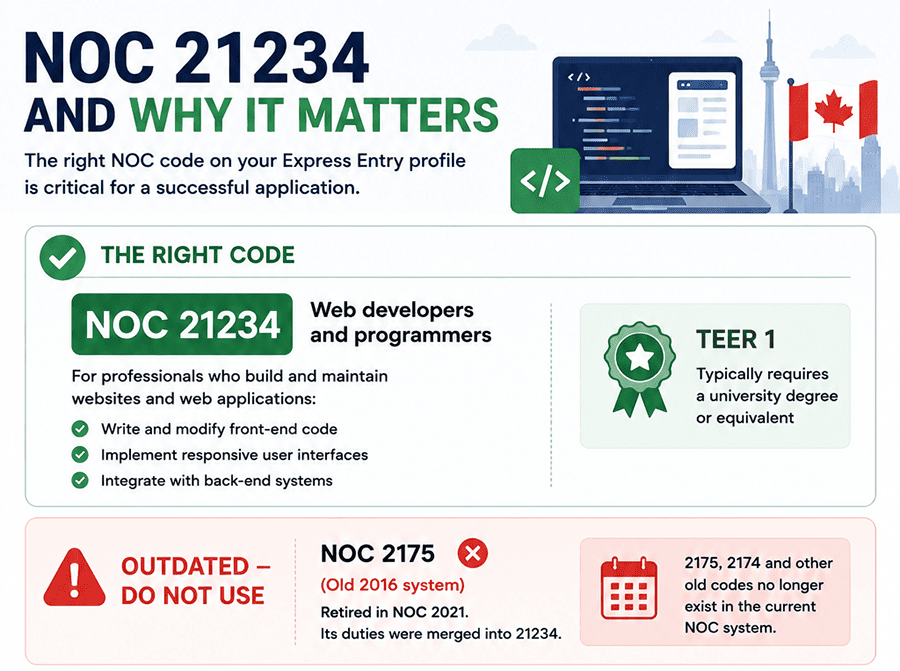
The NOC code frontend developer applicants need under the current 2021 classification is NOC 21234 - Web developers and programmers . This is the code that should appear on your Express Entry profile if your day-to-day work is building and maintaining websites and web applications: writing and modifying front-end code, implementing responsive interfaces, and integrating with back-end systems.
Here's where a lot of confusion sets in. Older forum threads, outdated blog posts, and even some immigration consultants still reference NOC 2175 , which was the code under the previous 2016 classification system. When Canada moved to NOC 2021, 2175 was retired and its duties were folded into 21234. If you're cross-referencing old advice, treat any mention of 2175 or 2174 as historical - those numbers no longer exist in the system IRCC uses today, and using them on a current profile will cause errors.
It's also worth distinguishing NOC 21234 from two codes it gets mixed up with:
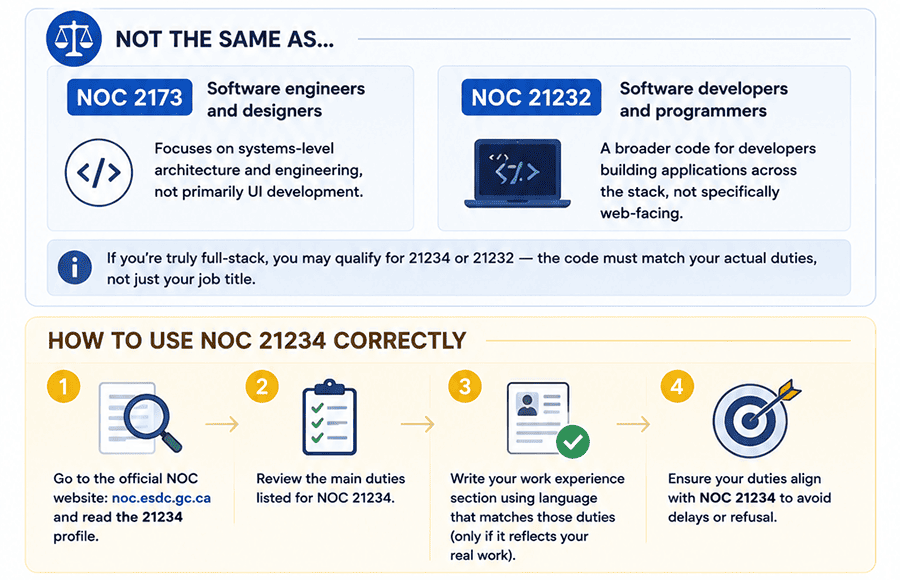
- NOC 2173 - Software engineers and designers : applies to candidates doing systems-level architecture and engineering work, not primarily UI development.
- NOC 21232 - Software developers and programmers : a broader code for developers building applications across the stack, not specifically web-facing.
If your job is genuinely full-stack, you may have a legitimate case for either 21234 or 21232 - but the code has to match your actual job duties, not your job title. NOC 21234 sits in TEER 1 , meaning it's generally associated with roles that typically require a university degree or equivalent - a factor that feeds directly into your education points under CRS.
The practical takeaway: when you write your work experience section in Express Entry, don't just copy your resume bullet points. Go to the official NOC 21234 profile at noc.esdc.gc.ca , read the listed main duties, and mirror that language where it genuinely reflects your work. IRCC assessors compare your stated duties against the official NOC description, and a mismatch - even an honest one caused by generic resume language - can slow down or jeopardize your application.
Express Entry Basics for Developers
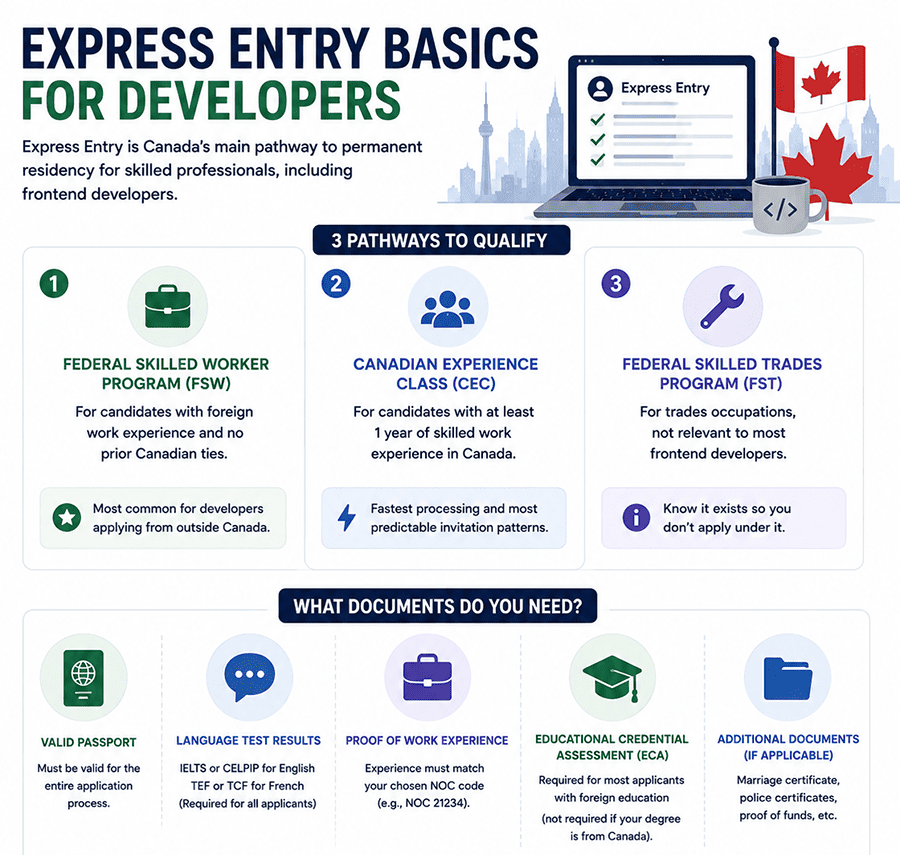
Express Entry frontend developer applicants generally qualify through one of three federal programs:
- Federal Skilled Worker Program (FSW) - for candidates with foreign work experience and no prior Canadian ties. This is the most common entry point for developers applying from outside Canada.
- Canadian Experience Class (CEC) - for candidates who already have at least a year of skilled work experience inside Canada, typically on a work permit. CEC applicants generally see the fastest processing and, in most draw cycles, the most predictable invitation patterns.
- Federal Skilled Trades Program (FST) - built for trades occupations, not relevant to most frontend developers, but worth knowing exists so you don't misfile under it.
Regardless of which program applies to you, the document list is largely the same: a valid passport, language test results (IELTS or CELPIP for English, TEF or TCF for French), proof of work experience matching your NOC code, and - for most applicants - an Educational Credential Assessment (ECA) . The ECA converts a foreign degree into its Canadian equivalent and is mandatory for FSW applicants whose education wasn't earned in Canada. It's issued by a small number of IRCC-designated organizations (WES is the most commonly used for tech applicants) and typically takes several weeks to process, so it's worth starting early - it's frequently the slowest-moving piece of an otherwise fast application.
How CRS Points Work for Tech Workers?
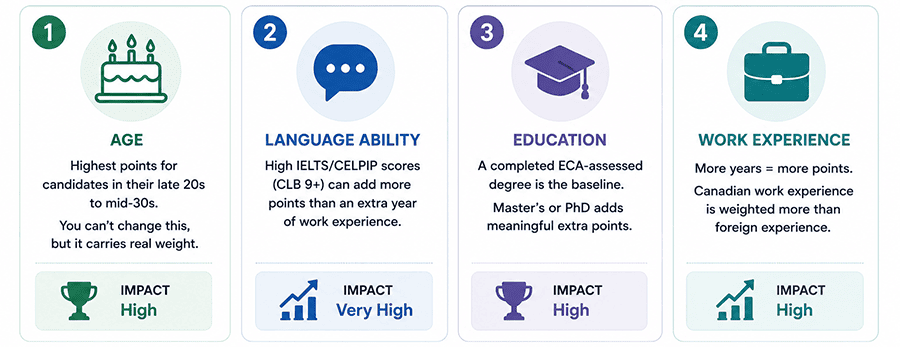
Once you're in the Express Entry pool, your ranking is determined by the Comprehensive Ranking System (CRS), which scores four core factors: age, education, language ability, and work experience, plus additional points for factors like a valid job offer or a sibling in Canada. For a typical frontend developer, here's where the score usually gets made or lost:
- Age rewards candidates in their late 20s to mid-30s most heavily - this is a fixed factor you can't influence, but it's worth knowing it carries real weight.
- Language ability is where many technically strong developers underperform. A high IELTS or CELPIP score (CLB 9 or above) can add more points than an extra year of work experience, and it's one of the few factors you can directly improve before applying.
- Education rewards a completed ECA-assessed degree, with a meaningful jump for a master's or PhD - but since NOC 21234 sits at TEER 1, a bachelor's degree already satisfies the baseline for the occupation itself.
- Work experience matters both in absolute years and in whether it's foreign or Canadian - Canadian work experience is weighted more heavily, which is part of why CEC applicants often move faster than FSW applicants with an identical resume.
As of 2026, IRCC has leaned heavily on category-based draws rather than pure general rounds, and general CEC draws have been sitting in the CRS 500s. The STEM occupation category - which frontend developers under NOC 21234 can technically qualify for - has been largely dormant, with no STEM-specific draw held for an extended stretch, so it's not something to plan a strategy around right now. In practice, this means most frontend developers pursuing PR as a web developer in Canada need either a strong CRS score for general/CEC draws, or a provincial nomination, which brings a bigger and more reliable boost.
Provincial Nominee Programs (PNP) as an Alternative
Express Entry isn't the only route, and for many developers it isn't even the fastest one. Provincial Nominee Programs (PNP) let individual provinces nominate candidates who match their local labour market needs - and a provincial nomination adds a substantial fixed points boost to your CRS score, one large enough to guarantee an invitation in the next general draw regardless of where your unassisted score would otherwise land.
Several provinces run tech-specific streams built with roles like frontend development in mind:
- BC PNP Tech - British Columbia's dedicated pathway for a defined list of tech occupations, with faster processing and, in some intake rounds, no job offer required.
- Ontario's tech-focused draws (through the Human Capital Priorities stream) - periodically targets tech occupations directly from the Express Entry pool, sometimes at CRS cut-offs well below general rounds.
- Alberta's Accelerated Tech Pathway - a similar model aimed at drawing tech talent into Alberta's growing Calgary-based tech sector.
None of these require a deep dive to know they exist and matter: the point is that a candidate whose CRS score doesn't clear the general or CEC cut-off on its own may still have a realistic path through a province actively recruiting frontend and web development skills. If you're serious about relocating rather than just exploring the idea, checking the current intake status of these tech streams alongside your Express Entry profile is worth doing in parallel, not as a backup plan you only consider after a rejection.
Where to Find Frontend Developer Jobs in Toronto, Vancouver & Beyond?
Frontend developer jobs in Toronto and Vancouver 2026 dominate the national market for a reason - these two cities host the bulk of Canada's tech employers, from major banks running large in-house engineering teams to venture-backed startups building product from scratch. Toronto's tech jobs for frontend developers skew heavily toward fintech and enterprise: the big five banks, insurance companies, and a dense cluster of fintech startups all compete for the same pool of React and TypeScript talent, which keeps demand - and salaries - consistently high. Vancouver runs a different mix, with more gaming studios, e-commerce companies, and a steady stream of Seattle-adjacent tech offices that treat it as a lower-cost extension of the US Pacific Northwest market.
Calgary is smaller but shouldn't be dismissed. Frontend jobs in Calgary cluster around energy-sector digitization and a growing fintech presence, and because fewer developers actively target the city, competition for open roles tends to be lighter than in Toronto or Vancouver. Montreal sits in its own category: a genuinely strong tech scene, particularly in gaming and AI-adjacent product companies, paired with a noticeably lower cost of living - worth serious consideration if take-home value matters more to you than headline salary numbers.
Remote frontend roles in Canada add a fifth path, and it's grown significantly less predictable in recent years. Some companies hire remote developers at a flat national rate regardless of city; others peg pay to the cost of living in the employee's home base, which means a remote offer from a Toronto-headquartered company doesn't automatically mean Toronto-level pay if you're based in a cheaper city. One detail that gets glossed over far too often: a large share of Canadian job postings, remote included, explicitly require legal right to work in Canada - meaning an existing work permit, PR, or citizenship - not a promise to sort out sponsorship later. If you're applying from outside the country, filtering for roles that actually sponsor or accept international applicants will save you a lot of wasted applications.
| City / Market | Where to look | What to expect | Notes |
| Toronto, ON | LinkedIn , Indeed , company career pages, Built In Toronto, recruitment agencies | Largest concentration of frontend roles in Canada, especially in fintech, banks, SaaS, and consulting | Toronto is the main hub, with a wide mix of startups, scale-ups, and enterprise employers |
| Vancouver, BC | LinkedIn , Workpolis , company career pages, startup job boards, remote-first companies | Strong market for product companies, SaaS, gaming, and cloud-related roles | Vancouver is one of the two main Canadian hubs, with many roles tied to tech product teams and remote-friendly employers. |
| Calgary, AB | LinkedIn , Indeed , Workpolis , niche job boards, energy-tech and fintech company sites | Smaller market, but growing in energy, fintech, and enterprise software | Calgary is more niche than Toronto or Vancouver, but it can be a good option if you want a less crowded market. |
| Montreal, QC | LinkedIn , ZipRecruiter , local company sites, French/English job boards | More affordable city, with roles in AI, gaming, SaaS, and enterprise | Montreal often offers lower cost of living, so nominal salary may be lower even when the role is solid. |
| Remote (Canada-wide) | Remote-first company pages, Indeed , Glassdoor , job aggregators | Large number of remote-friendly frontend roles, especially in distributed product teams | Many Canadian roles still explicitly require legal right to work in Canada, so that should be checked carefully in each posting |
Toronto and Vancouver are the two primary frontend job hubs in Canada , while Calgary is a smaller but growing market with more specialization, and Montreal is often attractive because of lower living costs. Remote roles are widely available, but “remote-friendly” does not always mean “open globally,” because many employers still require the legal right to work in Canada.
The employers actually hiring frontend developers right now break down into a few recognizable categories rather than an undifferentiated wall of "job openings": digital agencies serving multiple clients, banks and insurers with sizable in-house product teams, fintech and health-tech startups (including a meaningful number backed by YC and similar accelerators), and a steady stream of government and public-sector digital service teams modernizing legacy systems. Knowing which category you're applying into changes what the interview process - and the offer - actually looks like.
Conclusion
The numbers tell a clearer story than most salary guides let on: frontend developer pay in Canada isn't one figure, it's a range shaped by three things you can actually influence - your experience level, the city you target, and how deliberately you've built your stack around what employers pay a premium for. React and TypeScript get you in the door; design systems, testing, and performance work are what move an offer from average to strong.
The other takeaway is less about salary and more about process: if you're relocating rather than negotiating a raise, the NOC code on your Express Entry profile isn't paperwork - it's the foundation the rest of your application sits on. Get that right, understand where CRS points are actually won or lost, and treat provincial nominee programs as a real parallel path rather than a backup plan.
If you're preparing for the job search itself, not just the numbers behind it, our frontend interview questions guide and frontend developer roadmap break down exactly what to study and how to structure your preparation before you start applying.
Frequently Asked Questions about Job in Canada
What is a good frontend developer salary in Canada in 2026?
Anything from $80,000 to $95,000 CAD counts as solid for a mid-level developer, while a strong senior offer sits closer to $110,000-$130,000, depending on city and company type. What counts as "good" shifts a lot with location and stack: a $75,000 offer in Montreal reflects a much stronger real income than the same number in Toronto once cost of living is factored in, and offers that lean on RSUs or bonuses at fintech and bank employers often push effective total compensation well above the base salary alone. Rather than benchmarking against a single national average, compare offers against the specific city and experience-level ranges - a $90,000 offer can be excellent or mediocre depending entirely on where you're evaluating it from.
What NOC code should I use for Express Entry as a frontend developer?
Use NOC 21234 - Web developers and programmers, the current 2021-classification code that covers frontend and web development duties. Don't rely on older references to NOC 2175 or 2174; those codes belonged to the retired 2016 classification system and no longer exist in IRCC's current system. Before submitting your profile, cross-check the official duties listed for NOC 21234 on noc.esdc.gc.ca against your actual job responsibilities, and make sure the language you use in your work experience section genuinely reflects that description rather than generic resume phrasing - mismatches here are a common and avoidable source of application delays.
Can I get a Canadian frontend job without a degree?
Yes, but it's harder than it was a few years ago, and it depends heavily on having a portfolio that proves real skill rather than credentials. Self-taught and bootcamp graduates do get hired in Canada, particularly at startups and agencies that care more about shipped work than diplomas, but competition for junior roles has increased and employers now expect two to three portfolio projects with genuine business logic, not tutorial-style to-do apps. A degree still opens doors faster at large enterprises and banks, where HR filters sometimes screen on education before a hiring manager even sees the application, so the no-degree path tends to run through smaller companies first.
Is Toronto or Vancouver better for frontend developer salaries?
Toronto pays more on paper, with average frontend salaries typically running 15-20% higher than Vancouver's. That advantage narrows substantially once you account for cost of living - Toronto's housing costs are meaningfully higher, so the real gap in disposable income is smaller than the nominal salary difference suggests. Toronto also has a deeper concentration of fintech and enterprise employers, which means more senior-level openings and generally faster salary growth over time, while Vancouver offers a somewhat more balanced lifestyle-to-pay trade-off. Neither city is a clear winner; the right choice depends on whether you're optimizing for peak earning potential or overall cost-adjusted quality of life.
Do I need Canadian work experience to apply through Express Entry?
No - the Federal Skilled Worker Program is specifically designed for candidates applying from outside Canada with foreign work experience and no prior Canadian ties. That said, Canadian work experience meaningfully changes your options once you have it: it opens up the Canadian Experience Class, which typically processes faster and has shown more predictable invitation patterns than general draws in recent cycles. If you're weighing a temporary work permit as a stepping stone toward permanent residence, gaining even twelve months of Canadian experience before applying can shift you from a slower FSW path onto a faster CEC one.
Is React still the most in-demand frontend framework in Canada?
Yes, React remains the dominant framework across Canadian job postings, alongside TypeScript as a near-universal requirement at the mid-to-senior level. Vue and Angular still show up, particularly at companies with older codebases or specific enterprise contracts, but they're a minority share compared to React-based stacks in current listings. Knowing React well is no longer a differentiator on its own - it's the baseline expectation - so what actually separates candidates in 2026 is depth with the surrounding ecosystem: Next.js, testing tools, and experience working within a design system, not just familiarity with the core library.