
Frontend Developer Salary in Poland in 2026: From €21K to €66K
24 June 2026
399 views
This guide is up to date as of October 2026


Written by
Marcus Hale,
IT Talent Acquisition Specialist

Reviewed by
Jakub Nowak,
Engineering Hiring Consultant, Poland
Poland has spent the last decade building one of the largest IT outsourcing and product development hubs in Central and Eastern Europe, and frontend roles sit firmly inside that growth. Job postings range from junior listings at small agencies to senior positions at international product companies with teams spread across several countries. On paper, comparing offers should be straightforward - look at the number, pick the higher one. In practice, the number alone tells you almost nothing about what actually lands in a bank account at the end of the month.
That gap comes down to one factor most comparisons skip entirely: how the contract is structured. Two job postings advertising what looks like the same salary can pay meaningfully different amounts once taxes and social contributions are accounted for, and the difference has nothing to do with the company, the stack, or the city - it comes down to whether the role is offered as an employment contract or as a B2B arrangement. Understanding that distinction matters more than chasing a slightly higher headline figure, and it's the lens worth applying before comparing any two offers side by side.
Frontend Developer Salaries in Poland in 2026, by Level
Seniority is the single biggest lever on a frontend developer's pay in Poland, but the gap between levels isn't fixed - it shifts depending on contract type, and the difference between a UoP and a B2B rate widens noticeably as seniority increases. The breakdown below sets out what junior, mid-level, and senior developers typically earn under each contract type, along with a rough annual equivalent in euros, as a starting point before the next section explains why those two numbers diverge the way they do.
| Level | Gross UoP / month (PLN) | Net B2B / month (PLN) | ~Annual EUR |
| Junior | 7,600 | 8,390 | ~21,400-23,900 |
| Mid | 13,200 | 15,000 | ~37,200-42,600 |
| Senior | 19,900 | 23,500 | ~56,100-66,700 |
The salary figures by level come from Bulldogjob’s Frontend Developer salary report, which lists median monthly pay for Junior, Mid, and Senior roles in Poland for both UoP and B2B contracts.
The spread within each level is wide enough that two developers with the same title can earn 50% apart. Warsaw pays more than Kraków or Wrocław, but also costs more to live in. A React and TypeScript developer earns more than someone working primarily in Vue. A 200-person product company building its own platform pays differently than an outsourcing shop staffing client projects, even for the same seniority - outsourcing firms tend to compete on rate to win contracts, while product companies often pay a premium to retain people who understand the codebase long-term.
Company size matters too: a scaling startup and an established enterprise rarely land on the same number for a "mid-level React developer," even when the job description reads almost identically.
B2B vs. UoP: What Actually Lands in Your Account
The number in a job posting is the easiest thing to compare between offers and the least useful one. A 14,000 PLN listing means something different depending on whether it's structured as UoP or B2B, and the gap between the two isn't a rounding error - it's often the difference between a comfortable month and a tight one.
Here is an illustrative table for a Frontend Developer in Poland, using the same nominal monthly rate and comparing a UoP contract with a B2B contract taxed at 12% ryczałt.
| Line item | UoP | B2B (12% ryczałt) |
| Monthly gross / invoice amount | PLN 20,000 | PLN 20,000 |
| Taxable base | PLN 20,000 | PLN 20,000 |
| Estimated tax & social contributions | higher employee-side deductions | 12% ryczałt on revenue, plus separate ZUS/health costs |
| Net before fixed costs | lower take-home pay | higher take-home before business expenses |
| Typical fixed monthly costs | usually none paid directly by worker | accounting, insurance, ZUS, tools, admin |
| Employment benefits | paid leave, sick leave, labor protections | no paid leave, no statutory employee protections |
| Illustrative take-home result | lower net, but more stability and benefits | higher net potential, but with more responsibility |
This is a worked example, not a binding payroll calculation, because exact results depend on ZUS status, health contribution rules, deductible costs, contract terms, and local tax settings.
UoP: the employment contract
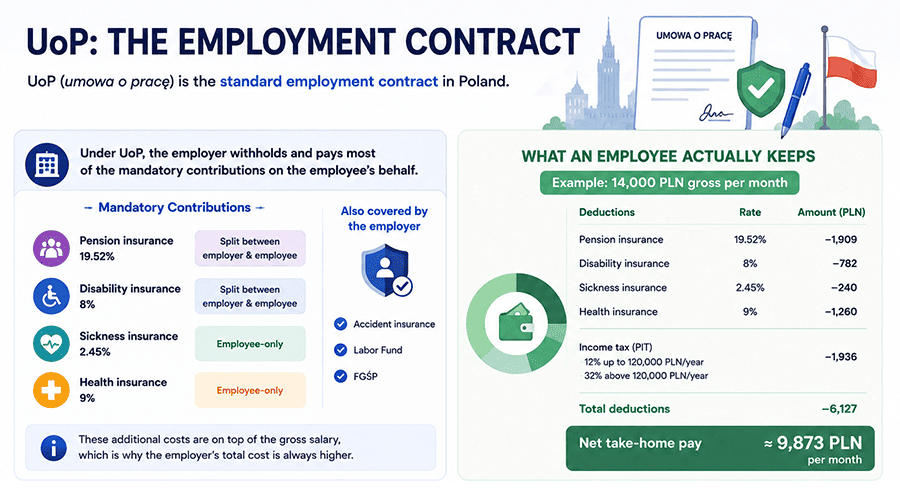
UoP (umowa o pracę) is the standard employment contract.
The employer withholds and pays most of the mandatory contributions on the employee's behalf: pension insurance (19.52%, split between employer and employee), disability insurance (8%), sickness insurance (2.45%, employee-only), and health insurance (9%). The employer also covers accident insurance, the Labor Fund, and FGŚP on top of the gross salary, which is why an employer's actual cost of hiring someone always runs higher than the number on the contract.
What an employee actually keeps depends on these deductions. At 14,000 PLN gross, after pension, disability, sickness, and health contributions plus the progressive income tax (12% up to 120,000 PLN of annual income, 32% above that), take-home pay lands around 9,873 PLN net per month. In exchange for that deduction, UoP comes with paid annual leave, paid sick leave, severance protections, and continuous pension contributions - none of which show up on a payslip but all of which have real value.
B2B: the contractor model
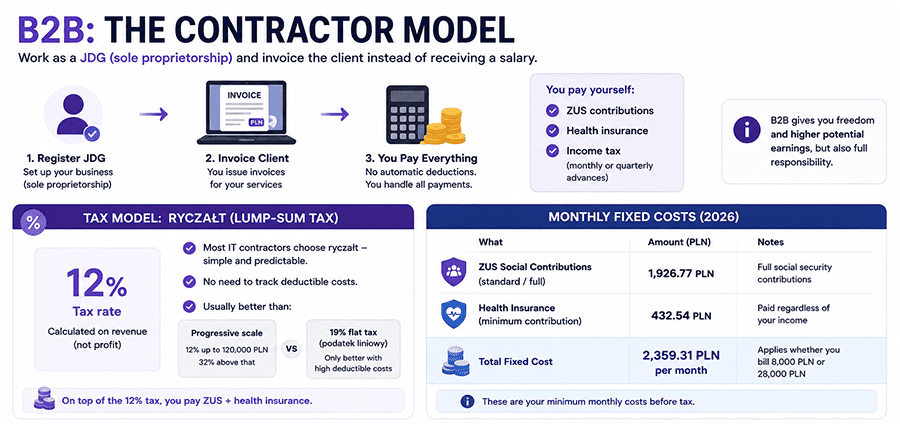
B2B means registering a JDG (sole proprietorship - jednoosobowa działalność gospodarcza) and invoicing the client instead of receiving a salary.
Nothing is withheld automatically; the contractor pays their own ZUS contributions, their own health insurance, and their own income tax, typically as a quarterly or monthly advance.
Most IT contractors in Poland choose ryczałt - a 12% lump-sum tax calculated on revenue rather than profit. It's simple (no need to track deductible costs) and, for someone with low business expenses, usually beats the alternatives: the progressive scale (12%/32%) or the 19% flat tax (podatek liniowy), which only pulls ahead once deductible costs are substantial. On top of the 12% tax, a contractor pays ZUS. In 2026, standard ("full") ZUS social contributions run about 1,926.77 PLN per month, plus a minimum health contribution of 432.54 PLN - a fixed cost that applies whether the contractor bills 8,000 PLN or 28,000 PLN that month.
New businesses get meaningful relief from that fixed cost. Ulga na start exempts a new JDG from social contributions entirely for the first 6 months (health insurance still applies). After that, preferential ZUS applies for 24 months, with social contributions calculated on a base of just 30% of the minimum wage - around 456 PLN per month in 2026, versus the full 1,926.77 PLN. That's a difference of roughly 1,470 PLN every month for two years, which matters enormously for anyone making the jump from UoP to B2B for the first time.
The same rate, two different outcomes. Take a 14,000 PLN monthly rate, structured two ways:
On UoP, after all mandatory contributions and progressive tax, take-home pay is approximately 9,873 PLN net.
On B2B with ryczałt 12% and full ZUS, the contractor pays roughly 1,927 PLN in social contributions, 433 PLN in health insurance, and 12% tax on the remaining revenue (with half the health contribution deductible from the tax base) - landing in the 12,800-13,200 PLN net range, depending on exact deductions claimed. With preferential ZUS during the first 24 months, that net figure climbs further, since the fixed contribution drops by close to 1,470 PLN a month.
The gap is consistently in the 3,000-4,000 PLN per month range at this income level - 36,000-48,000 PLN a year, enough to fully fund both an IKE and IKZE retirement account with room left over. That's the number that explains why so many mid-level and senior developers in Poland push for B2B once their rate clears roughly 14,000 PLN gross-equivalent: below that threshold, the fixed ZUS cost eats too much of the advantage to be worth the loss of paid leave; above it, the math tips clearly in B2B's favor.
Where B2B stops making sense
None of this means B2B is automatically the better deal. A contractor on B2B has no paid vacation, no paid sick leave, and no employer-funded pension top-up - those 3,000-4,000 PLN a month are compensation for risks an employee doesn't carry, not free money.
There's also a structural risk worth naming directly: if a B2B contract functions like employment in every way that matters - fixed hours, a single client, the contractor working under the client's direct supervision with no real business risk - Polish tax authorities can reclassify it as "ukryte zatrudnienie" (disguised employment) under Article 5b of the PIT Act. The criteria they apply come down to three things: who controls when and where the work happens, whether the contractor is subordinate to the client the way an employee would be, and whether the contractor carries any genuine business risk. If a B2B arrangement fails that test, the consequences land retroactively - up to five years of back ZUS contributions calculated as if the person had been on UoP the whole time, plus the tax difference between what was paid and what would have been owed. Enforcement on this has tightened noticeably in the IT sector over the past two years, which is worth knowing before treating a B2B contract as a pure tax optimization with no downside.
The practical takeaway: B2B makes the most financial sense at higher rates, ideally with more than one client or at least a contract structured with genuine independence - not as a thin wrapper around what is, in substance, a regular job.
Which Stack Pays: React, Angular, Vue, and the TypeScript Premium
- React paired with TypeScript is the default stack in the Polish job market in 2026 - the listing that shows up most often, across product companies, outsourcing shops, and everything in between. TypeScript proficiency itself carries a separate premium on top of that: not just importing types and moving on, but writing generics, utility types, and complex type logic comfortably. That level of TypeScript fluency adds roughly 5-10% to a rate compared to a developer working the same React codebase without it. By 2026, TypeScript is close to mandatory for senior roles specifically - a senior candidate who hasn't worked seriously with TypeScript is increasingly the exception, not the norm.
- Angular holds the second spot, concentrated heavily in enterprise software and fintech, where its opinionated structure and built-in tooling fit large, long-lived codebases with bigger teams. At junior and mid-level, Angular roles tend to pay slightly less than equivalent React positions, but the gap narrows and often disappears at senior level, where architectural decisions matter more than the framework's market popularity.
- Vue and Nuxt occupy a smaller slice of the market, but the demand that exists is steady rather than disappearing - e-commerce platforms and digital agencies in particular keep hiring for it, often because an existing Vue codebase makes switching frameworks impractical. It won't show up in as many listings as React, but it's not a dead-end choice either.
- One pattern cuts across all three stacks: developers who can also work comfortably with Node.js and PostgreSQL - enough to ship a backend feature, not just call an existing API - see rates 10-20% higher than frontend-only peers at the same level. This "T-shaped" profile, deep on frontend with working competence on the backend, has become one of the more reliable ways to push a rate up without changing frameworks or chasing a new title.
- For anyone deciding where to invest learning time, the practical read is straightforward: React and TypeScript cover the large majority of postings on the market, and that combination should come first. Angular and Vue are worth knowing if a specific opportunity calls for them, not because skipping them closes doors - for most developers, they're additive rather than essential.
Here is a table for Salary by Stack (B2B, monthly) for a Frontend Developer in Poland. The figures below are illustrative reference ranges based on 2026 market data for React, Angular, Vue, React Native, and Flutter roles in Poland, where senior B2B rates vary by stack and market demand.
| Stack | Junior B2B / month (PLN) | Mid B2B / month (PLN) | Senior B2B / month (PLN) |
| React / Next.js | 10,000-15,000 | 19,000-25,000 | 26,000-34,000 |
| Angular | 11,000-16,000 | 20,000-27,000 | 28,000-38,000 |
| Vue / Nuxt | 10,000-14,000 | 18,000-24,000 | 25,000-32,000 |
| React Native | 12,000-16,000 | 21,000-27,000 | 28,000-36,000 |
| Flutter | 10,000-15,000 | 18,000-24,000 | 25,500-32,000 |
The main source for the stack-based ranges is the 2026 «Frontend Developer Salary in Poland - Earnings, B2B Rates, and Financial Planning», which provides B2B benchmarks by framework and seniority. For broader context on frontend market pay in Poland, I also used a «Polish Developer Salary & Cost 2026: B2B, ZUS, EOR» that shows typical B2B ranges by experience level and confirms that B2B compensation is usually higher than UoP for the same role.
Location Matters: Warsaw, Kraków, Wrocław, and Remote Work
Warsaw sits at the top of the salary range for nearly every level and stack - it has the highest concentration of product companies, the largest number of listings, and the deepest senior-level demand. It's also the most expensive city in Poland to live in, by a noticeable margin, which means a Warsaw salary doesn't stretch as far as the raw number suggests.
Kraków and Wrocław are the two other major hubs, both built heavily around outsourcing and GCC (global capability center) operations for international companies. Salaries in both cities typically land somewhat below Warsaw at the same level, but the cost of living is meaningfully lower too - rent in particular can be 20-30% cheaper. The result is that real purchasing power between a Kraków offer and a Warsaw offer is often closer than the gross numbers alone would suggest.
Beyond these three, a handful of other cities maintain real IT hiring activity worth knowing about:
- Poznań - smaller but stable market, several established outsourcing firms
- Gdańsk - coastal tech hub with a growing gaming and product sector
- Łódź - lower cost of living, increasing BPO and shared-services presence
- Katowice - part of the Upper Silesian metro area, steady outsourcing demand
Remote and hybrid work complicate the city comparison further. It's possible to land a Warsaw-level rate while living somewhere cheaper, and plenty of developers do exactly that with international or fully remote companies. But it isn't guaranteed: many Polish employers - especially smaller product companies and those requiring occasional office presence - still price roles by the local market they're hiring into, not by what a candidate could theoretically earn elsewhere. Fully remote roles with companies outside Poland tend to offer the cleanest version of this arbitrage; remote roles with Polish employers often still track the salary band of whichever city the company is headquartered in.
A Junior's Realistic Path Into the Polish Market
There's no version of this where three months of tutorials turns into a job offer. The junior market in Poland in 2026 is more competitive than it was a few years ago - more applicants, fewer pure-junior openings, and recruiters who've gotten faster at filtering out candidates who can recite concepts but can't build anything. A realistic timeline runs closer to 6-12 months of focused, structured learning before someone is genuinely ready to interview, and that's assuming consistent effort rather than occasional evening study.
What actually gets a junior candidate past the first screen isn't a certificate or a course completion badge. Recruiters and hiring managers tend to look for a specific, narrow set of signals:
- A GitHub profile with a few complete, working projects - not dozens of half-finished ones, and not a single tutorial clone with no original logic added
- Comfortable, daily use of Git: branching, resolving merge conflicts, writing commit messages that explain intent, not just "fix bug"
- A working grasp of JavaScript fundamentals and basic algorithmic thinking - enough to reason through a simple coding problem out loud, not necessarily competitive-programming-level skill
- Functional English, spoken and written - for most outsourcing companies and international teams, English is the actual working language day to day, and a candidate who can't hold a technical conversation in it gets filtered out regardless of coding ability
Polish language requirements split sharply by company type. Polish product companies, especially smaller ones serving the domestic market, often expect at least conversational Polish, since team communication and sometimes client-facing work happens in it. Outsourcing firms and international or remote-first teams, on the other hand, frequently operate entirely in English - for a junior targeting that segment of the market, Polish is a nice-to-have rather than a requirement.
For a structured breakdown of what to learn first, in what order, and how long each stage realistically takes, the frontend developer roadmap walks through the path stage by stage rather than dumping the entire stack at once. Pairing that with focused interview preparation - practicing the kind of live-coding and system-design questions Polish tech interviews actually ask - closes the gap between "technically capable" and "ready to interview" faster than continuing to study in isolation.
Common Mistakes Job Seekers Make in Poland
Conclusion
The honest answer to "how much do frontend developers earn in Poland" is that the question itself is incomplete. Level matters, stack matters, city matters - but none of those move the final number as much as whether the contract is UoP or B2B. A junior on B2B can genuinely take home more than a mid-level developer on UoP, and a senior who treats B2B as a pure tax shortcut without checking the disguised-employment criteria can end up with a five-year-old liability instead of savings.
The data points in this article are a starting point, not a substitute for running the numbers on a specific offer. ZUS rates, tax thresholds, and the minimum wage all shift from year to year, and a contract that made sense under 2025 rules can land differently under 2026 ones. Before accepting any offer - UoP or B2B - it's worth recalculating the actual net figure against current rates rather than relying on last year's math, and worth asking directly how a B2B contract is structured if independence and risk allocation aren't obvious from the job description.
Stack and location decisions matter too, just on a longer timeline. Choosing React and TypeScript over a narrower stack, or weighing a Kraków offer against a Warsaw one with cost of living in mind, shapes earning potential over years, not just the first paycheck. None of that complexity is a reason to avoid the Polish market - it's simply the difference between comparing two numbers and actually understanding what each of them means.
The number worth asking about in any offer isn't the gross figure in the posting - it's what contract sits behind it, and what that contract actually nets out to once ZUS and tax are accounted for. Get that answer first, and every other comparison - level, stack, city - becomes much easier to make honestly.
Frequently Asked Questions
How much does a junior frontend developer earn in Poland in 2026?
A junior frontend developer in Poland typically earns 6,000-9,500 PLN gross per month on a UoP contract, or 7,500-12,000 PLN net on B2B. The wide range comes down mostly to city, stack, and company type - outsourcing firms and smaller product companies tend to sit at the lower end of that range, while Warsaw-based product companies hiring for React and TypeScript sit closer to the top. It's worth noting that very few "junior" listings in 2026 are truly entry-level in the traditional sense; many expect a working portfolio, comfortable Git usage, and basic algorithmic thinking before extending an offer at all. Annualized, that range translates to roughly €19,000-€31,000, depending on contract type and exchange rate at the time. Candidates evaluating multiple junior offers should always confirm contract type before comparing the headline numbers, since a B2B junior offer and a UoP junior offer at the same gross figure can differ by a meaningful margin once taxes and ZUS contributions are accounted for.
Is B2B better than UoP for a frontend developer in Poland?
It depends heavily on the rate and on how the contract is actually structured. Below roughly 14,000 PLN gross-equivalent per month, the fixed ZUS cost on B2B - around 1,927 PLN in social contributions plus 433 PLN in health insurance under full ZUS - eats too much of the advantage to clearly beat UoP, particularly once paid vacation and sick leave are factored into the comparison. Above that threshold, B2B typically nets an extra 3,000-4,000 PLN per month, which adds up to 36,000-48,000 PLN a year. That said, B2B only makes sense as a genuine business arrangement: a single client, fixed hours, and direct supervision that mirrors employment can trigger a "ukryte zatrudnienie" (disguised employment) reclassification, with up to five years of back ZUS contributions and tax owed retroactively. New entrepreneurs should also factor in ulga na start and preferential ZUS, which significantly lower the fixed cost during the first 24 months.
Do I need to speak Polish to work as a frontend developer in Poland?
Not necessarily, and it depends almost entirely on the type of company. Outsourcing firms and international or remote-first teams generally operate in English as the default working language - code reviews, stand-ups, and documentation all happen in English, and many of these teams have colleagues spread across multiple countries where Polish wouldn't help anyway. Polish product companies serving the domestic market are a different story: team communication, client meetings, and internal documentation are more likely to happen in Polish, so at least conversational fluency becomes genuinely useful, even if the job posting doesn't explicitly require it. For a junior or mid-level developer targeting the outsourcing segment specifically, investing in stronger English typically pays off faster than investing the same hours into learning Polish, since English directly affects how a candidate performs in technical interviews.
What's the most in-demand frontend stack in Poland right now?
React combined with TypeScript covers the large majority of frontend listings in Poland across nearly every level and company type in 2026, and that combination should be the first priority for anyone planning their learning path. TypeScript fluency specifically - writing generics and complex types, not just using existing ones - adds a separate 5-10% premium on top of the base React rate, and by 2026 it's close to mandatory for senior roles. Angular holds a steady second position, concentrated heavily in enterprise software and fintech, where its more opinionated structure suits large, long-lived codebases. Vue and Nuxt occupy a smaller niche, mostly in e-commerce and digital agencies, with demand that's stable rather than growing. Developers who also work comfortably with Node.js and PostgreSQL - enough to ship backend features, not just consume an API - typically see rates 10-20% higher than frontend-only peers at the same seniority.
Which Polish city pays the highest frontend developer salaries?
Warsaw leads on gross salary at nearly every level and for nearly every stack, driven by the highest concentration of product companies and the deepest senior-level demand in the country. It also carries the highest cost of living by a clear margin, which means the raw salary number overstates how far that money actually goes day to day. Kraków and Wrocław, the two other major hubs, typically pay somewhat less in absolute terms but benefit from meaningfully lower living costs - rent in particular can run 20-30% cheaper than in Warsaw. The practical result is that real purchasing power between a Kraków offer and a comparable Warsaw offer often ends up closer than the salary figures alone would suggest, which makes location a question of lifestyle and cost trade-offs rather than a simple "highest number wins" comparison.