
Frontend Developer Job in the UK (2026): Permanent vs Contractor, Inside vs Outside IR35
01 July 2026
358 views
This guide is up to date as of October 2026


Written by
Marcus Hale,
IT Talent Acquisition Specialist

Reviewed by
Charlotte Thompson,
Senior Technical Recruiter, United Kingdom
Frontend developer salaries in the UK can range anywhere from £35,000 to £80,000 a year in 2026, and the size of that gap isn't random. Grade explains part of it - junior and senior roles sit at opposite ends. City explains another part - London still pays a real premium over Manchester or Glasgow. But the variable that moves the number the most, and gets talked about the least, is whether you're employed permanently or working as a contractor through your own limited company.
That contractor route comes with a catch almost no frontend career guide mentions: IR35. It's UK tax legislation that decides whether HMRC treats your day rate as genuine business income or as a disguised salary - and getting the classification wrong can quietly cut your take-home pay by 20-30%, even at the same rate. Most roadmaps and salary breakdowns stop at "junior vs senior" or "London vs everywhere else."
The UK frontend market in 2026 is crowded at the generalist end and thin at the specialist end.
Junior and mid-level roles asking for general "React experience" draw hundreds of applicants per posting. Roles asking for production TypeScript, Next.js at scale, or hands-on design system work draw far fewer - and take longer to fill, because there simply aren't enough developers who've done that work for real. This split shows up in how companies budget for the role, not just in the job description. Permanent roles are still advertised with an annual salary band. Contract roles are priced by day rate instead - a figure that only tells you what you're actually earning once you know how many billable days you're working and how your IR35 status affects it. Both numbers describe the same job market, but they're not directly comparable without doing that conversion, which is exactly what the rest of this guide walks through.
Frontend Developer Salary in UK by Experience Level
Grade is still the single biggest factor in what a frontend developer earns in the UK, more than stack, more than company size, and in most cases more than city. The jump from junior to mid-level typically brings the sharpest percentage increase in a developer's career, simply because the market treats "can build a feature with guidance" and "can own a feature end to end" as fundamentally different hires. The jump from mid to senior is usually smaller in percentage terms but wider in absolute pounds, since senior compensation starts factoring in scarcity - there are fewer developers who can be trusted with architecture decisions, mentoring, and production incidents at the same time.
What complicates a simple junior/mid/senior breakdown is that grade isn't standardised across companies. One company's "senior" is another's "mid-level with a title bump," and job ads don't always make that clear until you're in the interview process. That's worth keeping in mind when comparing the numbers below against a specific job posting - the salary band tells you less about the role than the actual responsibilities listed underneath it.
The table below breaks down current UK frontend developer salary ranges by experience level, both nationally and in London specifically, along with notes on where each figure comes from.
| Experience level | UK average (national) | London | Comment |
| Junior (0-2 years) | £26,000-£32,000 | £32,000-£38,000 | PayScale entry-level total comp is around £31K; national junior figures vary by source. |
| Mid (2-5 years) | £38,000-£46,000 | £44,000-£55,000 | PayScale early-career total comp is about £39.6K, which sits near the lower end of the mid band. |
| Senior (5+ years) | £46,000-£60,000 | £60,000-£80,000 | Morgan McKinley’s 2026 London recruiter range is broadly £50K-£60K, while other London senior tech data often runs higher. |
| Lead / Staff | £55,000-£70,000+ | £75,000-£95,000+ | Upper-end figures are usually from FAANG, finance, or highly competitive placements, so they are not typical market pay. |
Sources: Indeed UK Salaries , Glassdoor UK , PayScale UK , Morgan McKinley 2026 Salary Guide
The numbers differ because each source measures pay differently: Indeed and Glassdoor rely heavily on self-reported or job-posting-based salary data, PayScale leans on self-reported compensation, and Morgan McKinley reflects recruiter-market intelligence and placements. That is why London averages can sit anywhere from roughly £50K to £70K+ depending on methodology, role definition, and whether bonuses or total comp are included.
Salary Outside London: City Breakdown
London still sets the ceiling, but it's no longer the only city worth checking before you negotiate. Manchester, Bristol, Edinburgh, and a handful of other UK cities have built genuine tech clusters over the past few years, and the salary gap with London has narrowed - even if it hasn't closed. For anyone comparing frontend developer jobs London outside London, the headline number in a job ad only tells half the story; the other half is what that number is actually worth where you'd be living.
The table below lists median frontend developer salaries by city, but a raw pound figure doesn't account for what you can actually do with it.
| City | Median salary | Note |
| London | £59,993 | Highest-paying UK city in the data set; London consistently sits above the national average. indeed+1 |
| Manchester | £43,000 | A strong regional market, typically below London but still competitive for frontend roles. wearedevelopers+1 |
| Edinburgh | £39,000 | Solid tech hub with salaries usually in the upper regional band rather than London-level pay. wearedevelopers+1 |
| Bristol | £41,000 | Often one of the better-paying regional cities, especially for product and tech companies. indeed+1 |
| Liverpool | £38,000 | Lower than Bristol and Manchester, but still within a healthy regional frontend range. wearedevelopers+1 |
| Belfast | £37,000 | Tends to sit near the lower-middle of the UK city distribution for frontend work. wearedevelopers+1 |
| Birmingham | £43,031 | Close to Manchester in this benchmark set and supported by Indeed city data. indeed+1 |
| Leeds | £38,000 | Competitive regional salary, usually slightly below Manchester and Birmingham. wearedevelopers+1 |
| Glasgow | £39,000 | Similar to Edinburgh, with pay typically in the mid-regional band. wearedevelopers+1 |
Sources used: Indeed UK Front End Developer salaries , WeAreDevelopers frontend salary article , Reed frontend developer salaries .
The numbers vary because each source uses a different method: Indeed leans on reported salaries and live job data, WeAreDevelopers summarizes city medians from its own benchmark dataset, and Reed reflects its job-market listings. That is why London can land near £60K in one source while regional cities cluster in the high-30s to low-40s.
Cost of living is where the comparison gets more interesting than the table alone suggests. A £43,000 salary in Manchester often stretches further than a £55,000 salary in London once rent, transport, and everyday costs are factored in - the nominal gap looks bigger than the real one. This isn't a fixed conversion rate, and it shifts depending on whether you're renting alone, sharing, or commuting in from further out, so treat any rule of thumb as a starting point, not a guarantee. If you're weighing a specific offer, it's worth running the two cities through a cost-of-living comparison tool like Numbeo before deciding whether the London number is actually the better deal.
There's also a third option that's reshaped this comparison entirely: staying outside London while working for a London-based company. Remote and hybrid roles have made it possible to earn close to London-level pay without paying London-level rent, and this is increasingly what people mean when they search for frontend developer salary outside London 2026 - not necessarily a locally-based role in Leeds or Glasgow, but a remote contract with a London company's budget attached to it.
Not every employer offers this, and some still adjust pay by location even for remote staff, so it's worth clarifying during the interview rather than assuming.
Frontend Developer Contractor vs Permanent UK: The Real Difference
The choice between permanent employment and contracting isn't just about the number on the contract - it's a completely different structure for how you get paid, taxed, and protected. Understanding that structure matters more than comparing headline figures, because a higher day rate doesn't automatically mean a higher take-home income once you account for what a permanent role includes that a contract doesn't.
As a permanent employee, you're paid through PAYE (Pay As You Earn), which means income tax and National Insurance are deducted automatically before the money reaches your account. In exchange, you get a package that goes beyond salary:
- Paid holiday, typically 25-28 days plus bank holidays
- Sick pay and statutory parental leave
- Employer pension contributions
- Job security tied to a notice period, not a fixed contract end date
- Often training budgets, equipment, and other perks bundled into the role
Contracting works differently. You're typically paid a day rate through your own limited company (a Personal Service Company, or PSC) or via an umbrella company, and none of the above is included by default. There's no employer pension top-up, no paid holiday, no sick pay - every non-working day is simply a day you don't invoice for. What you get instead is a higher headline rate and, depending on how the contract is taxed, the potential for meaningfully higher take-home pay than an equivalent permanent salary.
Day rates for frontend contractors vary by seniority and by how much of the role is genuinely specialist. According to ITJobsWatch data from UK contract job postings in 2026, the median day rate for a front-end developer sits around £478, rising to roughly £575 for senior front-end roles - a range that lines up with ContractorUK's broader market rate reports, which put most developer contracting work at £400-£550+ a day depending on location and sector, with financial services and London-based contracts typically at the top of that range.
That day rate is only ever a starting number, though. What actually lands in your account depends heavily on one thing this guide hasn't touched yet: whether HMRC classifies your contract as inside or outside IR35. That distinction is the difference between a £500 day rate performing like a solid contractor income and it performing like a permanent salary with none of the permanent benefits - and it's covered in full in the next section.
IR35 Explained: The Tax Trap No One Warns You About
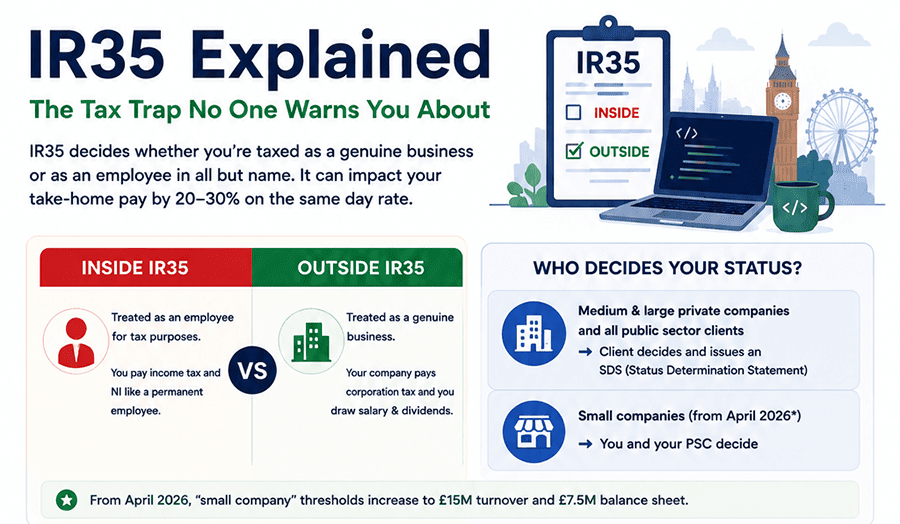
IR35 is the piece of UK tax legislation that decides whether a contractor working through their own limited company is taxed as a genuine business or as an employee in all but name. It was introduced in 2000 to close what HMRC calls "disguised employment" - cases where someone sets up a Personal Service Company (PSC), invoices a client through it, but in practice shows up, takes direction, and does the job exactly like a permanent staff member would, while paying less tax than an employee on the same income. IR35 exists to remove that gap. For frontend developers moving between permanent roles and contracting, it's the single most important piece of tax law to understand, because it decides how much of your day rate you actually keep.
Inside vs outside IR35
Being "inside IR35" means HMRC treats the engagement as employment for tax purposes - you're taxed roughly the same way a permanent employee would be, even though you're technically running your own company. Being "outside IR35" means the engagement is treated as a genuine business-to-business relationship - your company pays corporation tax on its profits, and you draw income from it as salary and dividends, which is typically taxed more favourably. Same contract structure, same limited company, completely different tax outcome - and the difference isn't something you choose. It's determined by how the contract actually works in practice.
Who determines your status in 2026
For contracts with medium or large private-sector clients, and all public-sector clients, the client is responsible for assessing your status and must issue a Status Determination Statement (SDS) confirming whether the role is inside or outside IR35. For contracts with genuinely small companies, that responsibility sits with you and your own PSC instead. This distinction matters more in 2026 than it has in previous years: from April 2026, the turnover and balance sheet thresholds that define a "small company" are rising to £15 million turnover and £7.5 million balance sheet.
That reclassifies a meaningful number of businesses from "medium" to "small" - which means contractors working with those companies go from having their IR35 status determined for them to having to determine it themselves. If you're contracting with a mid-sized company in 2026, it's worth checking directly whether their size classification has changed, because it changes who's legally on the hook for getting your status right.
Joint & Several Liability and why it matters for contract availability
A second change lands at the same time: from April 2026, new Joint & Several Liability (JSL) rules make umbrella companies, recruitment agencies, and end clients jointly responsible for unpaid PAYE and National Insurance in a contractor's supply chain. If an umbrella company fails to pay HMRC correctly, the liability doesn't disappear - it moves up the chain, first to the agency, then to the end client if the agency can't cover it. That's a new risk for companies that currently route contractors through umbrella arrangements, and it's already pushing some employers to reconsider blanket "inside IR35" policies in favour of genuine outside-IR35, project-based contracts instead - because a well-structured outside-IR35 engagement doesn't carry the same umbrella-related liability exposure. If this trend continues, it's good news for frontend contractors who've found outside-IR35 work harder to come by since the 2021 reforms.
The three tests that actually decide your status
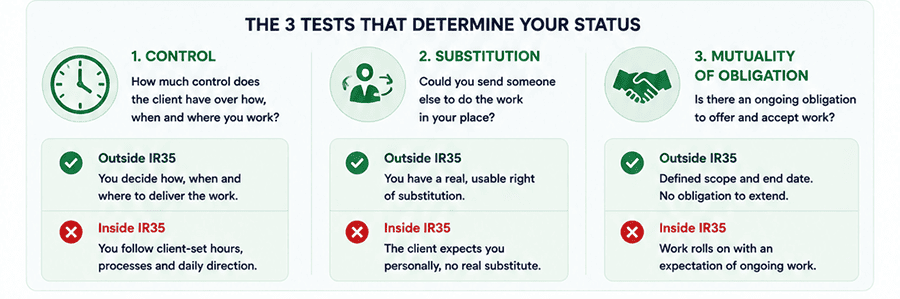
HMRC and case law boil the assessment down to three core questions, and it's worth understanding each one in a frontend context specifically, since "control" and "substitution" look different for a developer than they do for, say, a contractor on a building site.
- Control - how much say does the client have over how, when, and where you work? A frontend contractor who's required to attend daily standups at fixed times, work client-set hours, and follow a prescribed workflow looks more like an employee under this test. One who agrees a scope of work and delivers it on their own schedule, using their own approach, looks more like a genuine contractor.
- Substitution - could you send someone else to do the work in your place? If your contract includes a real, usable right of substitution - you could genuinely send another qualified developer to pick up your sprint work and the client would accept it - that points firmly outside IR35. If the client's expectation is clearly you specifically , with no realistic substitute allowed, that points inside.
- Mutuality of obligation (MOO) - is the client obliged to keep offering you work, and are you obliged to accept it? A contract with a defined scope and end date, where neither side is expected to extend it automatically, points outside IR35. An arrangement that quietly keeps rolling over sprint after sprint with an unspoken expectation you'll keep saying yes starts to look like ongoing employment.
What this actually costs you
The financial gap between inside and outside IR35 is real, and it's usually described as a 20-30% difference in take-home pay for the same day rate. Here's roughly how that plays out: take a contract at £500 a day, worked close to full-time - somewhere around £115,000-£120,000 a year in gross billings. Taxed inside IR35, that income is processed broadly like employment income - income tax and National Insurance are deducted at source, typically via an umbrella company that also takes its own margin and accounts for employer NI costs out of the rate before you're paid.
Taxed outside IR35 through your own PSC, your company pays corporation tax on its profits, and you draw a modest salary plus dividends - dividends taxed separately from income tax, with the first £500 tax-free in the 2026/27 tax year and the remainder taxed at 10.75% for basic-rate taxpayers, 35.75% at the higher rate, and 39.35% at the additional rate. Structured this way, the same £500 day rate can leave you with several thousand pounds more in take-home pay over a year outside IR35 than inside it.
That said, this is illustrative, not a tax calculation you should rely on. Your actual take-home depends on your specific circumstances - other income, expenses, how your company is structured, and how the numbers are drawn down - and getting an IR35 assessment wrong carries its own financial risk in the form of backdated tax and penalties. If you're weighing a contract based on its IR35 status, it's worth running your actual numbers past an accountant who specialises in contractor tax before signing anything.
What Tech Stack UK Employers Actually Pay For
Job descriptions are a more honest signal of what the UK frontend market values than any roadmap or "learn this in 2026" listicle. Scanning through current postings on LinkedIn Jobs UK, Indeed, and Otta shows a clear split: some skills show up in almost every listing regardless of company size or sector, while others appear far less often - but tend to sit in postings with noticeably wider salary bands attached. That gap is the difference between a skill that gets you shortlisted and one that actually moves your offer.
The table below breaks that down - what's effectively table stakes now versus what still functions as a premium skill in the UK market, based on a review of current frontend job postings rather than assumptions about what "should" be in demand. Worth treating as a snapshot rather than a fixed ranking, since this shifts every few months as job postings turn over.
| Technology | Label | What the market signal says |
| HTML , CSS , JavaScript | Table stakes | These appear as baseline requirements in frontend ads and are treated as the default entry point, not a differentiator. |
| React , React Native | Table stakes | One of the most repeated frontend frameworks in UK listings, especially in larger enterprise and product teams. |
| TypeScript | Table stakes | Often paired with React and shown as a core requirement rather than a bonus skill. |
| REST APIs | Table stakes | Common across ads because frontend hires are usually expected to integrate with backend services. |
| Vue.js | Table stakes | Present in UK roles, but less common than React in the sample set; still a real hiring requirement. |
| Next.js | Premium | When it appears, it is usually attached to stronger senior or product-focused roles with better salary bands. |
| GraphQL | Premium | More often seen in higher-complexity product teams than in baseline frontend roles, which suggests a stronger compensation signal. |
| Testing stack: Jest, Cypress, Playwright | Premium | Ads that specify stronger testing expectations often sit in more mature teams and can carry higher ranges. |
Sources used: Indeed UK frontend jobs , LinkedIn UK frontend jobs , Indeed UK front-end developer listings , and IT Jobs Watch London
A useful read of the market is that employers still pay for bread-and-butter frontend fundamentals first, but salary jumps are more likely when the role combines React or TypeScript with newer architecture skills such as Next.js, GraphQL, strong testing, and end-to-end delivery ownership. In the sample jobs, the clearest higher-range signals came from postings like React / TypeScript / Next.js roles in London, while generic JavaScript-only or framework-light roles were usually
How to Get Your First Frontend Job in the UK With No Experience
Breaking into frontend development in the UK with no prior experience is genuinely harder in 2026 than it was a few years ago - junior roles get flooded with applicants, and many companies have quietly raised the bar on what counts as "junior" in the first place. That doesn't mean it's impossible, but it does mean generic advice like "build a portfolio" or "apply to lots of jobs" isn't enough on its own. What actually moves the needle is being specific about what you build, where you apply, and how you present yourself as hireable despite having no paid experience to point to.
There's also a barrier that most guides skip over, and international readers in particular deserve a straight answer on: visa sponsorship for junior frontend roles in the UK is rare. Sponsoring a Skilled Worker visa costs UK employers money and admin, and most companies only do it for roles they can't fill locally - which junior frontend rarely qualifies as, given how many UK-based candidates are already competing for the same roles. If you're applying from outside the UK, factor this into your job search from day one rather than discovering it after dozens of rejections.
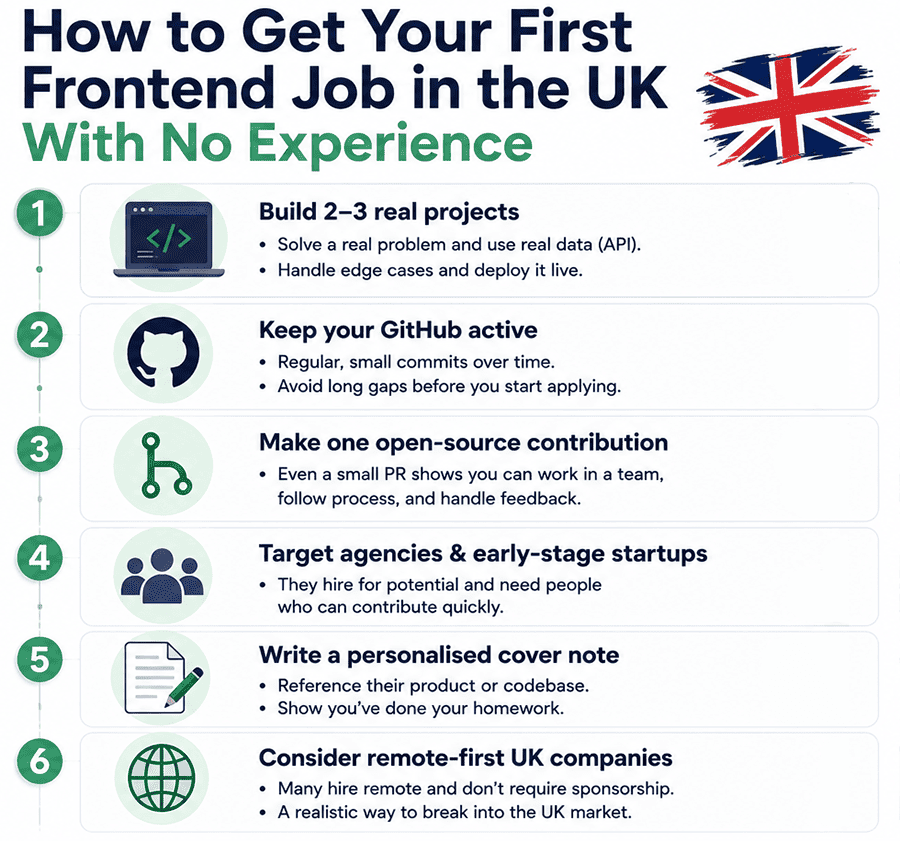
- Build 2-3 projects that solve a real problem , not tutorial clones. A to-do app or a cloned Netflix homepage tells a hiring manager you can follow instructions. A project that fetches real data from a public API, handles actual edge cases, and is deployed somewhere live tells them you can think. Pick something you'd genuinely use, and make sure it's deployed - a GitHub repo with no live link makes reviewers do extra work they usually won't bother with.
- Keep your GitHub activity consistent, not just present. A profile with one big commit from three months ago reads very differently to one showing regular, smaller commits over time. You don't need daily activity, but reviewers do check contribution history, and a long gap right before you start applying is a visible red flag worth avoiding.
- Make one real open-source contribution, even a small one. A merged pull request - even something as small as fixing a broken link in a popular repo's docs - is proof you can work inside someone else's codebase, follow a review process, and get feedback. That's a more convincing signal of team-readiness than another solo project, and it costs a weekend, not months.
- Target agencies and early-stage startups before enterprise companies. Agencies and small startups are far more likely to hire for potential over experience, because they need someone who can start contributing fast on varied projects. Enterprise companies tend to have more rigid junior requirements and slower, more competitive graduate schemes - worth applying to, but don't make them your only strategy.
- Write a cover note that references the actual codebase or product or use Front End Developer Job Description: Generator Template . Mentioning something specific - a bug you noticed on their site, a technical choice in their public repo, a feature you'd approach differently - takes ten extra minutes and puts you ahead of the generic applications hiring managers skim past.
- If sponsorship is a blocker, look at remote-first UK companies before ruling out the UK market entirely. Some UK companies hire remote contractors or remote employees without requiring a UK-based visa at all, since the arrangement doesn't require sponsorship the way an in-country hire does. It's a narrower pool of roles, but it's often more realistic than competing for the small number of sponsored junior positions.
Conclusion
The honest answer to "where can a frontend developer earn more in the UK" isn't London, and it isn't contracting - it's whichever of the two actually matches your circumstances. London still pays a premium, but remote and hybrid roles have made that premium accessible without the London cost of living attached to it. Contracting can outearn permanent employment by a meaningful margin, but only when the contract is genuinely outside IR35, bookings stay consistent, and you're accounting for the benefits you're giving up to get there. Neither path is automatically the better one; both come with trade-offs that only make sense once you've done the actual math for your situation.
If you're earlier in that process - still building toward your first UK role or your first outside-IR35 contract - the stack and experience gaps matter more than the tax structure for now. ReadyToDev.Pro's frontend roadmap breaks down exactly what UK employers are hiring for at each level, so you're building toward a role that actually exists in this market, not a generic one.
FAQ about Frontend Job in UK
Is £50K a good frontend developer salary in the UK in 2026?
It depends entirely on where you're based and what stage you're at. Outside London, £50K sits comfortably above median for a mid-level frontend developer and is a strong result for someone with 3-5 years of experience. In London, it's closer to the middle of the range - solid for a mid-level role, but below what an experienced senior would typically expect given the city's higher cost of living. The more useful comparison isn't a flat "good vs bad" number, but how it stacks up against the specific city and grade breakdowns covered earlier in this guide.
What's the difference between inside and outside IR35?
Inside IR35 means HMRC treats your contract as employment for tax purposes, even though you're working through your own limited company - you're taxed roughly the same way a permanent employee would be. Outside IR35 means the engagement is treated as a genuine business-to-business relationship, letting you draw income as salary and dividends, which is usually taxed more favourably. The distinction isn't something you pick; it's determined by how the contract actually works day to day, based on tests like control, substitution, and mutuality of obligation.
Do I need a visa to work as a frontend developer in the UK?
If you're not a UK or Irish citizen and don't already have the right to work in the UK, yes - you'll typically need a Skilled Worker visa, which requires an employer willing to sponsor you. Sponsorship is realistic for mid-level and senior roles at companies that already hold a sponsor licence, but it's genuinely rare for junior positions, since most employers only sponsor roles they can't fill with local candidates. Check a company's sponsor status before investing time in an application if this applies to you.
Is contracting more profitable than permanent employment for frontend developers?
It can be, but only under the right conditions - genuinely outside-IR35 status, consistent bookings with minimal gaps between contracts, and enough experience to command a competitive day rate. Factor in the benefits contracting doesn't include - no paid holiday, no employer pension, no sick pay - and the real comparison is closer than the headline day rate suggests. For someone early in their career or without reliable client pipelines, permanent employment is usually the safer and often equally profitable option once total compensation is accounted for.
What frontend stack should I learn to maximize my salary in the UK?
Based on current UK job postings, React and TypeScript together function as the baseline expectation for most mid-to-senior roles - not learning them limits you more than knowing them helps you. What tends to move salary bands upward is depth beyond that baseline: strong Next.js experience, comfort working within or building design systems, and the ability to work close to performance or architecture decisions rather than just implementing UI. Breadth across frameworks matters less than genuine depth in the stack a specific employer already runs.