
Frontend Developer Salary in Switzerland (2026): FAANG Offers & Work Permits
22 July 2026
306 views
This guide is up to date as of October 2026

Written by
Marcus Hale,
IT Talent Acquisition Specialist

Reviewed by
Felix Meier,
Engineering Recruitment Consultant, Switzerland
Frontend developer salaries in Switzerland span a wide range - roughly CHF 70,000 to CHF 151,000 or more per year (about $79,000-$171,000, or €73,000-€158,000), depending on city, seniority, and employer type. That gap is the whole story: a junior in Bern and a senior engineer at a Zurich-based tech giant are technically in the same national market, but their paychecks barely overlap.
The sections below break down what actually drives that spread - salaries by city, from Zurich's premium down to more affordable regions like Bern and Lausanne; how Swiss pay compares to Germany, the UK, and the Netherlands; and what compensation looks like at the FAANG and big-tech offices clustered around Zurich, including Google, Meta, and Microsoft. One thing to flag early: Switzerland isn't an EU member state, so the visa and work-permit process for non-EU/EEA developers works differently than it does elsewhere in Europe - that distinction matters more than most salary comparisons, and it's covered in detail further down.
How Much Do Frontend Developers Earn in Switzerland in 2026?
National averages are a useful starting point, but they hide more than they reveal in a market as fragmented as Switzerland's. Ask three different salary aggregators what a frontend developer earns here, and you'll get three different answers - not because the data is wrong, but because each source pulls from a different sample size, a different mix of self-reported versus employer-reported figures, and a different definition of "frontend developer" (some lump it in with full-stack roles, others don't). Glassdoor, ERI SalaryExpert, and Talent.com each publish 2025-2026 figures that land in overlapping but distinct ranges, and the honest approach is to show that spread rather than collapse it into one tidy number.
Frontend Developer Salaries by Level
What does stay consistent across sources is the shape of the curve: entry-level developers sit well below CHF 100,000 (about $79,000 / €73,000 at current rates), while senior engineers - particularly those working in Zurich's finance and tech sector - routinely clear CHF 130,000 and can push past CHF 150,000 once bonuses are factored in. The jump between mid-level and senior isn't gradual; it's closer to a step change, driven less by years of experience and more by whether a developer has moved into a role with architectural ownership, team leadership, or a specialization employers are actively short on.
The table below lays out that progression by experience level, pulling from multiple aggregators so you can see where they agree and where they diverge - and why relying on a single source would give you a distorted picture either way.
| Level | Glassdoor (vacancy + self‑reported) | ERI / SalaryExpert ( employer surveys ) | Talent.com (declared salaries) | Notes |
| Junior | CHF 70-85k | CHF 67-75k | CHF 82-90k | Talent.com often reads higher in Zurich/Zug due to large bank/tech sample. |
| Mid | CHF 85-100k | CHF 85-100k | CHF 95-120k | Mid roles in finance/fintech push toward 115-125k total. |
| Senior | CHF 100-130k | CHF 100-119k | CHF 120-150k | Senior in large cities can reach 160-180k with bonus + shares |
| Lead | CHF 120-160k (estimated) | No clear lead split | CHF 130-170k (role‑based) | Lead pay often includes senior base plus leadership bonus and equity. |
Why the numbers differ:
- Glassdoor mixes self‑reported salaries and job postings, often showing ranges without detailing bonuses or equity.
- ERI / SalaryExpert relies on employer‑reported survey data, usually reflecting base salary only.
- Talent.com aggregates declared salaries from users, sometimes including “base + bonus” and therefore showing higher medians.
- SwissDevJobs skew toward major hubs (Zurich, Geneva, Zug), where salaries are higher than in smaller cantons.
- Larger samples (e.g., SwissDevJobs, Talent.com) produce tighter percentiles, while smaller or unbalanced datasets create wider spreads.
- ERI often reports only base pay, whereas senior/lead packages in fintech can include 10-20% bonus and shares, pushing total compensation well above base.
A few things stand out here. First, the Junior-to-Mid jump is real but incremental - it mostly rewards consistency and breadth, not a specific new skill. Second, the Mid-to-Senior transition is where the curve bends sharply: Glassdoor's data shows this step adding CHF 20,000-30,000 ($22,000-$34,000 / €21,000-€31,000) or more to base pay, a bigger single jump than any other stage in the ladder. That's not a coincidence - it reflects a shift in what companies are actually paying for. A mid-level developer executes well within a defined scope; a senior developer is trusted to define that scope, make trade-offs nobody explicitly asked them to make, and be right often enough that the team doesn't need to double-check the work.
For anyone plotting this out deliberately, the practical implication is that generic skill-stacking (more frameworks, more certifications) matters less at this stage than developing judgment: knowing when to reach for a heavier state management solution versus when it's overkill, understanding the performance cost of a rendering pattern before it ships, or being the person a team turns to when an architecture decision needs to hold up two years later.
Frontend Developer Salaries by City
Switzerland is small enough that people often talk about "Swiss salaries" as if the country were one labor market. It isn't. A frontend developer's paycheck can shift by 20% or more depending on which canton - sometimes which side of a lake - they work in, and that variation tracks almost exactly with where the employers are. Zurich absorbs the largest share of the country's tech and finance sector, so it sets the ceiling; smaller cities without that concentration of employers simply don't compete on offer size, regardless of cost of living.
That said, higher pay in Zurich doesn't mean higher purchasing power. The city runs roughly 24% above the national average cost of living, which eats into the premium fast enough that a developer in Bern or Lausanne on a lower gross salary can end up with comparable disposable income. Geneva sits in its own category, driven by international organizations and private banking rather than tech specifically, while Basel's market leans on pharma and biotech giants like Roche and Novartis, which pay well for developers who can work inside regulated, enterprise-scale codebases. Zug is the outlier worth knowing about even if you're not chasing crypto or startup work - its tax regime pulls in a disproportionate number of small, well-funded companies relative to its size, and salaries there reflect that concentration of capital rather than any deep local labor market.
| City | Typical Range | Notes |
| Zurich | CHF 100-135k | Highest averages; FAANG, banks, fintech push top earners to 150k+ |
| Geneva | CHF 95-130k | Strong international orgs, fintech, and some tech hubs; slightly below Zurich but high floor |
| Basel | CHF 90-120k | Pharma and life sciences dominate; good tech salaries, but slightly lower than Zurich |
| Bern | CHF 85-115k | Government and mid-sized tech firms; salaries closer to national average or slightly below |
| Lausanne | CHF 85-115k | Part of Vaud region, EPFL ecosystem; salaries around national average, growth in startups |
| Zug | CHF 110-140k | High base + tax advantages; crypto/web3/fintech startups often pay premium packages |
Sources:
- SwissDevJobs - Frontend Developer salaries by city
- Talent.com - Front end developer in Switzerland (incl. city breakdown)
- Glassdoor - Front End Developer in Switzerland
- LivingEase - Salary by canton comparison
Skills That Increase Frontend Salaries in Switzerland
Employers here aren't paying premiums for framework trivia or the ability to recite hooks from memory - the Swiss market is dominated by finance, pharma, and enterprise-scale companies, and what actually moves salary is whether a developer can operate inside the constraints those industries impose. A bank doesn't need someone who's fast at building a landing page; it needs someone who understands why a trading dashboard can't drop a single render frame under load, or why a form for a pharma compliance system has to be accessible to a legally defined standard, not just a best-effort one.
This shows up clearly in how compensation breaks down by specialization. TypeScript stopped being a "nice to have" years ago and is now close to a baseline expectation for anything past junior level, simply because most Swiss engineering teams work in codebases too large to maintain safely without it. Beyond that baseline, the skills that actually shift an offer upward tend to cluster around three things: proven ability to own a system at scale rather than a feature, domain exposure that lets a developer speak the same language as compliance or risk teams, and enough cloud/infrastructure literacy to not be dependent on a separate DevOps team for every deployment decision.
| Skill | Why Swiss employers care (typical sectors) | Minimum Required Level |
| TypeScript | Fintech, banks, SaaS, enterprise tools, crypto/web3, and most modern startups in Zurich, Geneva, Zug. | Solid basics: types, interfaces, generics; comfortable reading and writing TypeScript in React/Next.js/Vue projects. |
| React + Next.js | Corporate platforms, e-commerce, SaaS, media, fintech; very common in Zurich and Geneva. | Strong component model, hooks, routing, SSR/SSG with Next.js; ability to build multi-page apps with API integration. |
| Vue.js | Mid-sized companies, public sector, some enterprise and B2B projects, especially outside Zurich/Geneva. | Components, directives, lifecycle, Pinia/Vuex; can implement forms, lists, and integrate REST/GraphQL APIs. |
| Angular | Banks, insurance, large enterprise, some public-sector and regulated industries (often with Java portal ecosystems). | Modules, components, services, RxJS basics, dependency injection; can build forms, tables, and consumer-facing UIs. |
| CSS + CSS Frameworks (Tailwind, CSS Modules, Sass) | All sectors: from marketing sites to complex dashboards and enterprise apps. | Solid CSS, Flexbox/Grid, responsive design; can work with Tailwind or Sass and maintain consistent themes and accessibility. |
| Testing (Jest, Vitest, React Testing Library, Cypress/Playwright) | Fintech, SaaS, e-commerce, B2B, and enterprise systems with strict quality and compliance requirements. | Write unit tests for components/functions; basic e2e tests for critical flows; understand coverage and smoke tests. |
| Performance & Accessibility (bundle optimization, lazy loading, WCAG basics) | High-traffic sites (media, e-commerce), regulated products (finance, health), and public-sector platforms. | Understand performance impact of bundles/images/requests; apply lazy loading, SSR/ISR, and basic WCAG principles (labels, focus, contrast). |
Brief notes per skill for the Swiss market:
-
TypeScript
Almost every serious frontend role in Switzerland now expects TypeScript, especially in Zurich, Geneva, and Zug where fintech, banks, and crypto companies operate.
Minimum: not just “type as string”, but comfortable with interfaces, generics, and refactoring existing TypeScript code. -
React + Next.js
React is dominant in product companies, SaaS, and enterprise; Next.js is frequently required for SSR/SSG and performance.
Minimum: build multi-page apps with routing, handle state, integrate APIs, and use SSR/SSG patterns. -
Vue.js
Still strong in mid-sized companies, some public-sector projects, and B2B platforms, particularly outside the main tech hubs.
Minimum: components, directives, lifecycle, and a state management solution (Pinia/Vuex), plus REST/GraphQL integration. -
Angular
Very common in banks, insurance, and large enterprises, often paired with Java portal environments (e.g., Liferay).
Minimum: modules, components, services, basic RxJS, and ability to build forms and data-heavy UIs. -
CSS + Modern Styling
Required across all sectors: marketing sites, dashboards, enterprise apps, and e-commerce.
Minimum: solid CSS fundamentals, Flexbox/Grid, responsive design, and ability to work with Tailwind or Sass while maintaining consistency and accessibility. -
Testing
Swiss companies, especially in regulated sectors, expect some testing maturity.
Minimum: unit tests for components/functions, basic e2e for critical flows, and an understanding of coverage and smoke testing. -
Performance & Accessibility
Critical for high-traffic sites, finance, health, and public-sector platforms where compliance and UX matter.
Minimum: understand performance bottlenecks, apply lazy loading/SSR/ISR, and follow basic WCAG guidelines for labels, focus, and contrast.
FAANG & Big Tech Salaries in Switzerland
Zurich has quietly become one of the most concentrated big-tech clusters in Europe, and that concentration is a big part of why national salary averages look skewed once you zoom into the city. A handful of employers here pay meaningfully above the rest of the market, and it's worth knowing who they are and roughly what they pay before assuming any "Swiss salary" figure applies to your situation.
- Google - Zurich is Google's largest engineering site outside the US, with roughly 5,000 employees spread across its Hürlimann and Europaallee campuses, working on Search, Maps, YouTube, and infrastructure.
- Meta - smaller footprint than Google's, but growing, with a research and engineering presence that has expanded in recent years.
- Microsoft - runs its Swiss headquarters out of The Circle at Zurich Airport, combining local sales operations with product and engineering teams.
- IBM Research - has operated a research lab in Zurich since 1956, one of the company's oldest international sites, with two Nobel Prizes credited to work done there.
- NVIDIA - maintains R&D operations in the region focused on AI and robotics.
- UBS - Switzerland's largest bank, and one of the country's biggest employers of software engineers building internal trading, risk, and client-facing platforms.
- Roche and Novartis - Basel-based pharma giants that hire frontend developers for internal enterprise systems and, increasingly, digital health products.
- ABB - a Zurich-based industrial automation company with a growing software and IoT engineering footprint.
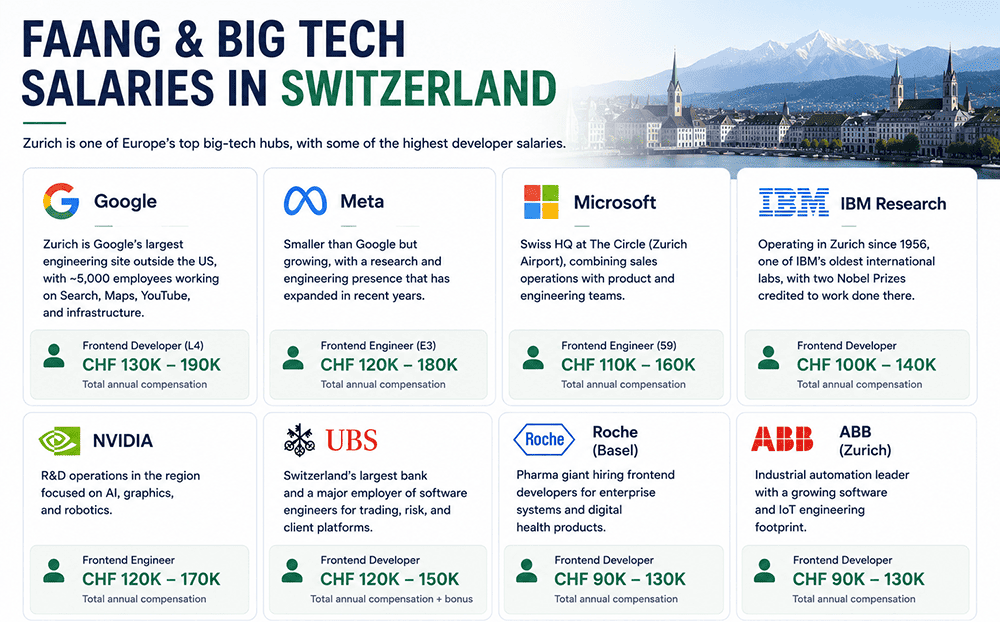
Total compensation at these companies for a senior software engineer typically falls somewhere between CHF 130,000 and CHF 200,000+ (roughly $147,000-$226,000 / €137,000-€211,000) once base salary, annual bonus, and stock or RSU grants are factored in - figures drawn from aggregators like levels.fyi that track self-reported offers. Frontend specifically tends to sit at the lower end of that band rather than the top: full-stack and backend roles at the same companies, especially anything touching infrastructure or machine learning systems, often command a premium over pure frontend positions, so it's worth treating the upper end of that range as the exception rather than the baseline for a frontend-specific role.
Is it realistic to get hired remotely from abroad?
Not easily, and rarely as a first move. These companies overwhelmingly hire for on-site or hybrid roles in Zurich, and a non-EU/EEA candidate applying from abroad is competing against a much larger EU/EEA applicant pool that doesn't require visa sponsorship - a factor covered in more detail in the visa section below. It happens, particularly for senior or highly specialized candidates a team has already identified through referrals or open-source work, but treating it as a standard entry path would be setting expectations that don't match how these companies actually recruit.
Switzerland vs Other Countries: Is It Really the Highest-Paying Market?
Switzerland's reputation as Europe's top-paying tech market holds up in gross terms, but it's worth seeing the actual numbers side by side rather than taking that reputation at face value. The table below compares mid-to-senior frontend salary ranges across a few markets developers commonly weigh against Switzerland when deciding where to relocate.
| Country | Gross Salary Range (Local Currency) | Approx. CHF Equivalent | Notes |
| Switzerland | CHF 85,000-151,000 | CHF 85,000-151,000 | Highest nominal ceiling, driven by Zurich's finance/tech cluster |
| Germany | €55,000-85,000 | ~CHF 51,000-79,000 | EU Blue Card lowers the entry barrier considerably |
| UK (London) | £80,000-150,000 | ~CHF 92,000-172,000 | Global Talent visa is the rare route not requiring a job offer first |
| Netherlands | €60,000-95,000 | ~CHF 56,000-88,000 | 30% ruling tax break for qualifying expats softens the lower gross figures |
| USA (market average) | $95,000-160,000 | ~CHF 84,000-142,000 | Included for context only, not a focus of this article |
On paper, Switzerland wins outright - its upper range outpaces every market here except a strong London offer, and its floor is already close to what Germany or the Netherlands pay at the top. That's the gross story, and it's accurate as far as it goes.
It's not the whole story, though. Gross salary comparisons ignore what each country actually costs to live in, how much of that paycheck disappears to tax and mandatory insurance, and what's left over once rent is paid. Switzerland's cost of living, particularly in Zurich , is high enough that some of this nominal advantage narrows considerably once you convert it to purchasing power. That comparison - gross salary versus what actually lands in your account and what it buys you - is covered in the next section.
Work Visa & Permit Requirements for Non-EU/EEA Developers
This is the part of the salary conversation that gets skipped most often, and it shouldn't be - for a large share of developers reading this, the visa process determines whether any of the numbers above are even reachable in the first place. Switzerland isn't an EU member state, and its immigration system draws a hard line between two groups of candidates that has nothing to do with skill level, seniority, or how good your portfolio is.
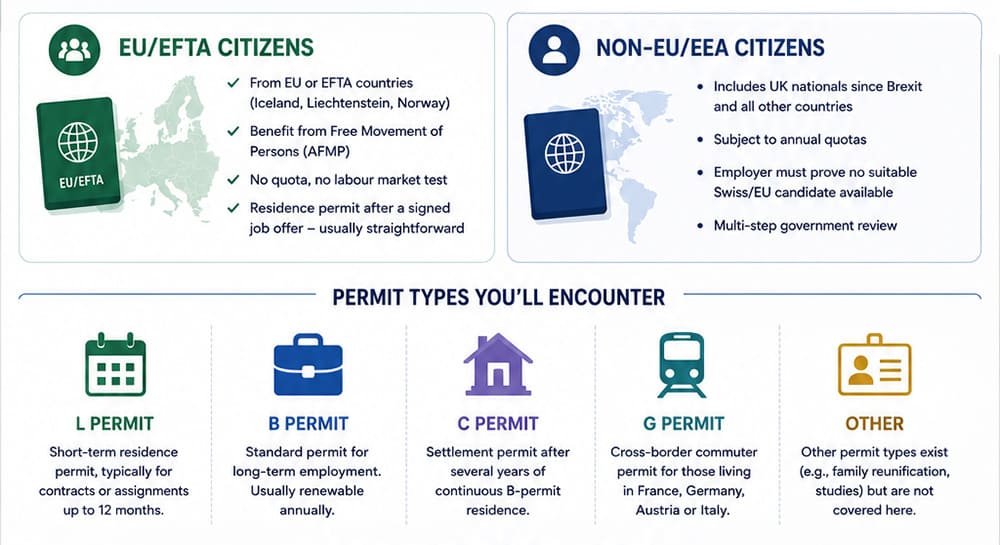
If you hold a passport from an EU or EFTA country (Iceland, Liechtenstein, Norway), you benefit from the Agreement on the Free Movement of Persons (AFMP). In practice, this makes getting a residence permit close to a formality once you have a signed job offer - no quota, no labour market test, no proof that a "better" local candidate wasn't available. Non-EU/EEA candidates, including UK nationals since Brexit, fall into an entirely different system, one built around annual quotas, employer obligations, and multi-step government review.
The permit types you'll actually encounter
- L permit - short-term residence permit, typically tied to contracts or assignments of up to 12 months
- B permit - the standard residence permit for longer-term employment, usually renewable annually and the one most relocating developers are aiming for
- C permit - settlement permit granted after several years of continuous B-permit residence, removing most restrictions tied to a specific employer
- G permit - cross-border commuter permit, relevant only if you live just across the border in France, Germany, Austria, or Italy and commute daily
How the approval process actually works
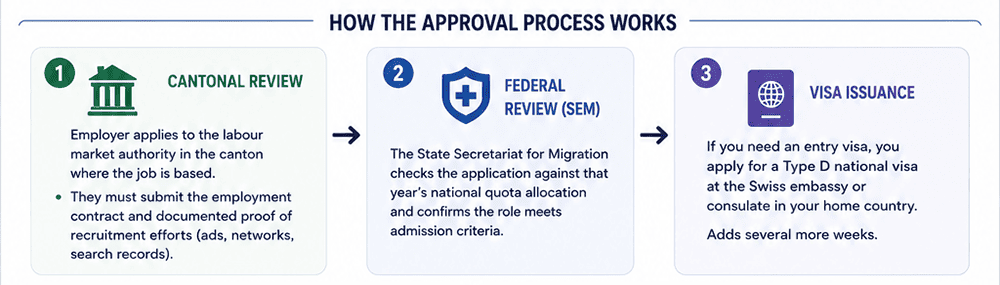
Getting a non-EU/EFTA candidate into a B or L permit isn't a single application - it moves through three separate layers of approval, and any one of them can stall or reject the case:
- Cantonal review - the employer applies to the labour market authority in the canton where the job is based (Zurich and Geneva typically process faster than smaller cantons), submitting the employment contract and documented proof of recruitment efforts
- Federal review (SEM) - the State Secretariat for Migration checks the application against that year's national quota allocation and confirms the role meets admission criteria
- Visa issuance - if you're from a country that requires an entry visa, you then apply for a Type D national visa at the Swiss embassy or consulate in your home country, which adds several more weeks
Why most companies won't sponsor you?
Before any of that starts, your employer has to clear a legal hurdle: they must demonstrate a genuine, documented effort to fill the role with a Swiss or EU/EFTA candidate first, and show that none was suitably qualified or available. This "labour market test" typically means proving they advertised the position through Swiss job platforms and professional networks, and kept records of that search. It's exactly why visa sponsorship for frontend roles concentrates so heavily around large corporations and banks - companies like the ones covered in the FAANG section above already have the legal and HR infrastructure to run this process repeatedly, while a 20-person startup usually doesn't have the time, budget, or incentive to.
The 2026 quota picture
For 2026, the Federal Council kept quotas unchanged from the prior year: 8,500 permits total for qualified non-EU/EFTA workers across all industries and professions - 4,500 B permits and 4,000 L permits. That's not a tech-specific allocation; it's shared across every sector in the entire country. By the end of September 2025, cantons had already used roughly half of the equivalent quota pool, and popular cantons like Zurich have historically run out of slots before the calendar year ends - which makes timing an application early in the year meaningfully important.
Timeline and other routes worth knowing about
Once an employer commits to sponsoring, the combined cantonal review, federal quota check, and visa issuance (if applicable) typically takes somewhere between 8 and 14 weeks, depending on the canton and how much quota headroom remains that year. One route worth flagging separately: developers who complete a degree at a Swiss university get a six-month post-graduation window to search for a qualifying job, without competing against the standard priority-recruitment rules that apply to applicants abroad.
Where to Find a Frontend Developer Job in Switzerland?
Job hunting in Switzerland works differently depending on which language region you're targeting, and that's the first thing to get right before opening any job board. The market splits cleanly into German-speaking Switzerland (Zurich, Basel, Bern), French-speaking Switzerland (Geneva, Lausanne, Neuchâtel), and a much smaller Italian-speaking region - and the dominant job platform changes depending on which one you're in. On top of that regional split, a meaningful share of positions, especially at smaller companies, never get posted publicly at all; they're filled through recruiters, referrals, or direct outreach. That makes it worth combining a couple of general boards with at least one platform built specifically for developers, plus a remote-focused site if relocating isn't the immediate goal.
- jobs.ch - the largest general job board in German-speaking Switzerland, covering Zurich, Basel, and Bern, with thousands of English-language listings and a built-in salary calculator worth using for benchmarking.
- jobup.ch - the equivalent leader for French-speaking Switzerland (Romandie), essentially mandatory if you're targeting Geneva, Lausanne, or Vaud specifically.
- SwissDevJobs.ch - a developer-specific board covering every Swiss region, listed in English, German, and French, with a tighter focus than generalist boards and less noise from unrelated industries.
- ictjobs.ch - a niche IT and tech board with a smaller but more relevant candidate pool than the big generalist sites, useful if you want fewer irrelevant results.
- LinkedIn - indispensable for Switzerland's international employers, particularly FAANG offices and multinational banks, where hiring often runs through LinkedIn recruiters rather than public postings.
- arbeit.swiss / job-room.ch - the official public employment service portal, useful less for tech-specific roles and more as a baseline check on what's publicly listed nationwide.
- We Work Remotely and RemoteOK - not Switzerland-specific, but the two most active boards for developers looking to work for Swiss (or Swiss-adjacent) companies remotely without relocating.
How to Get a Frontend Developer Job in Switzerland?
Finding the listings is the easy part - actually landing an offer in this market means adapting to expectations that differ from what a lot of developers are used to elsewhere. Swiss hiring tends to be more formal and process-heavy than in the US or UK: application dossiers are expected to be complete rather than minimal, employers value stability and precision over flashy portfolios, and a meaningful share of interview processes still run through recruitment agencies rather than direct applications. None of that is a bad sign; it's just a different set of unwritten rules, and ignoring them is one of the more common reasons qualified candidates get filtered out early.
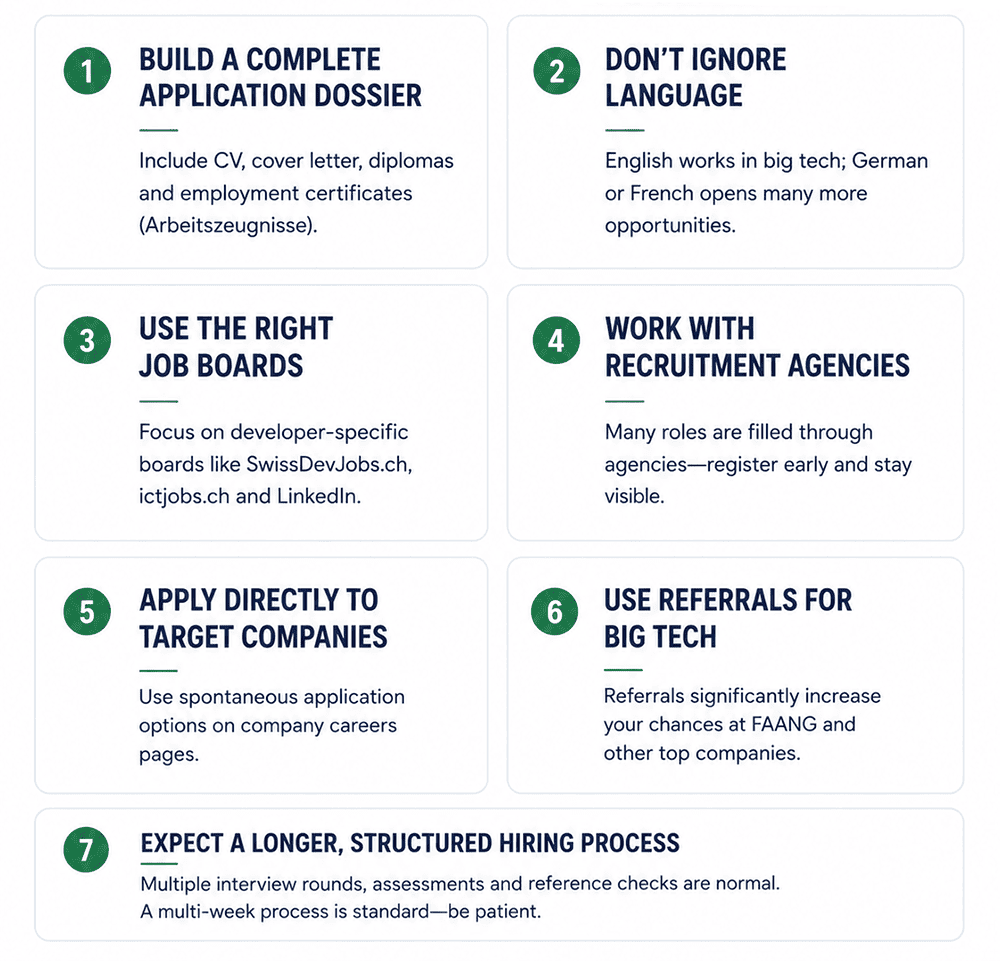
The advice below covers what actually moves the needle for frontend developers specifically, from how to structure an application to how to think about the language question, which trips up more candidates than almost anything else.
- Build a complete application dossier, not just a CV. Swiss employers, especially outside the most international companies, expect a full application package: a CV, a tailored cover letter, copies of diplomas or certifications, and - this catches a lot of candidates off guard - employment certificates (Arbeitszeugnisse) from previous employers. These are formal, standardized reference documents common in Swiss and German-speaking business culture, and their absence can read as a red flag rather than a minor omission. If you're coming from a market where a CV and a quick intro message is the norm, budget real time to assemble this properly before applying anywhere serious.
- Don't assume English is enough outside the international tech bubble. Inside Google, Meta, or Microsoft's Zurich offices, English is genuinely the working language and German fluency isn't required. Outside that specific bubble - at UBS, at a mid-sized Swiss software company, at almost anything in the French-speaking regions - German or French, even at a working conversational level, meaningfully widens the pool of roles you're competitive for. Treat "English is fine" as true for a specific, narrow slice of employers, not the market as a whole.
- Target developer-specific and English-language boards first. Generalist Swiss job boards are enormous and cover every industry from retail to construction, which means a huge amount of noise for a frontend-specific search. Boards like SwissDevJobs.ch and ictjobs.ch filter that out by design, and LinkedIn's targeting tools let you narrow by company and seniority in a way flat job boards don't. Spend less time scrolling generalist listings and more time on platforms built around the role you're actually looking for.
- Get in front of recruitment agencies early, not as a last resort. A significant share of Swiss tech hiring, including for developer roles, runs through agencies like Adecco, Manpower, or specialized IT recruiters rather than direct company applications - particularly for positions that never get posted publicly at all. Registering with a couple of relevant agencies before you start actively applying elsewhere means recruiters already have your profile when a matching role opens, instead of you finding out about it after it's filled.
- Lean on direct, spontaneous applications for companies you actually want. Many Swiss companies, including well-known names, maintain "spontaneous application" portals specifically for candidates who don't see an open role that fits but want to be considered anyway. If there's a specific employer on your list - a bank, a pharma company, a smaller product company - checking their careers page for this option and applying directly can put you ahead of the generic applicant pool competing through job boards.
- Treat FAANG and big-tech applications as a numbers-and-referral game. Competition for Google, Meta, or Microsoft's Zurich offices is intense, and cold applications through a careers page have a meaningfully lower response rate than an internal referral. If you have any connection - a former colleague, an open-source contributor you've interacted with, an alumni network - using it before applying cold is a legitimate and expected part of how these companies actually fill roles, not a shortcut that reflects poorly on you.
- Prepare for a longer, more structured interview process than you might expect. Swiss hiring, particularly at larger or more traditional companies, tends to move slower and involve more stages than what's common in faster-moving markets - technical assessments, multiple interview rounds, sometimes formal reference checks with previous employers. Pace your expectations accordingly: a multi-week process here is normal, not a sign the company has lost interest or that something's wrong with your candidacy.
Conclusion
The honest answer to "how much do frontend developers earn in Switzerland" is that it depends far more on city, seniority, and employer type than on any single national figure. A junior developer in Bern and a senior engineer at a Zurich-based bank or big-tech office aren't really competing in the same market, even though both salaries technically fall under "Switzerland." Anyone using this data to plan a move should treat the ranges here as a starting point for negotiation, not a fixed number to expect on day one.
For developers weighing a relocation, the realistic profile that benefits most is a mid-to-senior engineer with a specialization employers are short on - fintech domain knowledge, design systems experience, or performance work at scale - applying to companies large enough to sponsor a visa if needed. Junior developers and those without EU/EFTA citizenship face a narrower path: quota limits, the labour market test employers have to clear, and intense competition for the handful of companies that actually sponsor non-EU candidates all stack against a first move into the Swiss market straight out of a junior role.
None of that makes Switzerland a closed door - it makes it a market that rewards specificity over general ambition. Knowing which city fits your priorities, which employers realistically hire from abroad, and what the visa process actually requires turns a vague "I want to work in Switzerland" into a plan with concrete steps.
Frequently Asked Questions
Is CHF 100K a good frontend developer salary in Switzerland?
It depends heavily on where in Switzerland and at what career stage. CHF 100,000 (about $113,000 / €105,000) sits comfortably above junior-level pay almost everywhere in the country and lands close to the mid-level range in most cities outside Zurich. In Zurich specifically, though, it's closer to the lower end of what a solid mid-level developer earns, given the city's higher cost of living and concentration of well-paying employers. Context matters more than the raw number. CHF 100,000 in Basel or Bern goes noticeably further than the same figure in Zurich, once you factor in rent and the roughly 24% cost-of-living premium the city carries over the national average. Rather than asking whether CHF 100,000 is "good" in the abstract, it's more useful to compare it against the specific city and experience-level ranges covered earlier in this guide, and weigh it against what that salary actually buys where you'd be living.
Do I need to speak German or French to work as a developer in Zurich?
Not necessarily, but the answer depends heavily on which employer you're targeting. Inside Zurich's international tech offices - Google, Meta, Microsoft, and similar companies - English genuinely functions as the working language, and many teams operate day-to-day without requiring German at all. That's a real exception, though, not the norm across the broader Zurich job market.
Outside that specific bubble, German fluency (or at minimum strong conversational ability) opens up a much wider set of employers: local Swiss companies, banks outside the biggest multinationals, and most roles that involve direct client or stakeholder communication. Treating "English is enough in Zurich" as universally true is a common mistake - it's accurate for a narrow, competitive slice of employers, and assuming it applies everywhere can mean missing out on a much larger pool of roles that do expect at least basic German.
Can I get hired by Google or Meta in Zurich without an existing Swiss work permit?
Yes, this is possible, and it's actually the more common path for non-EU/EEA candidates specifically because companies at this scale have the legal and HR infrastructure to sponsor permits - something smaller employers usually can't manage. Getting an offer is the hard part; visa sponsorship tends to follow once a company has decided to hire you, not the other way around. That said, it's far from guaranteed and shouldn't be treated as a standard entry route. These companies still have to complete the labour market test proving no suitable EU/EEA candidate was available, and you're competing against a large EU/EEA applicant pool that requires no sponsorship at all. Referrals, prior open-source contributions, or a strong existing network meaningfully improve the odds here. Cold applications from abroad happen, but they're the exception rather than the reliable path this route is often assumed to be.
What's the difference between gross and net salary in Switzerland?
Gross salary is the headline number quoted in job postings and salary aggregators - the full amount before any deductions. Net salary is what actually lands in your account after mandatory contributions: federal, cantonal, and municipal income tax (which varies significantly by canton), social security contributions, and pension fund payments. Unlike many countries, Switzerland doesn't deduct health insurance from your paycheck at all - it's a separate, mandatory private insurance premium you pay directly.
The gap between gross and net varies more by canton than by profession. Low-tax cantons like Zug or Schwyz leave a noticeably higher percentage of gross salary intact compared to higher-tax cantons like Geneva or Basel. This is exactly why comparing gross salary alone across cities, or against other countries, can be misleading - the real comparison has to account for local tax rates and mandatory insurance costs, not just the number on an offer letter.
Are there remote frontend jobs with Swiss companies for people living abroad?
They exist, but they're less common than fully on-site or hybrid roles, particularly at the larger employers covered earlier in this guide. Big tech offices and banks in Zurich generally hire for on-site or hybrid positions tied to their physical campuses, so fully remote frontend roles tend to come from smaller Swiss companies, startups, or agencies with a more flexible working culture rather than the biggest names in the market. Job boards like We Work Remotely and RemoteOK are a more realistic starting point for this specific path than Swiss-focused boards like jobs.ch, which skew heavily toward on-site roles. It's worth noting, too, that a remote arrangement with a Swiss company doesn't resolve the visa question if the goal is eventually relocating - it's a separate path entirely, useful for developers who want Swiss-company experience without going through the permit process at all.
Which Swiss city offers the best salary-to-cost-of-living ratio for developers?
There's no single answer here since it depends on what you're optimizing for, but Bern and Lausanne consistently come up as the more balanced options. Both offer meaningfully lower gross salaries than Zurich, but the gap narrows substantially once cost of living is factored in, since neither carries anything close to Zurich's cost premium.
Zug is worth a separate mention: gross salaries there can rival Zurich's for the right role, and its notably low cantonal tax rate means take-home pay stretches further than the gross figure alone suggests. It's a smaller, less diverse job market overall, concentrated around startups and crypto-adjacent companies, so it fits a specific kind of role rather than being a broadly comparable alternative to Zurich for every developer.