
Frontend Developer Jobs in Dublin: Salary, Stack and How to Get Hired in 2026
10 June 2026
306 views
This guide is up to date as of October 2026

Written by
Marcus Hale,
IT Talent Acquisition Specialist

Reviewed by
Ciaran O'Connor,
Senior Tech Recruiter, Ireland
Most cities that call themselves "tech hubs" mean a cluster of co-working spaces and a few funded startups. Dublin is something different. Google runs its entire EMEA operations from here. So does Meta - its largest office outside the US. LinkedIn's international headquarters is a 10-minute walk from Trinity College. TikTok's European trust and safety centre, Stripe's global engineering base, HubSpot, Salesforce, Workday, Twitter/X - all headquartered in a city of 1.3 million people.
That's not a tech hub. That's the operational backbone of the European internet, packed into one city centre.
For a frontend developer, the practical implication is this: the companies building the world's most-used interfaces are competing for the same local talent pool. That competition drives salaries up and keeps the hiring market active even when other European markets slow down. Dublin had over 2,400 open tech roles in Q1 2026 - a figure that compares well against cities three times its size.
There's also something worth understanding about the culture. These aren't satellite offices taking orders from California. Google Dublin owns EMEA product decisions. Meta's Irish engineers work on products used by hundreds of millions of people. The work is real, the scope is large, and the career ceiling is genuinely higher than in most European cities.
Ireland is an EU member state. That means citizens of all 27 EU countries have the automatic right to live and work here - no work permit, no sponsorship, no fees, no waiting period. You can decide to move to Dublin on a Tuesday and start a job the following month. No application to a government office. No bureaucratic queue.
This is not a minor administrative detail. In a post-Brexit Europe where the UK now requires a visa for most non-British tech workers, Ireland is the only English-speaking country in the EU. That single fact has redirected a significant wave of European developer talent that previously would have gone to London. If you hold an EU passport and you're weighing Dublin against other options - Berlin, Amsterdam, Warsaw, Lisbon - you are on equal legal footing with a local candidate from the moment you land. That's rare. Most global tech cities either don't speak English as a working language or they sit behind a visa process that adds months of uncertainty to any career move. Dublin removes that friction entirely.
The Exact Stack Dublin Employers Want in 2026
Job boards in Ireland are unusually transparent about technology requirements. Unlike markets where job postings hide behind vague phrases like "modern frontend stack" or "familiarity with JavaScript frameworks," Dublin employers - especially at the mid-to-senior level - list specific technologies, versions, and testing tools. That transparency makes it possible to do what most Dublin career guides don't bother doing: actually count what's in demand.
The breakdown below comes from analysis of 100+ live frontend job postings on LinkedIn, Indeed IE, and BuiltInDublin collected in May 2026. Not surveys. Not recruiter opinions. Actual job listings, parsed for technology frequency. A few things stand out immediately when you look at the data this way.
React dominance is real but not total. It appears in the overwhelming majority of postings across all company tiers - but Angular holds a stronger position in Dublin than in almost any other European city. That's not an accident. It follows directly from the internal codebases of Dublin's largest employers. Google, Workday, and the legacy LinkedIn architecture all run heavily on Angular. If you've been treating Angular as a skill worth downplaying on your CV, the Dublin market is the one place in Europe where that calculation is wrong.
TypeScript is no longer a differentiator - it's a baseline. It appears in 68% of Dublin job postings and is explicitly required, not listed as a nice-to-have, in virtually every senior role. Submitting a portfolio of plain JavaScript projects to a Dublin senior role in 2026 will hurt your application in ways that are hard to recover from in the screening stage.
The other consistent signal is testing culture. Dublin's largest employers - particularly the product companies like Intercom, HubSpot, and Workhuman - have invested seriously in QA automation. Cypress appears in over half of mid and senior-level postings. Jest is effectively assumed. Candidates who can't speak to their testing approach with any depth tend to stall at the technical screen stage, not because the question is a trick, but because test coverage is genuinely part of how these teams work.
What follows is the full stack breakdown by technology, demand level, and the specific company tier where each skill matters most.
| Technology | Demand | Why Dublin Employers Need It | Level |
| React (with Hooks) | Very High | Core for building modern SPAs in fintech and SaaS companies | Intermediate |
| TypeScript | Very High | Improves code quality and scalability in large teams | Intermediate-Advanced |
| Next.js | High | Enables SSR/SSG for performance and SEO in production apps | Intermediate |
| Node.js (Express/NestJS) | High | Supports full-stack JavaScript development and microservices | Intermediate |
| REST & GraphQL APIs | High | Essential for connecting frontend applications with scalable backend systems | Intermediate |
| CSS Frameworks | Medium-High | Speeds up UI development and helps maintain consistent design systems | Intermediate |
| Testing (Jest, React Testing Library) | Medium-High | Ensures application reliability, stability, and long-term maintainability | Intermediate |
| Git & CI/CD (GitHub Actions) | High | Required for team collaboration, code reviews, and automated deployments | Intermediate |
| Cloud (AWS Basics) | Medium-High | Needed for deploying, monitoring, and managing scalable web applications | Beginner-Intermediate |
| Web Performance Optimization | Medium-High | Critical for delivering fast user experiences and improving SEO performance | Intermediate |
Not all Dublin tech companies hire the same stack:
- Big Tech (Google, Meta, Amazon): React, TypeScript, GraphQL, internal design systems, strong focus on performance and scalability
- Large Multinationals (Microsoft, HubSpot, Salesforce): React, Next.js, TypeScript, REST APIs, Azure/AWS integration
- Fintech Companies (Stripe, Revolut, PayPal): React, TypeScript, Node.js, high emphasis on security, testing, and data handling
- Mid-size Product Companies: React, Next.js, Tailwind, Node.js, pragmatic stacks focused on speed and maintainability
- Startups (Seed-Series B): Next.js, TypeScript, Firebase/Supabase, minimal setups with fast iteration and shipping
- Agencies and Outsourcing Firms: Flexible stacks, often React or Vue, strong focus on adaptability, UI skills, and client requirements
Frontend Developer Salary in Dublin 2026: Real Numbers
Salary data for the Dublin tech market is more accessible than most European cities - and more fragmented. Indeed IE, Glassdoor, SalaryExpert, and the annual Morgan McKinley Salary Guide all publish figures, and they don't always agree. That's not a data quality problem. It reflects genuine variation across company tiers, contract types, and the difference between what gets advertised and what actually gets offered after negotiation.
Indeed IE, drawing on 69 self-reported salaries updated in February 2026, puts the average frontend developer salary in Dublin at €71,279. Glassdoor IE's larger sample of 133 salaries collected through December 2025 shows a broader range - €46K at the lower end, €75K at the 75th percentile. SalaryExpert lands higher, reporting an average of €77,299 with entry-level figures around €54K and senior roles averaging €88K. The Morgan McKinley Salary Guide 2026, which reflects recruiter-placed candidates rather than self-reported data, gives a median band of €55K-€65K for mid-level frontend roles.
Read together, these numbers tell a consistent story: mid-level frontend developers in Dublin are earning somewhere between €55K and €75K depending on company size and stack, seniors are clearing €75K-€95K with Big Tech outliers above €100K, and entry-level roles start around €38K-€54K.
What the averages don't show is the spread within each level - and that spread is wide enough to matter. A mid-level React developer at a funded Dublin startup and a mid-level React developer at Google EMEA are both "mid-level frontend developers in Dublin." Their salaries are not in the same conversation. Company tier, total compensation structure, and whether a role includes equity or RSUs can move the real number by 30-40% relative to the base figure on any salary aggregator.
The table below breaks this down by experience level, with gross annual figures, approximate take-home after Irish tax, and notes on where the outliers come from.
| Experience Level | Salary Range in Dublin (2026) | What Employers Usually Expect | Notes |
| Entry-Level | €30,000-€40,000 | Strong HTML, CSS, JavaScript basics, some React | Often closer to the lower end at local companies. |
| Junior | €40,000-€50,000 | React, responsive UI, Git, working with APIs | Common for candidates with 1-2 years or strong portfolios. |
| Mid-Level | €50,000-€65,000 | React, TypeScript, component architecture, testing | This aligns well with Dublin Front End/UI averages. |
| Strong Mid-Level | €65,000-€75,000 | Next.js, TypeScript, performance, modern frontend practices | More common in product companies and better-funded firms. |
| Senior | €75,000-€90,000 | Architecture, mentoring, ownership, system design | Frequently seen in larger tech companies and high-growth teams. |
| Senior+ / Lead | €90,000-€110,000+ | Technical leadership, cross-team influence, delivery ownership | Usually tied to multinational or fintech roles. |
| Top-Tier / Big Tech | €110,000-€120,000+ | Deep expertise, scalable systems, strong impact | Upper-end compensation is possible in select Dublin companies. |
For 2026, Dublin frontend pay is strongest in fintech, big tech, and multinational product teams, while local companies and agencies often stay closer to the lower-mid bands. PayScale’s Ireland-wide average of €53,281 also supports the idea that mid-level frontend roles sit around the low-to-mid €50k range.
The Irish Tax Reality - What Nobody Explains
Most salary guides for Dublin stop at the gross figure. They tell you frontend developers earn €70K, which is true, and leave you to figure out the rest. The rest matters - because Ireland's income tax system has a design feature that surprises almost every developer who relocates here, regardless of where they're coming from.
Ireland taxes income through three separate mechanisms, not one. Understanding all three upfront is the difference between budgeting correctly from month one and spending your first six months confused about why your payslip looks the way it does.
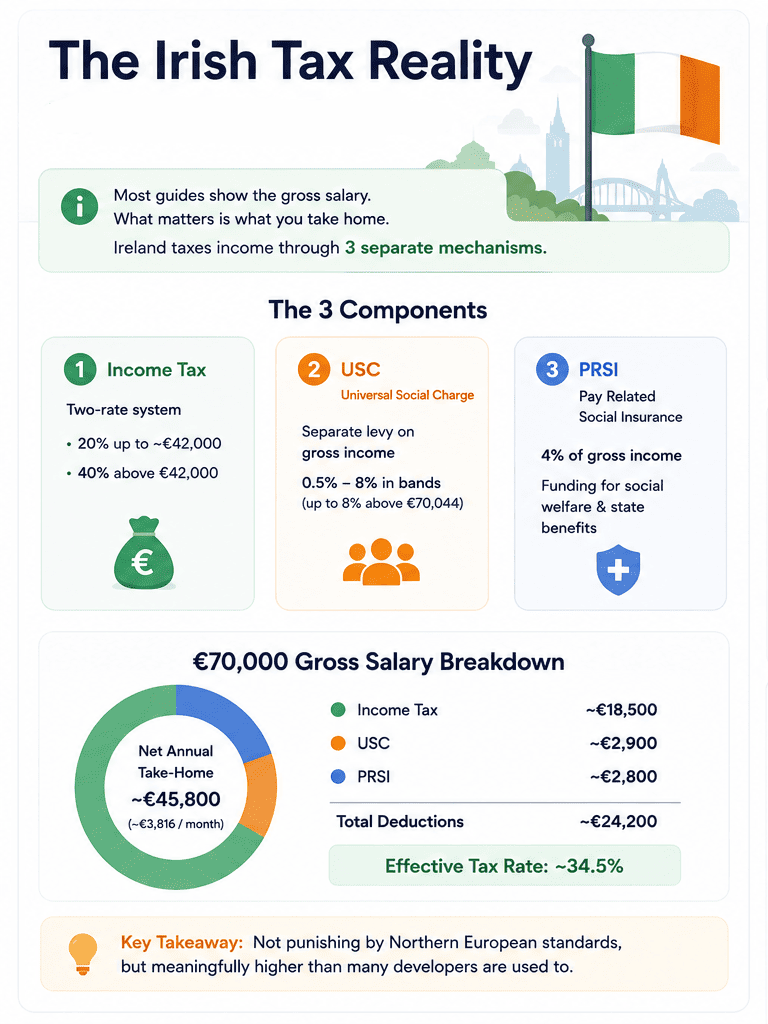
The three components
The first is Income Tax, structured as a two-rate system: 20% on income up to approximately €42,000, and 40% on everything above that threshold. For a developer earning €70K, roughly €28,000 of their income is taxed at the higher rate. That's the number that catches people off guard - not because 40% is unusual by European standards, but because developers moving from countries with flat or lower marginal rates don't expect to hit it at €42K.
The second component is the Universal Social Charge, or USC. This is a separate levy on gross income, applied in bands starting at 0.5% on the first €12,012 and rising to 8% on income above €70,044. It was introduced as a temporary measure during the 2008 financial crisis and has remained permanent ever since. On a €70K salary it adds roughly €2,900 to your annual tax bill.
The third is PRSI - Pay Related Social Insurance. At 4% of gross income for employees, it funds Ireland's social welfare system and entitles you to certain state benefits including the state pension. On a €70K salary, PRSI adds approximately €2,800 per year.
Combined, these three deductions on a €70,000 gross salary look like this in practice:
- Income tax: ~€18,500
- USC: ~€2,900
- PRSI: ~€2,800
- Total deductions: ~€24,200
- Net annual take-home: ~€45,800 - approximately €3,816 per month
That's an effective rate of around 34.5%. Not punishing by Northern European standards, but meaningfully higher than what developers relocating from Poland, Romania, Portugal, or the Czech Republic are used to paying at home.
The tax credit most new arrivals miss
Here's the detail that doesn't appear in most relocation guides. Every Irish tax resident receives two automatic tax credits: a Personal Tax Credit of €1,875 and an Employee Tax Credit of €1,875, totalling €3,750 per year. These credits reduce your actual tax bill directly - not your taxable income, but the tax itself. That's a meaningful number.
The problem is that new arrivals frequently don't claim both credits from day one. Your employer applies the credits based on a Tax Credit Certificate issued by Revenue - Ireland's tax authority. If you don't register with Revenue promptly after starting work, your employer defaults to emergency tax rates, which are significantly higher and take months to recover. Register new account before or immediately after your first day. It takes 20 minutes and the difference on your first payslip can be €300-€400.
How Dublin compares to other European tech cities on tax
The honest comparison: Ireland's effective tax rate on a €70K salary sits broadly in line with Germany and slightly above the Netherlands, but below Denmark and Sweden. Developers relocating from lower-tax environments - particularly Eastern European countries or Portugal's NHR scheme - will notice the difference. Developers coming from the UK will find the net figures comparable, with the added factor that Ireland's lower cost of some goods and services partially offsets the tax burden.
What Ireland doesn't have, unlike Germany or Portugal, is a wealth tax or significant local income tax layered on top of national tax. What you see on the Revenue calculation is broadly what you pay. No surprises after filing.
A significant portion of Dublin's senior frontend developer market works on contract rather than permanent employment. This is well-established in the Irish market - agencies like Morgan McKinley and Reperio run active contractor books, and Big Tech companies regularly engage contractors for project-specific work.
Contractors in Dublin typically operate through a Personal Service Company - a limited company through which they invoice clients. The tax advantages here are real: directors of Irish limited companies can split income between salary and dividends, manage their own pension contributions as a business expense, and potentially reduce their effective tax rate to the mid-20s percent range if structured correctly.
Mid-level contractor day rates currently run €350-€500. Senior contractor rates sit at €500-€750 per day. On a 220-day working year, a senior contractor billing at €600/day generates €132,000 in company revenue before expenses. After corporation tax at Ireland's 12.5% rate and efficient extraction of funds, the net position can be considerably better than an equivalent permanent salary - but it requires proper accounting setup and an Irish-registered accountant who understands the PSC structure.
This is not DIY territory. The one concrete piece of advice worth emphasising here: if you're considering contracting in Ireland, hire an accountant before you incorporate, not after. The cost is typically €1,500-€2,500 per year. The tax savings in year one alone usually cover it several times over.
The EU Advantage: Who Can Work in Ireland Without a Visa
Ireland sits in an unusual position in the global tech hiring map. It's English-speaking, it's inside the EU, and it's home to the European headquarters of most major American tech companies. Those three facts rarely coincide. The result is that Dublin draws a developer talent pool from two very different directions - EU citizens who can relocate with zero bureaucratic friction, and non-EU candidates navigating one of the more straightforward work permit systems in Europe.
Understanding exactly where you stand before you start applying saves weeks of confusion and, in some cases, prevents candidates from self-selecting out of a market they're fully entitled to enter.
EU / EEA / Swiss Citizens - Zero Barriers
If you hold a passport from any of the 27 EU member states, you have the automatic legal right to live and work in Ireland. No work permit. No job offer required before you move. No application to any government office. No fees. No waiting period.
This right is unconditional and permanent. It doesn't expire, it doesn't depend on your employment status, and it doesn't require you to register with Irish immigration authorities - though registering your address is useful for practical purposes. You can arrive in Dublin as a job-seeker, spend two months interviewing, accept an offer, and start work, all without producing a single immigration document.
The countries this covers: Austria, Belgium, Bulgaria, Croatia, Cyprus, Czech Republic, Denmark, Estonia, Finland, France, Germany, Greece, Hungary, Ireland, Italy, Latvia, Lithuania, Luxembourg, Malta, Netherlands, Poland, Portugal, Romania, Slovakia, Slovenia, Spain, and Sweden. EEA countries - Norway, Iceland, and Liechtenstein - carry the same rights under the European Economic Area agreement. Switzerland has a bilateral agreement with the EU that extends equivalent work rights to Swiss nationals.
The practical steps after arriving are administrative rather than bureaucratic. They take days, not months.
- Get a PPS number first. The Personal Public Service number is Ireland's equivalent of a national insurance or social security number. You need it for employment, tax registration, and opening a bank account. Apply at your local Intreo centre with your passport and proof of address - a rental agreement or a utility bill in your name is sufficient. Processing typically takes one to two weeks. Some Intreo offices offer same-day appointments if you book online early.
- Open a bank account in parallel. Most Irish employers pay salaries directly to an Irish bank account. AIB and Bank of Ireland are the two largest options and both have straightforward account-opening processes for EU nationals with a PPS number. If you're waiting on your PPS number, Revolut and N26 work as temporary solutions - both can be set up in under an hour and are accepted by some payroll systems as interim arrangements.
- Register with Revenue before your first payslip. This is the step that costs people money when they skip it. Register at myaccount.revenue.ie, confirm your tax credits, and make sure your employer has your correct Tax Credit Certificate before they run their first payroll cycle that includes you. Arriving late to this step means emergency tax - a higher withholding rate applied by default when Revenue doesn't have your information. It's recoverable, but the refund process takes time and the first payslip hit is jarring.
That's the complete list. PPS number, bank account, Revenue registration. For EU citizens, that's the entire administrative overhead of relocating to work in Ireland.
Non-EU Citizens - Work Permit Options
The picture for non-EU nationals is more involved but, relative to most English-speaking countries, reasonably navigable. Ireland's work permit system is built around the principle that tech roles are in short supply domestically - which means the government has structured the process to move faster for software developers than for most other professions.
This is the primary route for non-EU tech workers and the one most relevant to frontend developers. To qualify, you need a job offer from an Irish employer, a salary at or above €38,000 per year for roles on the Critical Skills Occupations List - which explicitly includes Software Developer - and a relevant degree or equivalent professional experience.
In practice, virtually every frontend developer role in Dublin pays well above the €38,000 threshold. The floor exists to filter out low-wage permit applications; it has no bearing on what Dublin employers actually offer, which starts around €46K for junior roles and rises quickly from there.
Processing time for the Critical Skills Employment Permit runs four to eight weeks from a complete application. The permit is valid for two years. After those two years, you can apply for a Stamp 4 - an immigration permission that gives you unrestricted right to work in Ireland without any employer sponsorship, in any role, for any company. After five years of continuous legal residence, you can apply for Irish citizenship, which carries full EU freedom of movement rights.
One detail worth knowing: the Critical Skills Permit is employer-specific for the first year. If you want to change jobs before your two-year permit expires, you need to apply for a new permit with the new employer. This is administratively manageable but adds a layer of friction to early job changes that EU citizens don't face.
-
Intra-Company Transfer Permit
If you currently work for a multinational with an Irish office - which describes a significant portion of the global tech workforce given how many companies have Dublin headquarters - you may be eligible to transfer internally without going through the standard permit process. Google, Meta, Microsoft, Salesforce, and most other large Dublin employers have established internal mobility programmes specifically for this route. The transfer process is faster than a new permit application and is handled largely by the company's internal immigration team. -
Trusted Partner Programme
Large companies with a strong Irish hiring track record - Google, Meta, Microsoft, and a handful of others - are designated Trusted Partners by the Irish immigration authorities. Candidates sponsored by Trusted Partner employers receive expedited permit processing, typically significantly faster than the standard four-to-eight-week timeline. If you're applying to one of these companies and you're non-EU, the practical processing burden on your end is lower than it would be with a smaller employer. -
The UK situation post-Brexit
British citizens no longer have EU freedom of movement rights and are not exempt from Irish work permit requirements. However, the Common Travel Area - a long-standing bilateral agreement between Ireland and the UK that predates EU membership - means British nationals retain the right to live and work in Ireland without a visa or work permit. This right is reciprocal and has remained unaffected by Brexit. British developers considering a move to Dublin face no immigration barrier, which is not the case in reverse for Irish citizens moving to work in the UK, where the standard visa process now applies.
For EU citizens, the Dublin market is as open as your home market. You compete on skills and interview performance, not on visa timelines or employer willingness to sponsor. In a market where competition for senior frontend roles is real, that's the only playing field you want to be on.
For non-EU candidates, the honest picture is that most Dublin Big Tech employers will sponsor a Critical Skills Permit for a strong candidate - but they won't do it for a marginal one. The permit process adds administrative overhead and a degree of commitment to the hire. That doesn't close the door; it raises the bar slightly for what "strong enough to hire" means in practice. Coming in with a standout portfolio, TypeScript throughout your work samples, and a demonstrable testing culture in your projects is more important for non-EU candidates than for EU ones, simply because the employer is taking on more process to make the hire happen.
How to Get a Frontend Developer Job in Dublin: Step by Step
The Dublin frontend market is active, well-documented, and - for candidates who prepare specifically for it rather than generically - genuinely accessible. The mistake most developers make is treating a Dublin job search like any other European job search: update the Front End Developer Job Description, apply on LinkedIn, wait. That approach works eventually, but it misses several Dublin-specific factors that meaningfully shorten the process for candidates who understand them.
What follows is the sequence that works, built around how Dublin employers actually hire in 2026.
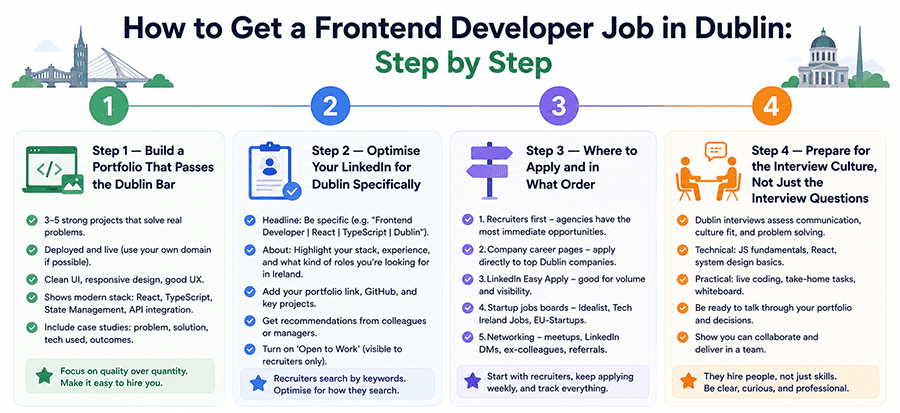
Step 1 - Build a Portfolio That Passes the Dublin Bar
Portfolios get screened before CVs at most Dublin tech companies. A recruiter or hiring manager clicking through your GitHub or personal site is making a decision in under two minutes. The signals they're looking for are specific to this market.
- Deployed projects with real URLs are non-negotiable. GitHub repositories with no live demo are significantly less compelling than a deployed project on Vercel, Netlify, or Railway. Dublin employers - particularly at the product company and Big Tech tier - click links. A README that says "clone and run locally" signals that the project has never been finished. Dead links are worse than no link at all.
- TypeScript throughout, including personal projects. This is the single most common portfolio gap for developers relocating from markets where TypeScript adoption is less mature. A 2026 portfolio of plain JavaScript projects tells a Dublin senior engineer one of two things: either you haven't worked in a professional team environment recently, or you're aware of TypeScript but chose not to use it. Neither reading helps your application. Migrate your strongest projects before you start applying.
- Tests. At minimum, unit tests with Jest or Vitest. For anything you'd describe as a serious project on your CV, add Cypress end-to-end tests. You don't need full coverage - you need enough that a reviewer can see you think about testing as part of building, not as an afterthought. Companies like Intercom, HubSpot, and Workhuman check for this explicitly.
- Accessibility as a visible signal. This is the detail that almost no candidates include and that immediately distinguishes the ones who do. If your project meets WCAG 2.1 AA standards - even partially - note it in the README. Add a Lighthouse accessibility score screenshot. At companies like LinkedIn, Workday, and Stripe, where accessibility is a serious engineering requirement rather than a compliance checkbox, a candidate who already thinks this way arrives with a head start that's hard to manufacture in an interview.
- Performance metrics. A Lighthouse score of 90+ in your README costs nothing to add and signals that you care about Web Performance Optimization. HubSpot and Intercom both have engineering blog posts about their performance work - candidates who show up already speaking that language get further faster.
Step 2 - Optimise Your LinkedIn for Dublin Specifically
LinkedIn is the primary sourcing tool for Dublin tech recruiters. It is not supplementary - it is where most mid-to-senior frontend hires in this market begin, either through inbound recruiter contact or through applications that get verified against the profile. Treating it as an afterthought is a real mistake.
- Set your location to Dublin, Ireland - or explicitly to "Open to relocation to Dublin." Recruiters in this market filter by location before they filter by anything else. A strong profile with a Warsaw or Lisbon location will be skipped by Dublin-focused searches unless relocation intent is explicit. You don't need to have moved yet. You need to signal clearly that Dublin is the target.
- Write a headline that includes your core stack. "Frontend Developer | React | TypeScript | Open to Dublin" is more findable than "Senior Software Engineer at Company X." LinkedIn's search algorithm weights headline keywords heavily, and Dublin recruiters search on specific technologies, not job titles.
- Load your About section with the technologies from Section 2. Not as a keyword dump - as a readable paragraph that happens to include React, TypeScript, Next.js, testing tools, and any Angular experience. Recruiters use LinkedIn's keyword search constantly, and the About section is indexed alongside the headline and job titles.
- Connect with Dublin-based tech recruiters proactively. The agencies with the most active Dublin frontend books are Morgan McKinley, Reperio Human Capital, Prosperity Recruitment, and Aligned Technology Solutions. A connection request with a short note - "frontend developer with React/TypeScript background, targeting Dublin roles in Q3 2026, happy to connect" - takes five minutes per recruiter and puts you in front of people whose entire job is to place candidates like you. This is not networking in the uncomfortable sense. It is using the market infrastructure that exists.
Step 3 - Where to Apply and in What Order
The Dublin job market has a clear hierarchy of channels, and working them in the right order avoids the common failure mode of spraying applications across every platform and getting lost in volume.
- LinkedIn is the primary channel for Big Tech and scale-up roles. Filter by Dublin, Frontend Developer, and date posted within the last week. Set job alerts for your core stack terms. Most Google, Meta, HubSpot, and Intercom roles appear here first and get significant application volume within 48 hours of posting - applying early matters.
- BuiltInDublin.ie is the highest signal-to-noise job board in the Irish market. It lists roles exclusively from Dublin tech companies and filters out the recruitment agency noise that clutters general boards. For mid-market and product company roles, this is often the cleaner source.
- IrishJobs.ie is the largest general job board in Ireland and has good volume for roles at Irish companies, mid-market employers, and positions that don't get posted on LinkedIn. Less relevant for Big Tech; more relevant for fintech, enterprise, and established Irish tech companies.
- Indeed IE - has good volume and a useful salary filter. Use the "Salary €X+" filter to cut the noise quickly. The quality of listings varies more than on BuiltInDublin, but the volume makes it worth checking weekly.
- Company career pages directly. For Google, Meta, LinkedIn, Stripe, and HubSpot specifically, check the company careers page in addition to LinkedIn. Internal mobility roles and referral-adjacent openings sometimes appear on company pages before they hit third-party boards. Stripe in particular tends to post detailed role descriptions on its own site that give a clearer picture of the actual work than the LinkedIn version.
Step 4 - Prepare for the Interview Culture, Not Just the Interview Questions
This is where Dublin-specific preparation diverges most sharply from generic tech interview advice - and where candidates who've prepared only for US-style technical screens consistently underperform relative to their actual ability.
The Dublin interview culture is collaborative, not adversarial.
Irish interview culture places genuine weight on how you think and communicate, not just whether you arrive at the correct answer. Thinking out loud is not a sign of weakness here - it's expected and evaluated positively. Asking clarifying questions before diving into a problem is not stalling - it signals engineering maturity. Explaining the tradeoffs in your approach, including the tradeoffs you're consciously accepting, is weighted as heavily as the solution itself at most Dublin companies.
This is a meaningful cultural difference from some US-style technical screens, where silence during problem-solving is more tolerated and the evaluation is more purely output-driven. Candidates who've prepared in a US-style context - heads down, grind to the answer, minimal communication - sometimes read as closed off or difficult to work with in a Dublin interview, even when their technical answer is correct. The fix is simple: practise narrating your reasoning out loud, not just solving the problem.
Calibrate your preparation to the company tier.
Big Tech - Google, Meta, Stripe - requires the most structured preparation. Expect algorithmic coding at LeetCode medium-to-hard difficulty, frontend system design questions (design an autocomplete, a news feed, an image carousel with lazy loading), and structured behavioural interviews in STAR format. Budget a minimum of four weeks of daily preparation if you're not currently solving these problems regularly. Six to eight weeks is more realistic for candidates coming from product or startup backgrounds where algorithmic interviews aren't part of the normal hiring process.
Scale-ups and product companies - HubSpot, Intercom, Workhuman - typically run a take-home project followed by a technical review and culture fit conversation. The take-home format rewards candidates who write clean, well-tested, well-documented code over candidates who optimise for speed. Read your take-home brief carefully: Dublin product companies often include deliberate ambiguity in the spec to see whether you make reasonable assumptions and document them, or whether you either over-engineer or under-deliver without explanation.
Fintech and enterprise - Stripe on the engineering side, AIB Tech, Fexco, Adyen - lean toward live coding with real-world domain problems. Angular knowledge gets tested explicitly at companies running Angular codebases. Expect data structure questions alongside practical frontend problems, and expect accessibility to come up in some form at companies where compliance requirements are part of the product.
Startups run the most variable processes - often a short take-home plus one or two technical calls with the founding or senior engineering team. The technical bar is real but the format is less rigid. At this tier, demonstrating that you understand their product and have thought about their specific frontend challenges matters more than at larger companies where the hiring process is more standardised.
One preparation detail that applies across all tiers: research the company's engineering blog before every interview.
HubSpot, Intercom, Stripe, and Google all publish detailed technical writing about their frontend architecture, performance decisions, and engineering culture. Candidates who've read that material and can reference it specifically - not generically - arrive in the room already a step ahead of the ones who only read the job description.
The Honest Summary
Dublin makes financial sense for most mid-to-senior frontend developers if they go in with clear eyes about housing costs and plan accordingly. The salary levels are competitive, the career opportunities are real, and the EU access is genuinely valuable. The city has a housing crisis that affects daily life in a tangible way, and pretending otherwise would be doing you a disservice.
The developers who thrive in Dublin are generally the ones who arrive with a realistic budget, a plan for housing that doesn't depend on finding a city centre apartment at a reasonable price, and an intention to engage with the tech community rather than treat it as background noise. The ones who struggle are usually the ones who arrived expecting London salaries with Lisbon costs and got Dublin on both counts.
FAQ - Questions Frontend Developers Ask About Dublin
Is Dublin more expensive than London for frontend developers?
Gross salaries in Dublin and London are broadly comparable for frontend roles at equivalent experience levels. A mid-level React/TypeScript developer in Dublin earns €55K-€75K; the London equivalent in GBP lands in a similar purchasing-power range. The tax comparison slightly favours Dublin - Ireland's effective rate on a €70K salary sits around 34-35%, while the UK's combined Income Tax and National Insurance on an equivalent figure runs 32-34%, close enough that tax alone isn't a deciding factor either way.
The meaningful difference is housing. Central London rental costs at the one-bedroom level are typically higher than Dublin city centre, which itself is expensive. Outside the centres, both cities have commuter belt options in a similar price range. Running costs for food, transport, and services are comparable.
The decisive factor for most European developers isn't cost - it's legal access. Post-Brexit, working in the UK requires a Skilled Worker visa for non-British, non-Irish citizens. That process involves a sponsor employer, a points-based assessment, and fees that can exceed £2,500 in visa and healthcare surcharge costs before you've moved. Dublin requires none of that for EU citizens. The financial comparison between the two cities is close enough that the visa question tends to settle it.
Do I need to speak Irish (Gaelic) to work in Dublin?
No. Irish is constitutionally the first official language of Ireland and is taught in schools, but it has no presence in the tech industry. Every major Dublin tech employer - Google, Meta, LinkedIn, Stripe, HubSpot, and the full range of scale-ups and startups - operates entirely in English. Code reviews, architecture discussions, one-on-ones, and all-hands meetings are in English without exception.
A small number of government IT roles specify Irish language requirements, but these represent a negligible fraction of the Dublin frontend market and are clearly labelled in job postings. For the purposes of a tech career in Dublin, Irish is irrelevant. You will encounter it on road signs and in some government correspondence, and that's broadly the extent of it.
How long does it take to find a frontend job in Dublin?
It depends significantly on experience level, target company tier, and how much Dublin-specific preparation you've done before starting.
A mid-level React/TypeScript developer actively applying - optimised LinkedIn profile, live portfolio, applications across LinkedIn, BuiltInDublin, and direct company pages - typically receives first recruiter contact or interview invitations within one to two weeks. An offer from a scale-up or mid-market employer usually follows within four to six weeks of starting the search in earnest.
Big Tech timelines are longer. From first application to offer at Google, Meta, or Stripe, budget eight to twelve weeks - and that assumes you're applying with your interview preparation already complete. The process itself takes four to eight weeks once it starts moving; the preparation before you're ready to apply credibly takes another four to eight weeks on top of that if you're not currently in interview-ready shape.
Senior candidates with a strong profile in the Dublin market - TypeScript, testing culture visible in portfolio, Angular alongside React - tend to get inbound recruiter contact without applying at all. Several Dublin-based agencies, Morgan McKinley and Reperio Human Capital in particular, actively source senior frontend talent and will reach out to strong LinkedIn profiles unprompted. Being findable on LinkedIn with the right stack keywords is not a passive strategy at senior level - it's a faster route to first contact than cold applications in many cases.
The timeline also compresses significantly for candidates who arrive in Dublin before they have an offer. In-person availability for same-week interviews removes the scheduling friction that remote candidates face, and some Dublin employers - particularly startups and scale-ups - move faster when a candidate is already local.
Can I negotiate salary in Dublin?
Yes, and you should. The Dublin tech market at mid-to-senior level is candidate-driven in 2026, and most employers expect negotiation as a standard part of the process rather than an awkward exception to it.
A 10-15% uplift from the initial offer is realistic for candidates who approach negotiation with a clear basis - competing offers, market rate data, or a specific number rather than a vague request for "more." The most effective single tool in a Dublin salary negotiation is a second offer, or a credible implication that one is in progress. Dublin is a small market and hiring managers are aware that strong candidates are typically in multiple processes simultaneously. You don't need to be aggressive about it - stating plainly that you're in conversation with another company and would like to resolve this process first if the numbers work is both honest and effective.
Total compensation is worth negotiating separately from base salary at companies that offer it. Big Tech employers in Dublin - Google, Meta, LinkedIn - structure significant portions of total compensation as RSUs that vest over four years. The initial RSU grant, the vesting schedule, and the refresh grants after year two are all negotiable to varying degrees and can add €20-50K annually to the real value of a package that looks like a single base salary number in the offer letter.
Benefits are less commonly negotiated in Dublin than in the US market but are not off the table. Private health insurance, pension contribution matching above the standard rate, and remote work flexibility have all become standard negotiation points post-2020. If any of these matter to you, raise them in the same conversation as salary rather than after the offer is signed.
Is Angular or React better to know for Dublin jobs?
React gives you the wider options - it dominates startup hiring, appears across Big Tech codebases, and is the default framework for new product development across most of the Dublin market. If you're building frontend skills from scratch and Dublin is your target, React is the correct starting point.
Angular is more relevant in Dublin than in almost any other European city, for reasons that trace directly to who's headquartered here. Google's internal EMEA engineering runs heavily on Angular. Workday's entire frontend stack is Angular. The legacy LinkedIn codebase before the ongoing React migration was built on Ember, but enterprise clients on the platform interact with Angular-heavy tooling. AIB Tech, Fexco, and the broader Irish fintech sector lean Angular for enterprise compliance reasons. If you already know Angular and you've been downplaying it on your CV because React feels more contemporary, Dublin is the one market where that instinct is actively wrong.
The practical answer for most candidates: if you know React, add Angular basics before applying to Dublin enterprise and Big Tech roles - enough to read and reason about an Angular codebase, understand RxJS fundamentals, and discuss the component architecture coherently in an interview. You don't need to be an Angular specialist unless you're specifically targeting Workday, the banking sector, or the Google Angular team. If you already know Angular and not React, prioritise React - it opens more doors in aggregate, and the Dublin market specifically rewards candidates who can work across both.
What are the biggest mistakes developers make when applying for Dublin jobs?
The most common is applying without TypeScript visible in the portfolio. In 2026 this is no longer a minor gap - it reads as either inexperience with professional development environments or a deliberate choice to avoid it. Either reading hurts the application at companies where TypeScript is mandatory, which is most of the mid-to-senior Dublin market.
The second is treating the Dublin market like a remote-first global market. Dublin employers, particularly at scale-up and Big Tech level, have a preference for candidates who are either already in Dublin or have a concrete, near-term relocation plan. Applications from candidates with no stated connection to Ireland and no relocation intent get deprioritised in a market where the same role can be filled with a local or EU-mobile candidate. Being explicit about your timeline - "available to relocate in 30 days," "currently in Dublin, available immediately" - removes ambiguity that otherwise works against you.
The third mistake is underestimating the communication dimension of Dublin interviews. Candidates who prepare technically but don't practise articulating their reasoning out loud consistently underperform relative to their actual skill level. Dublin hiring managers evaluate how you think as much as what you produce. An answer that arrives at a slightly suboptimal solution via clear, collaborative reasoning will often score better than the optimal solution delivered in silence.
Is the Dublin tech market stable, or is it affected by Big Tech hiring freezes?
Dublin is not immune to the hiring cycles of the companies headquartered here - the 2022-2023 tech contraction affected Dublin alongside every other major tech market, and any candidate who says they didn't notice is either very senior or wasn't paying attention.
What Dublin has that many other tech cities don't is structural employer diversity at the top end. When Meta contracts, Google may be expanding. When both are cautious, the scale-up layer - HubSpot, Intercom, Workhuman, Zendesk - often continues hiring. The Irish startup ecosystem, which has over 300 active tech companies, runs on a different cycle from Big Tech and provides a baseline of demand that doesn't correlate directly with FAANG headcount decisions.
The 2026 market as of the time of writing is active at mid-to-senior level, with particular demand in React/TypeScript, accessibility-aware engineering, and frontend performance. Junior hiring is more selective than it was in 2021, which reflects a global pattern rather than anything specific to Dublin. The market rewards prepared, portfolio-strong candidates at all levels; it is less forgiving of applications that rely on volume over quality than it was during the peak hiring years.