
How to Become a Front-End Developer in 2026?
12 February 2026
1188 views
This article is up to date as of October 2026

Written by
Michael Reynolds,
Senior JavaScript Developer

Reviewed by
Miles Bennett,
Senior Frontend Architect
The demand for skilled front-end engineers continues to grow across startups, enterprise companies, and product-driven organizations in the United States. Businesses compete on user experience, performance, and usability. That competitive pressure has made frontend development one of the most accessible yet highly respected career paths in tech. If you are researching how to become a front-end developer, you are entering a field that rewards precision, structured thinking, and technical discipline.
Front-end development focuses on building the visible layer of web applications - the interface users interact with daily. It requires more than knowing how to style buttons or arrange layouts. Professional front-end engineers understand browser behavior, performance constraints, accessibility standards, and component architecture. They translate design systems into scalable, maintainable codebases that serve thousands or millions of users.
Becoming a front-end developer is not about memorizing syntax. It is about mastering web fundamentals, learning modern tooling, and thinking like an engineer who solves real product problems. The right approach combines technical depth, practical projects, and a clear understanding of market expectations.
What Is Needed to Become a Front-End Developer?
To become a front-end developer, you need more than surface-level knowledge of HTML and CSS. Employers expect structured thinking, technical consistency, and the ability to ship production-ready interfaces. Front-end development combines design sensitivity with engineering rigor. It demands understanding how browsers render content, how users interact with interfaces, and how applications scale. You must learn to write clean, maintainable code and understand performance trade-offs. The role also requires continuous learning because tools and frameworks evolve rapidly. Below are the essential components required to build a strong foundation in this field.
Core technical skills
- HTML, CSS, JavaScript. Confident with semantic HTML, forms, structure, and basic accessibility. CSS layouts with Flexbox and Grid, responsive design, transitions and basic animations. JavaScript fundamentals: variables, functions, arrays, objects, DOM, events, ES6+, promises, async/await.
- Modern frameworks and UI tools. At least one framework: React, Vue, or Angular (React is most commonly recommended). CSS frameworks/utilities: Tailwind CSS or Bootstrap for faster, consistent UI.
Workflow, tooling, and deployment
- Version control and collaboration. Git basics (commit, branch, merge) and GitHub for hosting and collaborating on code.
- Testing, debugging, and performance. Using browser DevTools to inspect HTML/CSS/JS, debug layout and logic issues. Basic testing and debugging mindset; awareness of performance and page speed.
- Responsive and cross-browser design. Making sites work well on mobile, tablet, and desktop with media queries and flexible layouts. Understanding cross-browser quirks enough to ensure things look and behave consistently.
Basic understanding of APIs and data flow
- Front-end applications rarely exist in isolation. You must understand how HTTP requests work, what REST principles mean, and how to handle JSON data. Fetching, processing, and rendering data in the UI is a core responsibility.
Soft skills and mindset
- Problem-solving and communication. Breaking down UI problems, reading documentation, and working with designers/back-end devs. Attention to detail, especially for pixel-perfect layouts and accessibility issues.
- Continuous learning. Keeping up with new tools (like React/Next updates, CSS features, AI helpers) without chasing every trend.
Portfolio and real projects
- Practical experience. Build and deploy several projects: portfolio site, landing page, blog, small app with JS (todo, quiz, dashboard). Use GitHub for all projects and host them on Netlify/Vercel so they are visible to employers.
What Skills Are Important for a Professional Front-End Developer?
Becoming employable is one milestone; becoming a professional is another. A professional front-end developer is expected to contribute to production systems, collaborate across teams, and write code that remains maintainable for years. Technical knowledge alone does not guarantee this level of performance. Employers evaluate depth of understanding, architectural thinking, and communication clarity. The modern frontend environment includes complex applications, distributed teams, and performance-sensitive users. That reality demands both hard and soft skills.
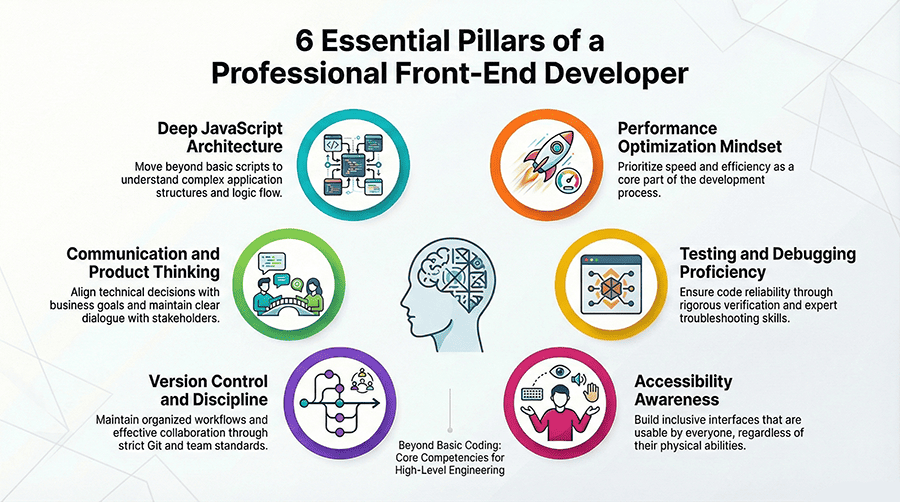
Below are the core skills that define a professional front-end developer and determine long-term career growth.
- Deep understanding of JavaScript architecture
This skill goes beyond knowing syntax. It involves understanding how large applications are structured, how modules interact, and how state is managed. Professional developers understand scope, closures, asynchronous patterns, and memory considerations at a deeper level. They know how to break features into reusable components and avoid tightly coupled logic. This skill exists to ensure applications remain scalable and maintainable as they grow. Without architectural thinking, projects quickly turn into unmanageable codebases.
To develop this skill, study real production-level repositories on GitHub. Analyze how experienced teams structure folders, separate concerns, and manage state. Build at least two medium-sized projects where you intentionally apply modular architecture. Refactor your own code regularly. Code reviews with more experienced developers accelerate growth significantly. Over time, architectural awareness becomes instinctive rather than forced.
- Performance optimization mindset
Performance is not an afterthought in professional environments. It directly affects user retention, SEO rankings, and business metrics. This skill involves understanding render cycles, bundle size optimization, lazy loading, and minimizing unnecessary re-renders in frameworks like React or Vue. Developers must measure performance using browser profiling tools rather than relying on assumptions.
To build this skill, practice using Chrome DevTools Performance tab and Lighthouse audits. Learn how to analyze network waterfalls and identify bottlenecks. Study Core Web Vitals and understand why metrics such as Largest Contentful Paint and First Input Delay matter. Then apply improvements to your own projects. Optimize images, split bundles, and measure again. Repeating this process builds practical expertise. Over time, you will start writing performance-conscious code by default.
- Accessibility awareness
Accessibility ensures that applications are usable for people with disabilities, including those using screen readers or keyboard navigation. Professional developers treat accessibility as a requirement, not an optional enhancement. This skill includes writing semantic HTML, managing focus states, providing ARIA attributes where necessary, and ensuring sufficient color contrast. It directly impacts inclusivity and legal compliance in many organizations. To develop accessibility skills, use screen readers such as NVDA or VoiceOver to test your own projects. Practice building forms with proper labels and validation feedback. Study WCAG guidelines and apply them deliberately. Audit your projects using accessibility testing tools. Over time, accessibility becomes part of your development workflow rather than a separate task.
- Version control and collaboration discipline
Professional front-end development rarely happens in isolation. This skill focuses on effective collaboration through Git workflows, pull requests, and clear communication. It includes writing meaningful commit messages, resolving conflicts safely, and participating in code reviews constructively. Collaboration skill exists to ensure team productivity and code stability. To improve this area, contribute to open-source projects or collaborate with peers on shared repositories. Practice working with feature branches and performing code reviews. Learn how to provide feedback that improves code quality without creating friction. Strong collaboration discipline builds trust within teams and accelerates career advancement.
- Testing and debugging proficiency
Testing ensures reliability. Debugging ensures stability. A professional developer understands unit testing fundamentals, basic integration testing concepts, and systematic debugging techniques. This skill exists to reduce production errors and maintain user trust. Developers who test and debug effectively reduce long-term maintenance costs.
To build this skill, start writing simple unit tests using tools relevant to your framework, such as Jest. Practice isolating bugs instead of randomly modifying code. Use breakpoints, console inspection, and network monitoring strategically. Reproduce issues consistently before attempting fixes. Over time, debugging becomes analytical rather than reactive.
- Communication and product thinking
Technical ability alone does not define professionalism. Front-end developers work with designers, backend engineers, product managers, and stakeholders. Communication skill ensures alignment between business goals and technical implementation. Product thinking involves understanding why a feature exists and how users interact with it. To strengthen this skill, participate in project discussions and ask clarifying questions before coding. Practice explaining technical decisions in simple language. Study basic UX principles to understand user behavior. When building projects, define the user problem clearly before implementing solutions. Developers who combine technical precision with product awareness consistently stand out in professional environments.
What to Learn to Become a Front-End Developer?
If you want clarity on what to study, you need structure, not scattered tutorials. Many beginners jump between videos, articles, and random exercises without understanding how the pieces connect. Professional growth requires sequencing. You start with web fundamentals, then add tooling, then move into modern frameworks, and finally expand into ecosystem-level knowledge that employers expect in production environments. This progression reflects how real teams build and maintain applications.
High-quality roadmaps for frontend developer roles follow this layered approach. They do not overload beginners with advanced abstractions too early. Instead, they focus on mastering fundamentals before introducing complexity. A front-end engineer who skips the basics eventually struggles with debugging, performance, and architectural decisions. On the other hand, someone who builds strong foundations adapts quickly to any framework or stack.
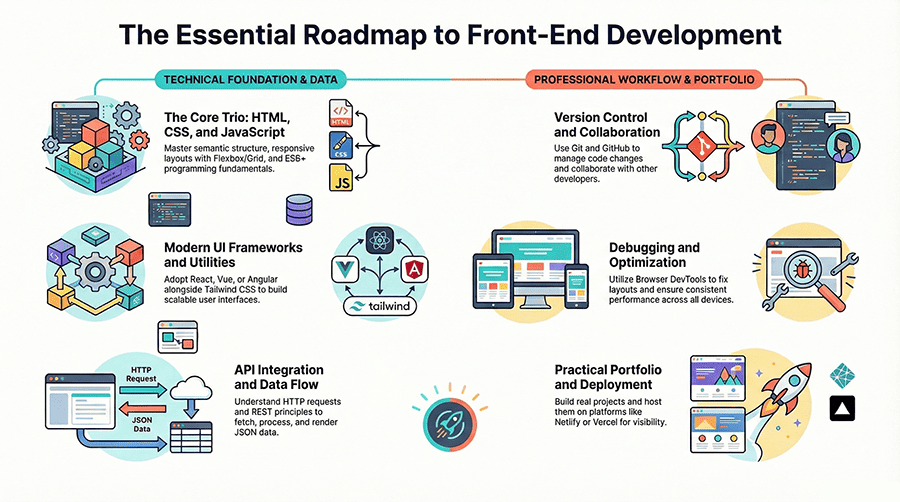
Below is a structured breakdown of what you must learn to become job-ready. Each stage builds on the previous one. Treat these as core pillars rather than optional topics. When mastered properly, they form a complete, employable skill set aligned with modern hiring standards.
Learn the Core Trio: HTML, CSS, JavaScript
The foundation of all front-end development is HTML, CSS, and JavaScript. Every framework, library, and tool sits on top of these technologies. If you do not understand them deeply, your knowledge remains fragile. Employers consistently identify weak fundamentals as the primary reason candidates fail technical interviews.
- Start with semantic HTML. Learn how to structure documents properly using meaningful tags. Understand forms, accessibility attributes, and document hierarchy. Study how browsers parse HTML and construct the DOM. Build multiple small static pages to internalize structure and best practices.
- Move to CSS with intention. Master the box model, positioning, Flexbox, and Grid. Learn responsive design principles and mobile-first strategy. Understand how layout calculations work and how stacking contexts affect rendering. Avoid memorizing snippets. Instead, build layouts from scratch repeatedly. Recreate landing pages and dashboards to strengthen practical skills. Study CSS specificity and how to prevent style conflicts in larger projects.
- JavaScript is where logic begins. Learn variables, functions, scope, closures, array methods, and object manipulation. Study asynchronous behavior, promises, and async/await patterns. Understand the event loop and how JavaScript interacts with the DOM. Practice building interactive components without relying on frameworks. Implement form validation, modal windows, filtering systems, and API calls manually. This builds mental models that frameworks later abstract.
- Do not rush this phase. Spend significant time building small projects using only HTML, CSS, and vanilla JavaScript. Strong mastery here determines long-term growth and technical confidence.
Learn Developer Tools and Git
Professional development depends on tools as much as code. Knowing how to write code is insufficient if you cannot debug, version, and manage it properly. Developer tools and Git are core parts of daily workflows in every serious engineering team.
- Start with browser DevTools. Learn how to inspect elements, edit styles live, monitor network requests, and debug JavaScript using breakpoints. Study the Performance tab to understand rendering bottlenecks. Learn how to simulate different devices and throttled network conditions. Debugging skill separates entry-level learners from professionals. Make it a habit to investigate issues methodically rather than guessing.
- Next, master Git. Version control is fundamental in collaborative environments. Learn how to initialize repositories, create branches, commit changes meaningfully, merge safely, and resolve conflicts. Understand pull requests and how code reviews function. Employers expect you to work within structured Git workflows such as feature branching or trunk-based development.
- Additionally, familiarize yourself with package managers like npm or yarn. Learn how dependencies are installed and managed. Understand the purpose of build tools and bundlers at a conceptual level, even if you do not configure them manually at first. Exposure to environments such as Vite or Webpack improves readiness for production systems.
- Consistent use of tools builds discipline. Treat every personal project as if it were part of a team repository. Use Git for everything. Debug intentionally. These habits accelerate your transition into professional environments.
Add a Modern Framework or Library
Once fundamentals are solid, add a modern framework. React, Vue, and similar tools dominate the U.S. job market. Frameworks exist to manage complexity in larger applications. They provide structure, state management patterns, and reusable components that vanilla JavaScript struggles to scale effectively.
- Choose one framework and go deep. Avoid jumping between multiple libraries early on. If you chooseReact, learn components, props, state, hooks, and lifecycle behavior. Understand how rendering works and how state updates trigger re-renders. Build projects that include routing, API integration, and conditional rendering.
- Study state management patterns carefully. Even if you do not immediately use advanced tools, understand how local state differs from global state. Learn how to structure folders logically and separate UI components from business logic. Professional-level development requires modular thinking.
- Performance awareness remains important inside frameworks. Learn how to prevent unnecessary renders and manage large component trees efficiently. Build medium-sized applications such as dashboards, task managers, or content platforms. These projects expose architectural decisions and scaling challenges.
- Framework knowledge significantly increases employability. However, it must rest on strong fundamentals. Treat frameworks as productivity tools, not shortcuts. When used correctly, they transform your ability to build structured, scalable applications.
Learn Ecosystem Skills That Employers Expect
Modern front-end development extends beyond writing UI components. Employers expect familiarity with a broader ecosystem. This includes API integration, authentication flows, testing basics, and deployment concepts. These skills demonstrate readiness for real-world environments.
- Start by understanding REST APIs and how authentication tokens function. Learn how to handle secure requests and manage error states. Build features that include loading indicators and user feedback. Professional applications must account for edge cases and failures gracefully.
- Next, study basic testing concepts. Even entry-level roles increasingly value awareness of unit testing. Learn how to write simple tests for components and utility functions. Testing improves reliability and demonstrates engineering discipline.
- Understand deployment fundamentals. Learn how hosting platforms work and how build processes produce optimized production bundles. Deploy your projects to platforms like Vercel or similar services. This demonstrates end-to-end capability.
- Finally, develop awareness of performance metrics and accessibility standards. Employers value developers who understand Core Web Vitals and inclusive design principles. Integrating these considerations early builds credibility.
Ecosystem skills transform you from a learner into a job-ready developer. They signal to employers that you understand production realities, not just tutorials.
How to Become a Front-End Developer in 100 Days
A 100-day plan is not about speed. It is about structured intensity. When learning is compressed into a defined timeline, focus increases and distractions decrease. Many beginners fail because they learn randomly without measurable milestones. A 100-day roadmap forces discipline, progression, and practical output. It assumes daily effort of 2-4 focused hours with active coding, not passive watching.
This plan moves from core fundamentals to production-ready skills. It builds HTML and CSS foundations first, then strengthens JavaScript logic, then introduces frameworks, tooling, and real-world expectations. Every phase includes implementation work because practical repetition builds retention. By the end of 100 days, you should have deployable projects, Git experience, framework familiarity, and interview-level confidence in fundamentals. The goal is not theoretical perfection. The goal is employable competence. Follow the progression strictly. Do not jump ahead. Depth at each stage compounds over time and creates long-term stability in your front-end career.
100-Day Front-End Developer Plan
| Days | Focus Area | What to Learn and Build |
| 1-10 | HTML Foundations | Learn semantic HTML structure: headings, sections, forms, inputs, accessibility basics. Understand document flow and DOM structure. Build 3 static pages (portfolio layout, blog layout, landing page). Focus on clean structure and validation. |
| 11-20 | CSS Fundamentals | Master box model, positioning, Flexbox, Grid, responsive design, media queries. Rebuild your previous HTML projects with responsive layouts. Implement mobile-first design. Practice spacing systems and consistent typography. |
| 21-30 | Advanced CSS & Real Layouts | Study advanced layout patterns, reusable styles, basic animation principles, transitions, hover states. Recreate a SaaS homepage and a dashboard layout. Focus on pixel precision and cross-device testing. Explore one of the CSS Frameworks. |
| 31-45 | JavaScript Core Concepts | Learn variables, functions, arrays, objects, scope, closures, array methods, DOM manipulation, event handling. Build interactive components: modal, accordion, form validation, filtering system. Avoid frameworks during this stage. |
| 46-55 | Asynchronous JavaScript & APIs | Study promises, async/await, fetch API, error handling. Learn how HTTP works and how JSON is structured. Build a small app that consumes a public API (weather app, movie search, crypto tracker). Implement loading and error states. |
| 56-60 | Git & Developer Tools | Learn Git basics: init, commit, branch, merge, pull requests. Practice structured commit messages. Use browser DevTools for debugging and performance inspection. Refactor one project using clean version control workflow. |
| 61-75 | Modern Framework (React, Angular or Vue) | Learn components, props, state management, hooks (if React), routing basics. Build a small single-page application with multiple views and API integration. Focus on understanding rendering cycles and component structure. |
| 76-85 | Intermediate Framework Skills | Study state management patterns, reusable components, folder architecture. Optimize rendering performance. Build a more structured app (task manager or mini dashboard). Practice conditional rendering and form handling in the framework. |
| 86-92 | Ecosystem & Production Skills | Learn basic testing concepts, environment variables, build processes, deployment fundamentals. Deploy at least two projects to a hosting platform. Ensure responsive design and accessibility improvements. |
| 93-97 | Portfolio & Polish | Select 3-4 strongest projects. Refactor code for clarity. Improve UI consistency. Write professional README files. Deploy a clean portfolio site showcasing projects and GitHub links. |
| 98-100 | Interview Preparation | Review JavaScript fundamentals, DOM behavior, async logic, and framework concepts. Practice explaining your projects clearly. Solve common coding challenges. Prepare structured answers for behavioral questions. |
If executed with discipline, this 100-day plan builds a complete foundation aligned with junior front-end job expectations. The key is consistency. Daily coding, daily problem-solving, and continuous refinement transform knowledge into capability.
From Learning to Landing the Job
Finishing courses and tutorials does not make you employable. The transition from learning to earning requires deliberate execution. At this stage, your focus must shift from consuming information to producing measurable results. Employers do not hire based on potential alone; they hire based on proof of capability. That proof comes from projects, visible work, and preparation aligned with real hiring standards.
Many beginners stall here. They continue studying instead of building. They watch more videos instead of shipping code. This phase is where discipline separates serious candidates from hobbyists. You must demonstrate that you can apply knowledge independently, structure code professionally, and solve real problems. The following steps outline exactly how to convert your technical foundation into a competitive profile ready for the U.S. job market.
Build Small Real Projects While Learning
The fastest way to strengthen your front-end skills is by building practical applications with real constraints. Tutorials create comfort. Projects create competence. Employers evaluate whether you can implement features, handle edge cases, and structure code cleanly. That ability develops only through consistent project work.
Start with focused, manageable builds. Examples of strong Front End Developer Projects include a responsive landing page with form validation, a task management app with filtering logic, a dashboard consuming a public API, or an e-commerce product grid with sorting and state management. Each project should solve a clear problem and include responsive design, interactive behavior, and error handling. Treat every project like a production product. Use Git from day one. Write structured commits. Refactor when needed. Implement loading states, accessibility considerations, and performance optimizations. Do not skip deployment. Hosting your work publicly demonstrates confidence and completeness.
Avoid building ten unfinished apps. Build three to five polished ones instead. Depth matters more than quantity. When projects grow slightly complex, you encounter architectural decisions and debugging challenges that accelerate growth. Over time, you develop engineering intuition rather than mechanical coding habits.
Projects transform theoretical knowledge into professional capability. They are the strongest signal of readiness you can present to hiring managers.
Create a Job-Ready Portfolio
A portfolio is not a gallery of experiments. It is a strategic document that communicates competence, clarity, and professionalism. Recruiters often spend less than a minute scanning a candidate’s portfolio. Your presentation must be structured, concise, and results-focused. Your portfolio should include three to five well-documented projects. Each project must explain the problem, your technical decisions, the stack used, and measurable outcomes. Describe performance improvements, accessibility considerations, or architectural reasoning where relevant. This demonstrates engineering thinking, not just visual output.
Design matters. As a front-end developer, your portfolio is itself a product. It must be responsive, fast, and accessible. Optimize loading time and avoid excessive animations that distract from content. Keep navigation simple and structured. Include a clean GitHub profile with organized repositories. Pin your strongest projects. Ensure README files are professional and clearly explain setup instructions and features. Employers frequently review repository structure to evaluate code discipline. Add a short professional summary outlining your focus area and technical strengths. Avoid generic claims. Instead, state clearly what you specialize in and what type of roles you are targeting. A sharp portfolio converts attention into interview opportunities.
Prepare for the Market and Your First Role
Technical ability alone does not secure a job. Preparation for hiring processes is essential. The U.S. market evaluates both knowledge depth and communication clarity. You must be prepared to explain your code, justify decisions, and solve problems live. Study common patterns from Frontend Developer Interview Questions. Focus on JavaScript fundamentals, asynchronous behavior, DOM manipulation, performance optimization, and framework-specific concepts. Practice explaining concepts aloud. Interviewers assess reasoning, not memorization.
Mock interviews accelerate readiness. Simulate real interview environments by solving problems under time constraints. Practice whiteboarding logic or sharing your screen while coding. Clarity of thought under pressure reflects professional maturity. Understand behavioral expectations as well. Be ready to discuss challenges you faced in projects, how you debugged issues, and how you collaborate. Employers value problem-solving discipline and communication reliability.
Research the companies you apply to. Tailor your portfolio emphasis to match their tech stack when possible. Preparation signals seriousness. When technical readiness meets structured preparation, you enter interviews with confidence and control rather than uncertainty.
Real-World Advice from Senior Front-End Developers
Frequently Asked Questions (FAQ)
How to become a front-end developer without a degree in computer science or a related field?
You do not need a formal computer science degree to become a front-end developer in the United States. Hiring managers evaluate skills, project quality, and problem-solving ability more than academic credentials. Many successful developers entered the field through self-study, bootcamps, or structured online programs. To succeed without a degree, you must replace academic validation with practical proof. That means building strong, deployable projects that demonstrate HTML, CSS, JavaScript, and framework competence. Your GitHub repositories must show consistent commit history and clean structure. Employers look for evidence of discipline and real understanding.
In interviews, you should clearly explain your learning path, technical decisions, and debugging approaches. Demonstrating structured thinking offsets the absence of formal education. A degree is considered an advantage in some environments, but proven capability remains the decisive factor in most frontend hiring processes.
How long does it realistically take to become a job-ready frontend developer from scratch?
The timeline depends on intensity and consistency. With focused daily practice of 2-4 hours, most disciplined learners reach junior-level readiness in 6 to 9 months. A structured 100-day sprint builds foundations, but deeper competence requires additional project refinement and interview preparation. The first two to three months typically focus on HTML, CSS, and JavaScript fundamentals. The next phase involves building projects and learning a framework such as React or Vue. After that, deployment, Git workflows, and interview preparation strengthen job readiness. Progress accelerates when learning includes daily coding, not passive watching. Beginners who build multiple real projects and refine them consistently progress faster than those who consume tutorials endlessly. Time is important, but structured execution determines results.
What are realistic front-end developer salary expectations in the United States for 2026?
Front-end developer salary expectations in 2026 depend on location, skill depth, and company type. Global rough ranges for 2026:
- United States (all levels). Average front-end developer salary around 88k-110k USD per year, with higher pay in major tech hubs. Junior roles are often in the 50k-90k USD range, depending on city and company size.
- Western / Central Europe (all levels). Germany: average front-end dev salary about 53k EUR per year. Remote Europe-wide averages for front-end devs are reported near 100k-105k USD, but with very wide ranges from 30k to 220k depending on role and company.
- Web3 / crypto niche (global, usually mid-senior). Average salary for a Web3 front-end developer is about 149k USD per year, with a typical range from 70k to 240k. Mid-senior roles in US-based Web3 companies frequently list bands like 150k-230k USD and higher in places like San Francisco and New York.
Junior vs mid vs senior (directional):
- Junior. Often roughly 50-70% of senior pay in the same region; in the US that’s commonly somewhere around 50k-90k USD.
- Mid-level. In the US, many guides show mid front-end/JavaScript roles around 110k-140k USD, more in SF/NYC.
- Senior / specialized (React/Next, Web3, high-scale products). Frequently 140k-200k+ USD in top markets and niches, especially in US or well-funded remote-first companies.
If you tell me your target country (e.g., France vs fully remote EU vs US), I can narrow this down into a more concrete “junior / mid / senior” range you can realistically aim for as you plan your front-end path.
What programming languages should a beginner focus on first when learning frontend development?
A beginner should focus exclusively on HTML, CSS, and JavaScript at the start. These three technologies form the structural, visual, and logical foundation of every web interface. Attempting to learn multiple frameworks or backend languages simultaneously weakens core understanding. HTML teaches semantic structure and accessibility. CSS develops layout precision and responsive design skills. JavaScript builds logic, interactivity, and problem-solving ability. Mastery of these technologies simplifies framework adoption later.
Only after gaining strong command of JavaScript fundamentals should a learner introduce a framework such as React. Rushing into frameworks without deep JavaScript knowledge leads to confusion during debugging and architectural decisions. Strong foundations consistently produce faster long-term growth.
Do I need to learn backend development to get hired as a front-end developer?
You do not need to become a backend engineer to secure a front-end role, but you must understand how frontend interacts with backend systems. Basic knowledge of APIs, HTTP methods, authentication tokens, and JSON data structures is expected.
Employers want developers who can integrate with backend services confidently. That means handling API calls, managing loading states, and dealing with errors gracefully. Understanding how data flows between client and server increases your value significantly.
However, deep backend specialization is not required for entry-level frontend positions. Focus first on building strong UI logic and API integration skills. Expanding into full-stack knowledge later can increase flexibility and career options.
What is the most common mistake beginners make when trying to become a front-end developer?
The most common mistake is consuming excessive educational content without building substantial projects. Watching tutorials creates familiarity but not competence. Many beginners delay project work because they feel unprepared. That delay slows growth dramatically. Another frequent error is skipping fundamentals and jumping directly into frameworks. Weak understanding of JavaScript fundamentals causes confusion during debugging and state management tasks. Professionals consistently emphasize foundational depth. Lack of structured progression also limits success. Random topic jumping prevents mastery. Following a clear roadmap, building projects intentionally, and reviewing mistakes critically accelerates development. Consistent execution, not resource quantity, determines long-term success in frontend learning.
Others Also Read
- 15 Most Important Skills for a Frontend Developer in 2026 Most popular
- 12 Best AI Tools for Frontend Development in 2026. My opinion Most popular
- 25 Best Frontend Tools for Developers in 2026. My Experience Most popular
- Complete Frontend Developer Roadmap for Beginners in 2026 New article
- Frontend Developer Career Path New article
- Common Mistakes Beginners Make When Learning Frontend Development New article