

Junior Frontend Developer: Entry-Level Jobs, Remote Work, Skills & Salary
13 May 2026
371 views
This article is up to date as of October 2026

Written by
Ethan Robinson,
Middle Frontend Developer

Reviewed by
Miles Bennett,
Senior Frontend Architect
Frontend development continues to rank among the strongest entry points into the technology industry. Companies across SaaS, eCommerce, fintech, healthcare, media, and AI actively hire specialists who understand how to build fast, responsive, and user-friendly web interfaces. A modern junior frontend developer no longer works only with buttons and layouts. Businesses expect junior engineers to understand component architecture, browser rendering, accessibility, performance optimization, API integration, and collaborative workflows used inside professional development teams.
The biggest advantage of frontend development comes from the visibility of the work itself. Beginners immediately see the results of their code inside real applications, dashboards, landing pages, and interactive platforms. This creates a faster feedback loop compared to many other technical careers. At the same time, competition for entry-level roles has become significantly stronger during the last few years. Recruiters no longer evaluate candidates only by certificates or completed tutorials. Hiring managers prioritize practical skills, portfolio quality, problem-solving ability, and understanding of modern frontend ecosystems.
Strong developers understand why technologies exist, how browsers process code, how users interact with interfaces, and how frontend applications communicate with backend systems.
The most competitive candidates consistently practice real-world projects, improve debugging skills, and learn professional development workflows used in production environments. Developers who focus on structured learning, practical experience, and long-term skill development position themselves far ahead of applicants who rely only on theory or copy-paste tutorials.
What Every Future Frontend Developer Needs to Learn First?
A beginner entering frontend development needs a clear understanding of the technologies that power modern websites and applications. HTML, CSS, and JavaScript still form the foundation of the profession, but employers expect deeper knowledge than basic syntax. A strong candidate understands semantic HTML structure, responsive layouts, CSS positioning systems, component-based UI development, asynchronous JavaScript, and browser behavior. Modern frontend engineering also requires familiarity with development tools such as Git, package managers, browser developer tools, and command-line workflows. Without these fundamentals, developers struggle to adapt to frameworks and large-scale applications.
Understanding how interfaces work across devices also plays a critical role. Frontend applications must load quickly, remain accessible, and function consistently on desktops, tablets, and mobile devices. Developers need to understand responsive design principles, CSS Flexbox and Grid, accessibility standards, optimization techniques, and performance metrics that directly affect user experience. Companies increasingly prioritize developers who know how to build interfaces that meet usability and accessibility expectations instead of focusing only on visual appearance. This separates professional frontend engineers from beginners who only reproduce designs from tutorials.
A future frontend developer also needs strong practical experience before applying for jobs. Recruiters consistently evaluate GitHub activity, portfolio projects, real application logic, and code organization. Building dashboards, API-based applications, authentication systems, responsive landing pages, and interactive UI components provides significantly more value than completing passive courses alone. Developers should practice debugging broken code, reading documentation, understanding technical requirements, and collaborating through Git workflows. Learning how to communicate technical decisions clearly during interviews also matters because frontend engineers work closely with designers, backend developers, QA specialists, and product teams. Consistent project work combined with structured learning creates the fastest path toward professional-level frontend development skills and stronger hiring opportunities.
Core Junior Frontend Developer Skills That Companies Expect in 2026
Modern companies no longer hire frontend developers based only on theoretical knowledge or completed online courses. Recruiters evaluate whether candidates understand real development workflows, browser behavior, UI architecture, and modern engineering practices.
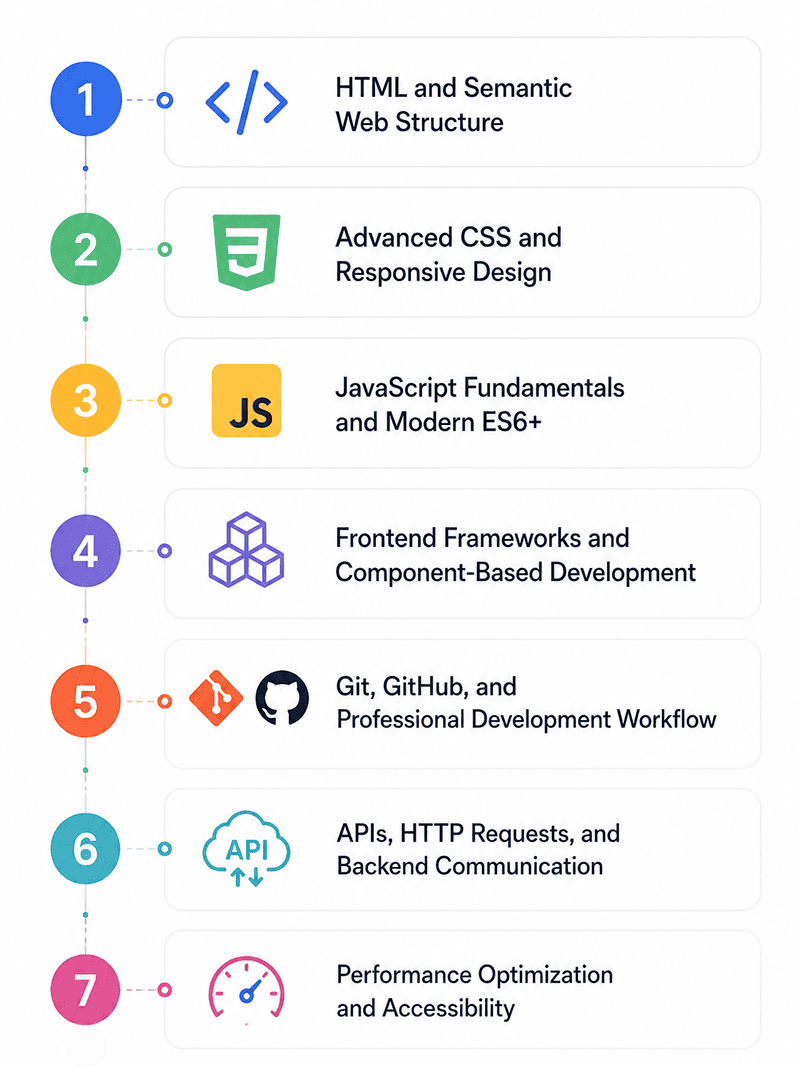
The strongest junior candidates consistently demonstrate practical coding ability, structured problem-solving, and confidence when working with production-level tools. Building professional frontend applications requires far more than learning how to center elements with CSS or create simple buttons with JavaScript. Developers who focus on the right junior frontend developer skills early create a significantly faster path toward interviews, internships, freelance projects, and full-time frontend positions.
-
HTML and Semantic Web Structure. HTML still forms the foundation of every frontend application, but professional frontend
development requires much deeper knowledge than basic tags and layouts. Junior developers need to understand semantic structure, accessibility principles, document hierarchy,
forms, metadata, and SEO-oriented markup. Modern companies expect developers to build clean, readable, and maintainable HTML that supports accessibility tools, screen readers,
and responsive behavior across devices.
Semantic HTML directly affects user experience, search engine visibility, and long-term maintainability of applications. Developers should know when to use sections, articles, headers, navigation elements, buttons, labels, dialogs, and forms correctly. Poor semantic structure creates accessibility issues and negatively impacts large-scale frontend projects. Recruiters often identify inexperienced developers immediately by reviewing messy or non-semantic markup.
A strong frontend engineer also understands how HTML interacts with browser rendering engines. This includes DOM structure, loading behavior, script placement, asset optimization, and page hierarchy. Developers should practice building complete responsive pages without relying heavily on frameworks during the learning stage. This creates a stronger understanding of how frontend systems work internally. -
Advanced CSS and Responsive Design. CSS separates beginners from professional frontend developers faster than almost any other
skill. Many new developers underestimate how much frontend engineering depends on layout systems, responsive behavior, scalability, and design consistency. Modern applications
require developers who understand Flexbox, CSS Grid, positioning, responsive units, media queries, animations, transitions, variables, and component styling strategies.
Responsive design remains one of the most important frontend requirements in modern development. Interfaces must work consistently across mobile devices, tablets, laptops, and large desktop screens. Developers need practical experience building layouts that adapt naturally to different screen sizes without breaking usability or performance. Companies consistently test this during technical interviews and portfolio reviews.
Junior developers should also understand CSS architecture and maintainability. Large applications quickly become difficult to manage when styles remain unorganized. Learning methodologies such as BEM, utility-first styling, design tokens, and component-based styling systems creates a more professional development workflow. Understanding Tailwind CSS or CSS Modules also increases hiring potential because many modern teams use these solutions in production environments. -
JavaScript Fundamentals and Modern ES6+. JavaScript remains the core programming language of frontend development.
Every interactive element inside a modern web application depends on JavaScript behavior. Junior developers need strong understanding of variables, functions, loops, arrays,
objects, conditions, events, asynchronous operations, and DOM manipulation before moving into frameworks like React or Vue.
Modern frontend development heavily depends on ES6+ syntax and concepts. Developers should understand arrow functions, destructuring, template literals, modules, promises, async/await, array methods, and object-oriented principles. Companies no longer consider outdated JavaScript knowledge sufficient for frontend roles because modern frameworks rely on contemporary syntax and architecture patterns.
Debugging also plays a major role in JavaScript development. Junior engineers should know how to use browser developer tools, console debugging, network inspection, and error tracing. Professional development involves solving problems consistently rather than memorizing syntax. Recruiters strongly value developers who can explain how they debug applications and isolate frontend issues independently. -
Frontend Frameworks and Component-Based Development. Modern frontend applications rarely use pure JavaScript without frameworks.
React currently dominates the frontend job market, while Vue and
Angular continue to maintain strong demand across many companies. Junior developers should understand component-based architecture,
reusable UI systems, props, state management, lifecycle logic, routing, and frontend rendering patterns.
React remains the strongest framework choice for beginners entering frontend development in 2026. Many startups, SaaS companies, agencies, and enterprise businesses actively hire React developers for entry-level roles. Developers should understand JSX, hooks, component composition, state updates, event handling, conditional rendering, and API integration before applying for frontend jobs.
Framework knowledge also changes how developers structure applications. Instead of writing isolated scripts, engineers build scalable systems composed of reusable components. This creates cleaner code organization and more maintainable frontend architecture. Junior developers who understand this mindset adapt faster inside real engineering teams. -
Git, GitHub, and Professional Development Workflow. Version control represents a mandatory skill for every frontend developer. Professional engineering teams
rely on Git workflows daily for collaboration, code review, deployment management, and feature tracking. Junior developers who ignore Git
immediately limit their employability because companies expect familiarity with modern development processes from the beginning.
Developers should understand repositories, commits, branches, merges, pull requests, and conflict resolution. GitHub also functions as a professional portfolio platform where recruiters evaluate code quality, consistency, project organization, and development activity. An active GitHub profile with structured projects creates stronger credibility during job applications.
Understanding collaborative workflows matters just as much as understanding commands themselves. Developers need experience working with feature branches, reviewing changes, documenting commits, and maintaining clean repositories. These habits demonstrate professional discipline and readiness for real engineering environments. -
APIs, HTTP Requests, and Backend Communication. Frontend applications constantly exchange data with backend systems. Developers who understand APIs gain a
major advantage during hiring because modern applications rely heavily on dynamic content, authentication systems, databases, and third-party services. Junior developers should
understand REST APIs, HTTP methods, request handling, JSON responses, and asynchronous data rendering.
Most frontend applications include features such as login systems, dashboards, search functionality, payment processing, or real-time updates. All of these require communication between frontend and backend services. Developers need practical experience sending requests, handling responses, displaying dynamic data, and managing loading states or errors inside interfaces.
Working with APIs also improves understanding of real application architecture. Instead of building static interfaces, developers create production-style applications that simulate professional environments. Projects involving weather apps, dashboards, movie search platforms, task managers, and authentication systems provide valuable hands-on experience for junior frontend portfolios. -
Performance Optimization and Accessibility. Modern frontend engineering focuses heavily on performance and accessibility because user expectations continue
increasing across every industry. Slow interfaces, layout shifts, inaccessible components, and poor mobile experiences directly damage business results. Junior developers who
understand optimization and accessibility stand out immediately during interviews and portfolio reviews.
Performance optimization includes lazy loading, image compression, code splitting, caching strategies, asset minimization, rendering optimization, and reducing unnecessary re-renders inside frameworks. Developers should understand how frontend performance affects Core Web Vitals, SEO visibility, user retention, and application scalability.
Accessibility also represents a critical professional skill. Frontend developers need to understand keyboard navigation, semantic structure, screen reader support, contrast ratios, focus management, and ARIA attributes. Companies increasingly prioritize accessibility compliance because modern products must remain usable for all audiences.
Essential Soft Skills That Separate Great Junior Frontend Developers
Technical knowledge alone does not guarantee success in frontend development. Companies hire developers who communicate clearly, solve problems efficiently, collaborate professionally, and adapt quickly inside fast-moving teams. Many entry-level candidates underestimate the importance of soft skills during interviews and project work. In reality, engineering managers consistently evaluate communication style, learning attitude, ownership, and teamwork alongside technical ability.
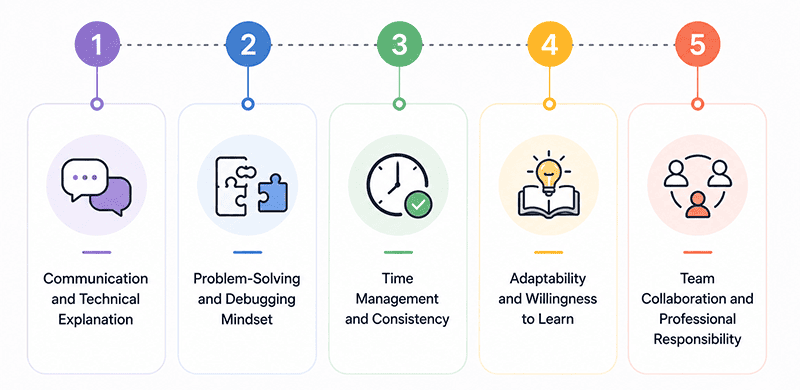
Junior frontend developers who combine strong technical foundations with professional soft skills build faster career growth, stronger industry reputation, and significantly better long-term opportunities.
-
Communication and Technical Explanation. Frontend developers constantly communicate with designers, backend engineers, project managers, QA specialists, and
clients. Strong communication skills help developers explain technical decisions clearly without creating confusion inside teams. Junior developers who communicate effectively
often progress faster because managers trust them with larger responsibilities and collaborative tasks.
Professional communication also includes asking precise questions. Developers should know how to explain blockers, request clarification, describe bugs, and provide progress updates during development cycles. Poor communication creates delays, misunderstandings, and inconsistent product implementation. Engineering teams value clarity and reliability far more than unnecessary technical complexity. -
Problem-Solving and Debugging Mindset. Frontend development revolves around solving problems daily. Applications break unexpectedly, APIs fail, layouts behave
inconsistently, and browser rendering creates unpredictable issues across devices. Strong junior developers approach debugging systematically instead of panicking when errors
appear during development.
A professional debugging mindset starts with understanding how to isolate problems logically. Developers should learn how to inspect browser errors, analyze network requests, test edge cases, and identify the real source of issues before changing code randomly. This creates faster development workflows and more stable frontend applications. -
Time Management and Consistency. Frontend development requires strong organizational discipline because engineering work includes deadlines, sprint planning,
feature prioritization, testing, and ongoing maintenance tasks. Junior developers who manage time effectively deliver more reliable results and adapt better to real-world
engineering environments.
Inside professional teams, developers must estimate task complexity realistically and communicate delays early. Time management directly affects project delivery quality and team productivity. Managers prefer developers who stay organized and reliable instead of constantly missing deadlines. Developers should also learn how to balance learning with execution. Endless tutorial consumption without practical implementation slows career growth dramatically. Strong junior developers allocate time for project building, debugging, documentation reading, and interview preparation simultaneously. -
Adaptability and Willingness to Learn. Frontend development evolves extremely quickly. Frameworks, tooling systems, browser APIs, and engineering workflows
constantly change across the industry. Developers who resist learning new approaches struggle to remain competitive in modern frontend environments. Junior developers need
strong adaptability because every company uses slightly different stacks, workflows, deployment systems, and coding standards. Teams often expect new engineers to learn
internal processes rapidly and adjust to unfamiliar technologies without excessive supervision.
Professional growth also depends on accepting feedback constructively. Code reviews represent a normal part of frontend engineering. Developers who treat feedback as a learning opportunity improve significantly faster than candidates who react defensively to corrections or suggestions. The strongest frontend engineers maintain curiosity about how technologies work internally. They explore browser rendering, performance optimization, accessibility improvements, and architectural decisions beyond basic tutorials. This learning mindset creates stronger technical depth and long-term career stability inside the frontend industry. - Team Collaboration and Professional Responsibility. Modern frontend applications rarely get built by isolated developers. Engineering teams collaborate continuously across design systems, backend services, QA processes, deployment pipelines, and product planning. Junior developers need strong collaboration skills to work effectively inside structured development environments. Professional responsibility starts with reliability. Developers should communicate delays honestly, complete assigned tasks carefully, and test their code before submission. Managers trust engineers who consistently maintain quality standards and take ownership of their work without constant supervision.
Best Front End Developer Entry Level Jobs to Start Your Career in 2026
The market for front end developer entry level jobs continues growing as companies invest heavily in digital products, SaaS platforms, mobile-first websites, AI dashboards, and interactive customer experiences. Businesses need developers who can build responsive interfaces, improve usability, and support modern frontend ecosystems. This demand creates strong opportunities for beginners who already understand HTML, CSS, JavaScript, Git, and at least one modern framework such as React or Vue. Companies no longer search only for computer science graduates. Hiring managers prioritize practical skills, portfolio quality, and real project experience when evaluating junior frontend candidates. An entry level front end developer typically works on UI implementation, responsive layouts, reusable components, bug fixing, accessibility improvements, and API integration tasks. Junior developers often collaborate with senior engineers, designers, and QA teams while learning production workflows used inside real engineering environments.
Many companies intentionally assign smaller frontend features to junior developers first, allowing them to build confidence while understanding team processes, deployment pipelines, and code review systems. This creates an excellent environment for rapid skill growth during the first years inside the industry.
The strongest opportunities usually appear inside startups, SaaS companies, digital agencies, eCommerce businesses, and remote-first technology teams. Startups often provide faster practical experience because junior developers participate directly in product development instead of handling isolated tasks only. Larger companies, however, frequently offer stronger mentorship systems, structured onboarding, and long-term career stability. Both paths provide valuable experience depending on personal career goals and learning preferences.
| Job Type | Main Responsibilities | Common Tech Stack | Typical Growth Potential |
| Junior Frontend Developer | Build UI components, responsive pages, bug fixes | HTML, CSS, JavaScript, React | Mid-Level Frontend Engineer |
| Web UI Developer | Convert designs into functional interfaces | Tailwind CSS, Sass, Vue | Frontend Specialist |
| Frontend Intern | Assist senior developers with smaller features | HTML, CSS, Git | Junior Developer Position |
| React Junior Developer | Develop component-based applications | React, APIs, TypeScript | React Engineer |
| eCommerce Frontend Developer | Improve product pages and customer UX | Shopify, JavaScript, CSS | Senior Frontend Developer |
| QA + Frontend Hybrid Role | Test interfaces and fix frontend issues | JavaScript, Cypress, Git | Frontend QA Engineer |
Companies increasingly value developers who demonstrate practical project experience instead of relying only on certificates or tutorials. A strong GitHub portfolio, deployed applications, clean code structure, and consistent technical growth create a major advantage during entry-level frontend job applications.
Where to Find the Best Junior Front End Developer Jobs?
The market for junior front end developer jobs has changed significantly during the last few years. Companies expect stronger practical skills from beginners, but the number of opportunities for motivated frontend developers continues growing across SaaS, eCommerce, AI, fintech, education, and media industries. Businesses actively search for developers who understand responsive interfaces, frontend frameworks, API integration, accessibility, and collaborative development workflows. Junior frontend positions now include far more real engineering responsibilities than basic website maintenance alone.
Many beginners make the mistake of applying only to large technology companies. In reality, startups, digital agencies, remote-first businesses, and product-based SaaS companies frequently provide better opportunities for junior developers to grow quickly. Smaller teams often allow developers to work directly on production features, improve UI systems, participate in code reviews, and gain practical experience much faster. This hands-on exposure creates stronger technical growth during the first one or two years of a frontend career.
Recruiters consistently prioritize candidates who already built real applications before applying for jobs. A strong portfolio containing dashboards, API-driven apps, responsive landing pages, authentication systems, or interactive UI projects immediately improves hiring potential. GitHub activity, deployment experience, and understanding of Git workflows also help candidates stand out in competitive frontend hiring markets. Companies want developers who already understand how modern frontend development works inside production environments. The strongest candidates usually combine technical skills with strong communication and problem-solving ability. Frontend teams collaborate closely with designers, backend engineers, QA specialists, and product managers daily. Developers who explain technical decisions clearly and demonstrate professional collaboration skills create a much stronger impression during interviews for junior frontend positions.
Best Platforms to Find Junior Front End Developer Remote Jobs
The demand for junior front end developer remote jobs continues increasing as more companies adopt distributed engineering teams and remote-first workflows. Remote frontend positions allow developers to work with international companies, gain access to larger job markets, and build professional experience faster without geographic limitations. However, competition for remote junior positions remains significantly stronger compared to local office roles. Developers need strong portfolios, active GitHub profiles, and practical frontend projects to stand out during remote hiring processes.
Junior Frontend Developer Salary in the USA (2026)
The average junior frontend developer salary in the United States continues growing as companies increase investment in digital products, SaaS platforms, AI tools, and web-based customer experiences. Most junior frontend developers earn between $65,000 and $90,000 annually depending on technical skills, location, framework expertise, and company size. Developers with strong React, TypeScript, API integration, and responsive design experience typically receive higher starting offers compared to candidates with only basic frontend knowledge. Remote opportunities also influence salary ranges significantly because many companies now hire developers nationally instead of limiting hiring to local markets only. Frontend engineers working in major technology hubs such as San Francisco, Seattle, and New York often receive substantially higher compensation packages, although living costs inside these regions remain considerably higher than national averages.
Junior Frontend Developer Salary Overview
| Percentile / Region | Annual Salary | Hourly Rate |
| 25th Percentile | $67,000 | $32 |
| Average Salary | $88,976 | $43 |
| 75th Percentile | $87,000 | $42 |
| Top 10% | $116,000+ | $55+ |
Salary by Location in USA
| Location Type | Typical Salary Range |
| San Francisco, New York, Seattle | $95,000 - $120,000 |
| Cupertino, California | Average around $109,773 |
| Austin, Denver | $75,000 - $95,000 |
| Lower-Cost Regions | $60,000 - $75,000 |
Main Factors That Affect Frontend Salaries
| Factor | Impact on Salary |
| React / Vue Skills | Strongly increases starting offers |
| Portfolio Quality | Helps candidates secure higher-paying interviews |
| Remote vs Onsite Roles | Remote jobs often provide broader salary ranges |
| Experience Level (0-2 Years) | Directly affects compensation growth |
| Startup vs Big Tech | Startups often begin around $65k, while larger tech companies frequently offer $90k+ with bonuses |
| Location | Tech hubs usually pay 20-40% more than smaller markets |
Final Thoughts on Starting a Frontend Development Career
Frontend development continues to stand among the strongest entry points into the technology industry for beginners who want practical skills, visible results, and long-term career growth. Companies across every sector actively invest in digital products, web applications, SaaS platforms, and interactive user experiences, creating strong demand for frontend engineers who understand modern development workflows. Becoming a successful junior frontend developer requires much more than finishing tutorials or memorizing syntax. Recruiters consistently prioritize candidates who demonstrate real project experience, structured problem-solving ability, strong communication skills, and understanding of professional engineering environments. Developers who focus on HTML, CSS, JavaScript, responsive design, Git workflows, APIs, and frontend frameworks create a significantly stronger foundation for long-term success.
The most important factor for beginners remains consistent practical work. Strong portfolios, deployed applications, GitHub activity, and real frontend projects help candidates stand out far more effectively than certificates alone. Modern companies want developers who understand how to build usable interfaces, collaborate inside teams, debug problems efficiently, and adapt to evolving frontend ecosystems. Frontend development rewards curiosity, discipline, and continuous learning. Developers who build projects regularly, study production-level frontend patterns, and improve both technical and soft skills position themselves for stronger salaries, better remote opportunities, and faster career progression inside the modern tech industry.
Frontend Career Questions Every Beginner Should Understand Before Applying for Jobs
Is Frontend Development Still a Smart Career Choice for Beginners Entering the IT Industry in 2026?
Frontend development continues ranking among the most accessible and practical ways to enter the IT industry because companies constantly need developers who can build modern interfaces and improve user experiences. Businesses across SaaS, eCommerce, AI, healthcare, fintech, and media rely heavily on frontend applications to serve customers and manage digital products. This creates steady hiring demand for frontend engineers who understand responsive design, JavaScript frameworks, accessibility, and component-based development.
One of the biggest advantages of frontend development comes from the visibility of the work itself. Beginners immediately see the results of their code inside browsers and applications, which creates faster learning feedback compared to many backend or infrastructure-focused careers. Frontend development also provides strong freelance, remote, and startup opportunities, making the career path highly flexible for different lifestyles and goals.
How Deep Should a Junior Frontend Developer Learn HTML, CSS, and JavaScript Before Applying for Jobs?
A junior frontend developer does not need senior-level mastery before applying for jobs, but a strong understanding of HTML, CSS, and JavaScript remains absolutely necessary. Companies expect beginners to understand semantic HTML structure, responsive layouts, Flexbox, CSS Grid, DOM manipulation, events, asynchronous JavaScript, API requests, and component-based frontend logic before entering professional environments.
HTML knowledge should include accessibility, forms, metadata, semantic structure, and SEO-oriented markup. CSS understanding should go beyond styling basics and include responsive design systems, positioning, animations, transitions, variables, and layout architecture. JavaScript knowledge should include functions, arrays, objects, asynchronous behavior, fetch requests, error handling, and ES6+ syntax. Recruiters usually evaluate whether developers can build complete small-to-medium frontend applications independently. A beginner capable of building responsive dashboards, API-driven interfaces, authentication pages, and interactive components already meets many junior-level hiring expectations. Companies prioritize practical implementation skills much more heavily than theoretical memorization.
Developers should also understand debugging workflows, browser developer tools, Git basics, and deployment processes. These skills demonstrate readiness for professional frontend environments and collaborative engineering teams.
What Are the Biggest Mistakes Beginners Make While Learning CSS for Frontend Development?
One of the biggest mistakes beginners make while learning CSS comes from focusing entirely on visual appearance without understanding layout systems and browser behavior. Many new developers memorize isolated properties but struggle when building responsive interfaces or scalable UI systems inside real applications. Professional frontend development requires understanding structure, spacing, positioning, responsiveness, accessibility, and maintainable styling architecture. Another common mistake involves avoiding Flexbox and CSS Grid because they initially appear difficult. These technologies represent core layout systems used in modern frontend engineering. Developers who delay learning them struggle significantly during interviews and real-world projects. Responsive design also becomes much harder without proper layout knowledge.
Beginners also frequently rely too heavily on copying tutorials without building independent projects. This creates shallow understanding and weak problem-solving ability. Strong frontend developers practice recreating layouts independently, debugging styling issues, and experimenting with responsive systems across multiple screen sizes. Ignoring browser developer tools creates another major limitation. CSS debugging requires inspecting styles, testing layouts, analyzing spacing, and understanding inheritance directly inside the browser. Developers who learn these workflows early improve much faster than candidates who only write styles blindly.
Should Beginners Learn React Immediately or Master Vanilla JavaScript First?
Beginners should build a strong JavaScript foundation before moving deeply into React or other frontend frameworks. React simplifies component-based development significantly, but developers who skip JavaScript fundamentals usually struggle with state management, asynchronous logic, debugging, and application architecture later in their careers. A frontend developer should first understand variables, functions, arrays, objects, loops, events, promises, async/await, DOM manipulation, and API requests comfortably before focusing heavily on React. Frameworks solve development problems efficiently, but developers still need to understand the language powering those frameworks internally. After building a solid JavaScript base, React becomes significantly easier to learn because concepts such as state updates, component logic, event handling, and asynchronous rendering feel more natural. Developers also gain stronger debugging ability because they understand what happens underneath the framework abstraction.
Companies hiring junior frontend developers frequently prioritize React knowledge, but interviewers also evaluate core JavaScript understanding carefully. Developers who combine strong JavaScript fundamentals with practical React projects create much stronger hiring potential compared to candidates who only memorize framework syntax superficially.
How Important Is a Portfolio for Getting Junior Frontend Developer Jobs Without Commercial Experience?
A portfolio remains one of the most important factors for junior frontend developers entering the industry without commercial experience. Recruiters and engineering managers want proof that candidates can build real applications instead of only completing tutorials or courses. Strong frontend portfolios immediately demonstrate technical ability, UI understanding, responsiveness, debugging skills, and practical frontend architecture knowledge. The best portfolios contain projects solving realistic problems. Examples include dashboards, authentication systems, API-driven applications, task managers, eCommerce interfaces, responsive landing pages, or interactive frontend components. Companies prefer seeing practical functionality instead of purely visual mockups without real logic behind them.
Quality matters significantly more than quantity. Three strong projects with responsive design, clean code structure, GitHub repositories, deployment links, and API integration usually outperform ten unfinished tutorial copies. Developers should explain technologies used, project challenges, and implementation decisions clearly inside project descriptions. A portfolio also helps beginners compensate for lack of professional experience. Hiring managers often use portfolios to evaluate growth potential, problem-solving mindset, and frontend engineering maturity before scheduling technical interviews.
How Long Does It Realistically Take to Become Job-Ready as a Junior Frontend Developer?
The timeline depends heavily on learning consistency, project practice, and study quality, but most motivated beginners require between 6 and 12 months of structured learning to become realistically job-ready for junior frontend positions. Developers studying consistently while building practical projects progress significantly faster than candidates relying only on passive tutorial consumption. The first stage usually focuses on HTML, CSS, responsive design, and JavaScript fundamentals. After that, developers typically move into React, API integration, Git workflows, deployment systems, and frontend architecture concepts. Practical project building should happen continuously during every stage instead of waiting until the end.
Job readiness does not require perfect knowledge of every frontend technology. Companies expect junior developers to continue learning after hiring. Recruiters mainly evaluate whether candidates understand modern frontend workflows, can solve practical problems independently, communicate clearly, and build functional applications consistently. Developers who practice daily, debug real projects, improve GitHub activity, and prepare for technical interviews often reach employable skill levels much faster than expected. Consistency, project work, and problem-solving practice create the biggest difference between beginners who remain stuck and developers who successfully enter the frontend industry.
Others Also Read
- 15 Most Important Skills for a Frontend Developer in 2026 Most popular
- 12 Best AI Tools for Frontend Development in 2026. My opinion Most popular
- How to Become a Front-End Developer in 2026? Most popular
- Complete Frontend Developer Roadmap for Beginners in 2026 New article
- Frontend Developer Career Path New article
- Common Mistakes Beginners Make When Learning Frontend Development New article