

What Does a Frontend Developer Do? Roles and Salary Overview
18 March 2026
470 views
This article is up to date as of October 2026

Written by
Daniel Carter,
Principal Frontend Engineer

Reviewed by
Miles Bennett,
Senior Frontend Architect
Modern websites and web applications rely heavily on interactive user interfaces that allow people to navigate content, complete tasks, and interact with digital services smoothly. Behind these interfaces stands a frontend developer who is responsible for building the visual and interactive parts of a website. When people search for what does a frontend developer do, they are usually trying to understand how these professionals transform design concepts into working digital products that users interact with every day.
Frontend developers focus on everything users see and interact with in a web application. This includes page layouts, buttons, forms, navigation menus, animations, and responsive design elements that adapt to different devices. Using technologies such as HTML, CSS, and JavaScript, frontend developers ensure that websites look consistent, load quickly, and behave correctly across various browsers and screen sizes. Their work bridges the gap between design and functionality, turning static design files into dynamic user experiences.
Understanding what does a frontend developer do is also important because the role has expanded significantly over the years.
Modern frontend developers not only implement interfaces but also work with APIs, optimize performance, maintain accessibility standards, and collaborate closely with designers and backend engineers. They often participate in discussions about product usability and architecture, helping teams build web applications that are both technically reliable and user-friendly. As digital products continue to evolve, frontend developers play a central role in shaping how users experience modern websites and online services.
What Does Front End Development Mean?
Front end development refers to the part of web development that focuses on building the visible and interactive elements of websites and web applications. It involves creating the interface that users see and interact with directly in their browsers. This includes page layouts, navigation menus, forms, buttons, animations, and other visual components that shape the user experience. In simple terms, front end development is responsible for transforming design concepts into functional interfaces that allow users to interact with digital products efficiently.
Frontend developers typically work with three core technologies: HTML, CSS, and JavaScript. HTML provides the structural foundation of a web page by defining elements such as headings, paragraphs, images, and links. CSS controls the visual appearance of these elements, including layout, typography, spacing, colors, and responsiveness across different screen sizes. JavaScript adds interactivity and dynamic behavior, enabling features such as form validation, real-time updates, interactive menus, and complex user interactions.
Modern front end development also involves working with advanced frameworks and tools that help developers build scalable applications. Frameworks such as React, Vue, or Angular allow developers to organize interfaces into reusable components and manage application state more efficiently. In addition, modern development workflows often include tools for code bundling, testing, performance optimization, and version control. Another important aspect of front end development is ensuring that applications perform well across different devices and browsers. Developers must implement responsive layouts that adapt to mobile phones, tablets, and desktops. They must also follow accessibility standards so that users with disabilities can navigate and interact with the interface effectively.
Overall, front end development combines technical implementation with design thinking. It requires developers to understand how users interact with digital interfaces while maintaining code quality, performance, and usability. This combination of technical and creative skills makes frontend development one of the most important disciplines in modern web development.
What Does a Frontend Developer Do?
Frontend developers are responsible for building the parts of websites and web applications that users see and interact with. Their work focuses on transforming design layouts into functional interfaces that respond to user actions and display information clearly. This includes creating page structures, implementing visual styles, and adding interactivity so that users can navigate through an application smoothly. In modern development teams, frontend developers collaborate closely with designers, backend engineers, and product managers. Designers create visual concepts and user interface layouts, while frontend developers translate those designs into code that runs in the browser. At the same time, they connect the interface to backend services through APIs, ensuring that real data is displayed correctly in the application.
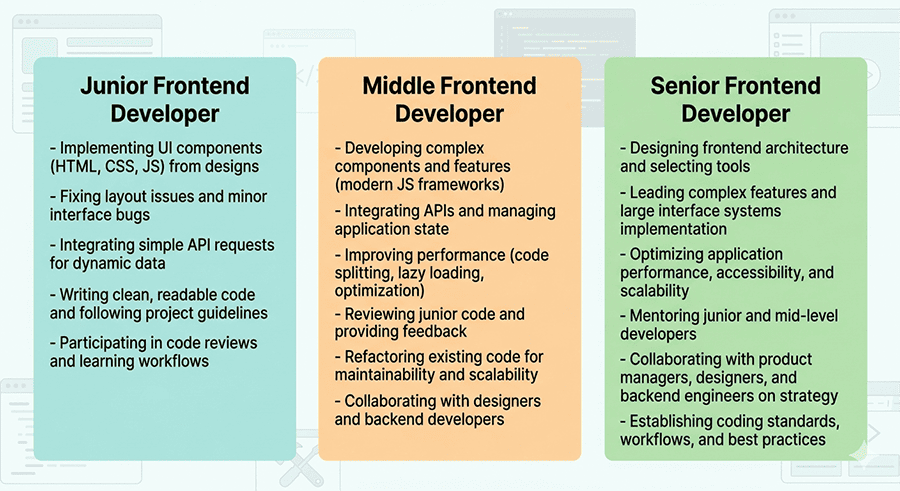
The exact responsibilities of a frontend developer depend on experience level. Junior developers usually focus on implementing smaller interface components and fixing bugs under guidance. More experienced developers take on architectural decisions, optimize performance, and lead development processes. Understanding how responsibilities evolve across experience levels helps explain the full scope of what frontend developers contribute to modern web products.
What Does a Junior Frontend Developer Do?
A junior frontend developer typically focuses on implementing user interface elements and learning how modern development workflows operate in real projects. At this stage, developers apply the fundamentals of HTML, CSS, and JavaScript while gradually becoming familiar with frameworks, development tools, and team collaboration practices. Their work usually involves building small interface components, adjusting layout styles, and fixing minor bugs identified by testers or senior developers.
Junior developers often work under the supervision of more experienced engineers who review their code and guide them through best practices. This mentorship helps beginners understand how production applications are structured, how components communicate with each other, and how development teams manage version control and code reviews. Another important responsibility for junior developers is learning to read and understand existing codebases. Many real projects involve maintaining and improving previously written code rather than building everything from scratch. By analyzing existing components, juniors gain valuable insight into scalable architecture and professional coding standards.
Typical responsibilities of a junior frontend developer include:
- Implementing UI components using HTML, CSS, and JavaScript based on design specifications
- Fixing layout issues, styling inconsistencies, and minor interface bugs
- Integrating simple API requests to display dynamic data in the interface
- Writing clean, readable code and following project coding guidelines
- Participating in code reviews and learning collaborative development workflows
What Does a Middle Frontend Developer Do?
A middle (mid-level) frontend developer typically works with greater independence and takes responsibility for implementing complex interface features within a project. At this stage, developers are already comfortable with core technologies such as HTML, CSS, JavaScript, and at least one modern framework like React, Vue, or Angular. They understand how large applications are structured and are capable of building scalable UI components that integrate with backend services and external APIs.
Unlike junior developers, mid-level frontend engineers are often responsible for designing parts of the frontend architecture. They make decisions about component structure, state management strategies, and performance optimization techniques. They also participate actively in code reviews, help maintain coding standards within the team, and ensure that new features align with the existing project architecture. Mid-level developers also spend time improving application performance and maintainability. They analyze rendering performance, optimize API requests, and refactor legacy code to make the system more efficient. Their role bridges implementation and engineering decision-making, which prepares them for senior-level responsibilities.
Typical responsibilities of a middle frontend developer include:
- Developing complex UI components and features using modern JS frameworks
- Integrating APIs and managing application state with appropriate architecture patterns
- Improving performance through code splitting, lazy loading, and optimization techniques
- Reviewing code from junior developers and providing technical feedback
- Refactoring existing code to improve maintainability and scalability
- Collaborating with designers and backend developers to implement product features accurately
What Does a Senior Frontend Developer Do?
A senior frontend developer plays a strategic role in the development process. In addition to writing code, they are responsible for guiding technical decisions, defining architecture patterns, and ensuring that frontend systems remain scalable and maintainable as projects grow. Senior developers have deep knowledge of frontend frameworks, browser behavior, performance optimization, and development workflows.
Senior engineers frequently lead complex projects and coordinate work across multiple team members. They analyze project requirements, choose appropriate technologies, and design component structures that allow applications to scale efficiently. Their experience allows them to anticipate potential performance issues or architectural problems before they appear in production. Another important aspect of the senior role is mentoring. Senior developers guide junior and mid-level engineers by reviewing their code, sharing best practices, and helping them understand advanced engineering concepts. This mentorship improves overall team productivity and code quality.
Typical responsibilities of a senior frontend developer include:
- Designing frontend architecture and selecting frameworks or tools for new projects
- Leading implementation of complex features and large interface systems
- Optimizing application performance, accessibility, and scalability
- Mentoring junior and mid-level developers through code reviews and technical guidance
- Collaborating with product managers, designers, and backend engineers on technical strategy
- Establishing coding standards, development workflows, and best engineering practices
Where Do Front-End Developers Work?
Front-end developers work in a wide range of industries because almost every modern business relies on websites or web applications. Their main responsibility is building user interfaces, which means they are needed anywhere digital products require interactive and visually structured experiences. From small startups launching new products to large technology companies operating global platforms, front-end developers play a crucial role in creating the interface layer that connects users with software systems.
Many front-end developers work in technology companies that build web platforms, SaaS products, or online services.
These companies develop dashboards, productivity tools, social platforms, and complex web applications that require scalable frontend architectures. At the same time, developers are also employed in industries such as e-commerce, finance, healthcare, education, and media. For example, e-commerce companies need frontend developers to build product pages and checkout systems, while financial companies rely on them to create secure dashboards and data visualization interfaces.
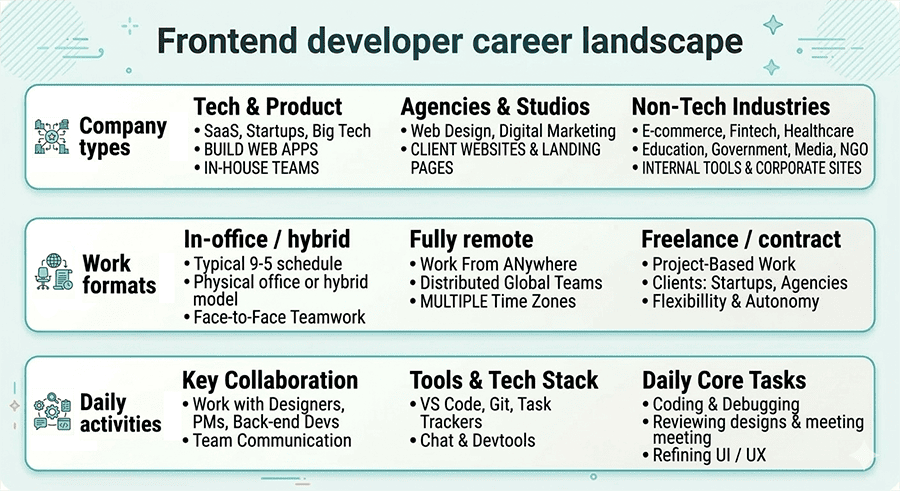
Front-end developers work across many types of companies and in several different setups: in‑house, agencies, startups, and freelance/remote.
Types of companies
- Tech and product companies. Software/SaaS firms, startups, and big tech build web apps and need in‑house frontend teams.
- Agencies and studios. Web design, digital marketing, and branding agencies build sites and landing pages for many clients.
- Non-tech industries. E‑commerce, banking/fintech, healthcare, education, government, media, and NGOs all hire frontend devs for their sites and internal tools.
Work arrangements
- In‑office or hybrid employee. Typical 9-5 in a shared office or hybrid setup, collaborating daily with designers and back-end devs.
- Fully remote employee. Many companies and distributed teams hire remote front-end developers worldwide, especially via specialized job boards.
- Freelance / contract. Freelancers work project-by-project for startups, agencies, or direct clients, often fully remote and with flexible schedules.
Daily environment
- Collaborative team setting with designers, product managers, and back-end developers, usually using tools like VS Code, Git, issue trackers, and chat apps.
- Mix of coding, debugging, reviewing designs, meetings, and refining UX on websites or web apps.
How Much Does a Front-End Developer Get Paid in 2026?
Frontend development remains one of the most in-demand roles in the technology industry, and compensation reflects that demand. Salaries for frontend developers vary depending on several factors, including experience level, geographic location, company size, and the complexity of the products being developed. In general, developers who work with modern frameworks, performance optimization techniques, and scalable frontend architectures tend to earn higher salaries because their skills are directly tied to building high-quality digital products.
In 2026, entry-level frontend developers typically earn lower salaries while they build practical experience and strengthen their technical skills.
However, compensation increases significantly as developers move into mid-level and senior roles. Developers who demonstrate strong knowledge of JavaScript frameworks, frontend architecture, and performance optimization often become valuable members of product teams. Many companies compete for experienced engineers who can design scalable interfaces and contribute to product strategy.
Another factor influencing salary is the type of company or project a developer works on. Developers employed by large technology companies, financial platforms, or SaaS businesses often receive higher compensation compared to those working on smaller websites or short-term projects. Remote work has also changed the salary landscape, allowing developers to work for international companies that offer competitive global pay rates.
Frontend developer salaries vary significantly by country, experience level, and specialization. Below is a comparison table with approximate yearly averages and ranges in USD (converted where needed; local currencies fluctuate). Data reflects general web3, remote, and traditional markets as of early 2026.
| Country/Region | Junior (0-2 years) | Mid (3-5 years) | Senior (5+ years) | Notes/Source |
| United States | $50k-$90k | $110k-$140k | $140k-$200k+ | Higher in SF/NYC; averages ~$120k overall |
| Web3/Global Remote | $70k-$100k | $120k-$160k | $180k-$240k | Niche pays more; avg $149k |
| Germany | ~$40k-$55k | $55k-$75k | $75k-$100k+ | Avg ~$53k EUR (~$57k USD) |
| France | ~$35k-$50k | $50k-$70k | $70k-$100k | Avg ~€47k (~$51k USD) |
| United Kingdom | $35k-$50k | $50k-$70k | $70k-$100k | Avg ~£50k (~$65k USD) |
| Poland | $25k-$40k | $40k-$60k | $60k-$90k | Avg ~$79k in some data |
| Ukraine (UAH to USD) | $10k-$20k | $20k-$35k | $35k-$50k+ | Avg ~$1.5k/month (~$18k/year) |
| India | $5k-$10k | $10k-$20k | $20k-$35k | Avg mid ~₹8-12L (~$10k-$15k) |
Key factors influencing pay:
- Location: US and top EU hubs (London, Berlin, Paris) pay the most; remote global roles often benchmark to US rates.
- Experience & skills: Junior roles start lower, but React/Next.js, TypeScript, and Web3 boost pay quickly.
- Remote vs. on-site: Remote-first companies (especially US-based) often pay top rates regardless of your location.
Conclusion
Frontend development has become a central part of modern software engineering. Every website, dashboard, and web application depends on well-designed interfaces that allow users to interact with digital systems easily. Throughout this article, we explored the responsibilities of frontend developers, how their roles evolve across experience levels, and the types of companies and industries where they work.
Understanding what frontend developer do in real projects helps clarify why this role is so important in product development. Frontend engineers translate design ideas into functional interfaces, connect applications with backend systems, and ensure that users experience smooth and responsive interactions across devices. Their work combines technical expertise, attention to detail, and collaboration with designers and backend engineers.
As digital products continue to grow in complexity, the demand for skilled frontend developers will remain strong. Developers who continuously learn new technologies, refine their problem-solving skills, and understand how frontend systems integrate with the broader application architecture will have significant career opportunities. Ultimately, knowing what frontend developer do provides valuable insight into one of the most influential roles in modern web development.
Frequently Asked Questions About Frontend's work
What does a frontend developer do on a daily basis in a real company or product team?
A frontend developer usually spends the day building and improving the parts of a website or web application that users directly interact with. This often includes creating new interface components, updating existing layouts, fixing visual bugs, improving responsiveness for mobile devices, and integrating data from backend APIs. In a real company, the work is rarely limited to writing code from scratch. Frontend developers also read existing code, participate in code reviews, test new features, and discuss implementation details with designers, backend developers, and product managers.
Daily responsibilities also depend on experience level. A junior developer may focus more on styling tasks and small features, while a senior developer may spend more time on architecture, performance, and mentoring. In most teams, frontend developers attend meetings to review priorities, clarify design intent, and plan upcoming work. Their day combines coding, collaboration, debugging, and continuous improvement of the user experience.
Do frontend developers only work with design and visuals, or do they also handle technical logic?
Frontend developers absolutely work with technical logic, not only design and visuals. While they are responsible for implementing layouts, colors, spacing, and interactive interface elements, their role also includes writing JavaScript or TypeScript code that controls application behavior. This means handling form validation, user events, asynchronous API requests, client-side state management, routing, conditional rendering, and performance optimization. In modern web applications, frontend development is closely connected to software engineering. A frontend developer must understand how data flows through the interface, how to structure reusable components, and how to keep the application stable as it grows. development is far more technical than many beginners initially assume.
What is the difference between what a junior, middle, and senior frontend developer does in practice?
The main difference between junior, middle, and senior frontend developers is the level of independence, technical ownership, and decision-making responsibility. A junior frontend developer usually works on smaller tasks, fixes bugs, implements simple UI components, and learns team workflows under guidance from more experienced engineers. Their focus is on improving execution and understanding how production projects are structured.
A middle frontend developer typically handles more complex features independently. They make decisions about component structure, integrate APIs, optimize performance in specific areas, and contribute actively to code reviews. A senior frontend developer works at a much broader level. Seniors define architectural direction, choose implementation strategies, mentor other developers, and ensure that the frontend codebase remains scalable, maintainable, and aligned with product goals. The higher the level, the more responsibility the developer has for both technical quality and team effectiveness.
Do frontend developers need to know backend development to be successful in their role?
Frontend developers do not need to become full backend specialists, but they do need a working understanding of backend concepts. In real projects, the frontend is constantly connected to backend services through APIs, which means developers must understand how requests and responses work, how authentication flows are handled, and how data is transferred in formats such as JSON. Without this knowledge, it becomes difficult to build dynamic applications that rely on real-time or server-based data.
Is frontend development a good career choice in 2026 for beginners who want stable work and long-term growth?
Frontend development remains a strong career choice in 2026 for beginners who want a realistic path into the technology industry. Nearly every company that builds digital products needs professionals who can create high-quality user interfaces for websites, dashboards, platforms, and web applications. This creates steady demand across industries such as e-commerce, SaaS, finance, healthcare, education, and media. The role also offers flexibility, since many frontend developers work remotely or freelance with international clients. Long-term growth is another major advantage. Beginners can start with core technologies such as HTML, CSS, and JavaScript, then progress into frameworks, architecture, performance, and leadership roles over time. Salary growth is also strong as developers move from junior to middle and senior positions. For people who enjoy both technical problem-solving and building visual user experiences, frontend development offers a stable and scalable career path with many opportunities for specialization.
Others Also Read
- 15 Most Important Skills for a Frontend Developer in 2026 Most popular
- 12 Best AI Tools for Frontend Development in 2026. My opinion Most popular
- How to Become a Front-End Developer in 2026? Most popular
- Complete Frontend Developer Roadmap for Beginners in 2026 New article
- Frontend Developer Career Path New article
- Common Mistakes Beginners Make When Learning Frontend Development New article